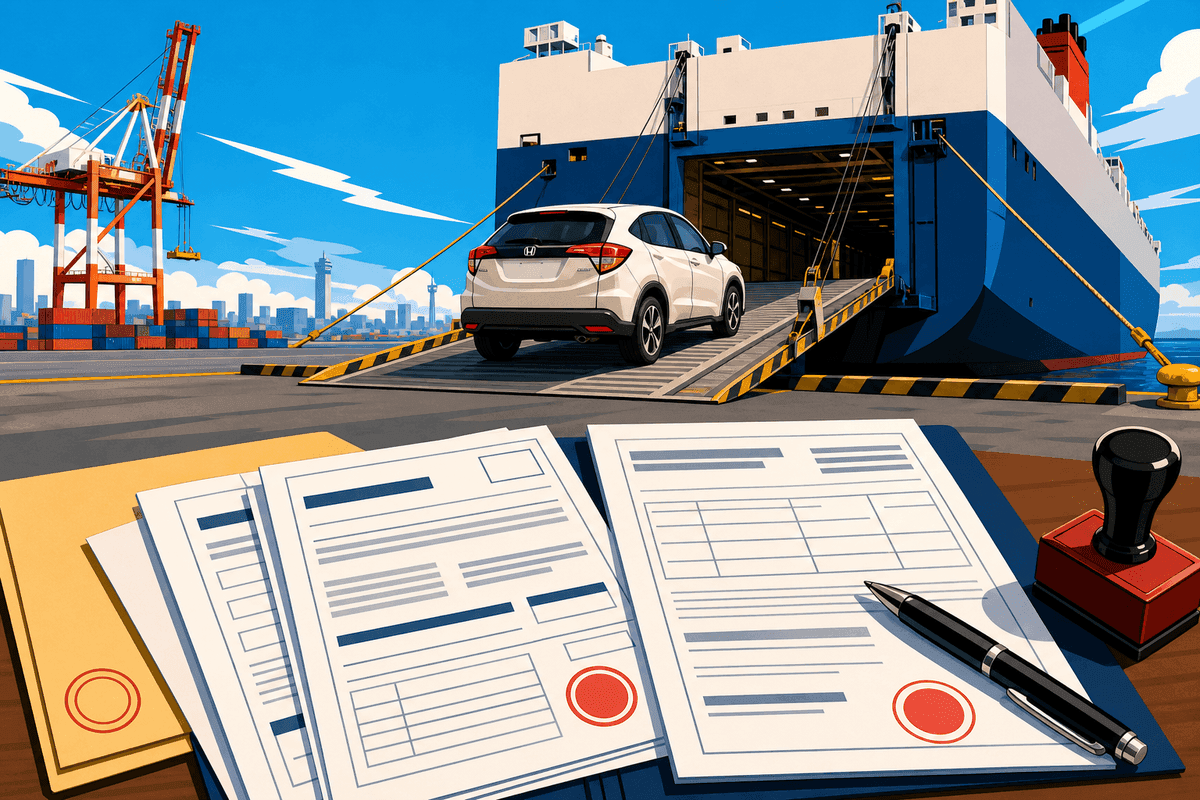
"How long does it take to import a car from Japan?" is the most-asked question in this trade — and almost always answered too optimistically. The honest answer: 6 to 14 weeks, depending on destination, sourcing approach, and how much paperwork your country requires. This guide breaks down every phase with realistic ranges, then gives country-specific totals for the major importing markets. Use this to plan timelines pessimistically and avoid the typical first-timer disappointment of expecting "4 weeks" and waiting 12.
The five phases of any import#
Every Japanese-to-overseas import goes through the same five phases. Where they vary is duration.
Phase 1: Sourcing (1–4 weeks)#
This is when your exporter finds a vehicle matching your spec.
- In-stock vehicles: 0–3 days (already at the exporter's yard)
- Auction-sourced (common spec): 1–3 weeks (multiple weekly auctions, decent supply)
- Auction-sourced (specific / rare): 2–8 weeks (waiting for the right vehicle to appear)
The narrower your spec, the longer this phase. "Any 2018 Toyota Allion" wins fast; "2018 Toyota Allion 1.5G CVT in pearl white with sunroof, mileage under 50,000 km, no accident history, FOB under ¥800,000" might wait a month.
Phase 2: Yard prep + inspection (3–10 days)#
After auction win or stock confirmation:
- Vehicle moved to exporter's yard: 1–3 days
- Cleaning, fueling, basic prep: 1 day
- Pre-export inspection (JEVIC etc.): 4–8 hours actual, but slot booking can be 2–7 days ahead
- Documentation prep (export certificate, B/L application): 1–2 days
Phase 3: Vessel booking + waiting (3–14 days)#
Vehicles wait at the export port for the next available vessel sailing.
- High-frequency routes (Yokohama → Vladivostok / Mombasa / Jebel Ali): often weekly, sometimes more
- Mid-frequency routes (Yokohama → Dar es Salaam / Karachi / Yangon): weekly typically
- Lower-frequency routes (specific Caribbean ports, Pacific Islands): biweekly or monthly
If you just missed a sailing, expect to wait the full interval until the next.
Phase 4: Ocean transit (5–50 days)#
This is the most variable phase by destination:
| Destination | RoRo transit |
|---|---|
| Vladivostok (Russia Far East) | 5–7 days |
| Toyama → Vladivostok | 1–2 days |
| Jebel Ali (UAE) | 22–28 days |
| Karachi (Pakistan) | 25–35 days |
| Mombasa (Kenya) | 30–40 days |
| Dar es Salaam (Tanzania) | 30–40 days |
| Yangon (Myanmar) | 25–35 days |
| Chittagong (Bangladesh) | 25–35 days |
| Durban (South Africa) | 35–45 days |
| US West Coast (Long Beach, Oakland) | 14–21 days |
| US East Coast (NY, NJ) | 35–45 days (via Panama) |
| Iquique (Chile) | 40–50 days |
| Mongolia (via Tianjin/China rail) | 25–35 days |
Container shipping is similar for direct routes, slower if transshipment is involved.
Phase 5: Destination clearance + registration (1–3 weeks)#
Customs clearance, duty payment, inspection verification, and final registration:
| Destination | Typical clearance + reg |
|---|---|
| UAE (JAFZA bonded) | 3–7 days |
| UAE (final use) | 1–2 weeks |
| Vladivostok | 1 week (often same-day GIBDD reg) |
| Mombasa | 2–4 weeks |
| Dar es Salaam | 2–4 weeks |
| Durban (South Africa) | 3–5 weeks (most complex) |
| Karachi | 2–4 weeks |
| Chittagong | 2–4 weeks |
| Yangon | 2–4 weeks |
| US ports | 1–2 weeks federal + state reg variable |
If your destination requires Pre-Shipment Inspection (PSI), the inspection timing is in Phase 2 — the destination-side process is "verify the inspection, assess duty, register". Without PSI, the destination side is "inspect on arrival, then duty + register" which typically takes longer.
Country-by-country total timelines#
For a typical mid-spec Japanese vehicle (2018 Toyota Allion or similar) from auction:
Russia (Vladivostok) — fastest#
- Sourcing: 1–2 weeks
- Yard prep: 1 week
- Vessel wait: ~3 days
- Transit: 5–7 days
- Clearance + reg: ~1 week
- Total: 4–6 weeks
UAE (Jebel Ali) — fast for the Middle East#
- Sourcing: 1–2 weeks
- Yard prep: 1 week
- Vessel wait: ~5 days
- Transit: 22–28 days
- Clearance + reg (UAE-final): 1–2 weeks
- Total: 6–8 weeks (or 5–6 weeks for JAFZA bonded re-export)
Pakistan (Karachi) — moderate#
- Sourcing: 1–3 weeks (3-year age cap narrows pool)
- Yard prep: 1 week
- Vessel wait: ~5 days
- Transit: 25–35 days
- Clearance + reg: 2–4 weeks
- Total: 8–12 weeks
Kenya (Mombasa) — moderate#
- Sourcing: 1–3 weeks
- Yard prep: 1 week
- Vessel wait: ~5 days
- Transit: 30–40 days
- Clearance + reg: 2–4 weeks
- Total: 8–11 weeks
Tanzania (Dar es Salaam) — moderate#
- Sourcing: 1–3 weeks
- Yard prep: 1 week
- Vessel wait: ~5 days
- Transit: 30–40 days
- Clearance + reg: 2–4 weeks
- Total: 8–11 weeks
Bangladesh (Chittagong) — moderate#
- Sourcing: 1–3 weeks
- Yard prep: 1 week
- Vessel wait: ~5 days
- Transit: 25–35 days
- Clearance + reg: 2–4 weeks
- Total: 7–10 weeks
South Africa (Durban) — slow#
- ITAC permit (if required, before sourcing): 4–8 weeks separately
- Sourcing: 1–3 weeks
- Yard prep: 1 week
- Vessel wait: ~5 days
- Transit: 35–45 days
- Clearance + reg: 3–5 weeks
- Total (after permit): 9–13 weeks
USA (West Coast, 25-year-rule JDM) — slow#
- Sourcing: 2–6 weeks (rare/specific JDM legends take longer)
- Yard prep: 1 week
- Container booking: ~5 days (most JDM ships container)
- Transit: 14–21 days
- Federal customs: 1 week
- State registration: 1–4 weeks (state-dependent)
- Total: 8–14 weeks (longer for difficult states)
Chile (Iquique) — slowest#
- Sourcing: 1–3 weeks
- Yard prep: 1 week
- Vessel wait: ~7 days (lower frequency)
- Transit: 40–50 days
- Clearance + reg: 2–4 weeks
- Total: 11–14 weeks
How to speed up a slow timeline#
Choose in-stock over auction#
In-stock vehicles skip the 1–3 weeks of sourcing. Trade-off: smaller selection, often higher price.
Choose RoRo over container#
RoRo is 0–5 days faster on direct routes, no container stuffing time, and weekly frequency on major routes.
Pay quickly#
Most exporters won't book a vessel until full payment is received. Same-day T/T can save 3–5 days.
Use a destination clearing agent in advance#
Have your customs broker arranged before the vessel arrives. Last-minute booking adds 3–7 days at the destination.
Plan around national holidays#
Japanese golden week (early May), obon (mid-August), and new year (late Dec / early Jan) all reduce capacity. Bangladeshi Eid weeks reduce destination-side capacity. Russian and Chinese new year affect specific routes.
Don't optimize for time at the cost of selection#
Saving 2 weeks by accepting a vehicle 10% off-spec usually isn't worth it — the vehicle stays with you for years.
Common timing scams#
- "Guaranteed delivery in X weeks" — no exporter can guarantee port-side timing. They control Phase 1–3, they don't control Phase 4–5.
- "Express clearance" promises at destination port — usually means "we're going to grease someone." Don't engage.
- "Vessel just left, next one in X weeks" then no vessel actually exists — verify on the carrier's tracker.
Bottom line#
Plan for 8–12 weeks for most destinations, 4–6 weeks for Russia, 11–14 weeks for Chile / South Africa. The biggest variability is sourcing time (controlled by spec narrowness) and destination clearance (controlled by destination paperwork).
If your timeline is hard (e.g., need the vehicle by a specific date), front-load sourcing 4–6 weeks earlier than your hard deadline.
Next steps#
To plan a timeline for a specific spec and destination, start a quote and we'll give you a realistic delivery estimate before you commit. For background, see How importing works, RoRo vs container, and first-time importer checklist.