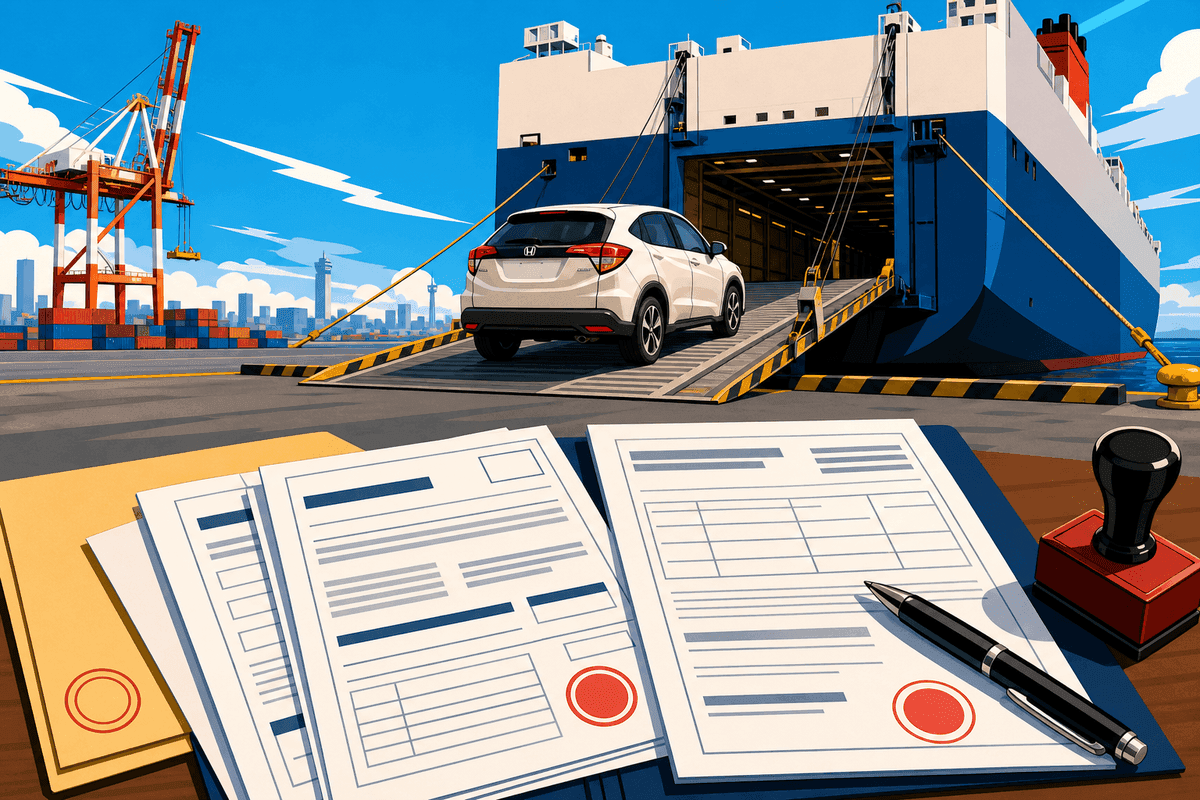
Understanding Japanese car export documents is the difference between a smooth customs clearance and a vehicle stuck at the port racking up demurrage. If you are importing a used vehicle from Japan for the first time, the paperwork can feel intimidating — Japanese, English, government stamps, shipping lines, and inspection agencies all produce their own documents. This guide walks through each one in plain language, explains who issues it and why your customs clearing agent needs it, and finishes with a practical destination-clearance checklist you can print and tick off.
Every reputable exporter should send you a complete document set before or shortly after the vessel sails. If yours does not, that is a red flag — see our payment & anti-fraud guidance.
The document set at a glance#
Here is the core paperwork that travels with almost every export. Not every destination requires all of it, but this is the standard bundle:
| Document | Purpose | Who issues it |
|---|---|---|
| Export Certificate (deregistration) | Proves the car is legally deregistered in Japan and cleared for export | Japan Land Transport Office (陸運局) |
| English translation of the certificate | Lets foreign customs read the Japanese original | Exporter / certified translator |
| Commercial invoice | Declares the sale value for duty & tax assessment | Exporter |
| Bill of Lading (B/L) | Title document + shipping contract; needed to collect the car | Shipping line / forwarder |
| Inspection certificate (JEVIC/EAA) | Certifies roadworthiness, mileage, and radiation/biosecurity | JEVIC, EAA, JAAI, QISJ |
| Packing list (container only) | Lists cars/parts loaded in a container | Exporter / consolidator |
The Export Certificate (deregistration / 輸出抹消仮登録証明書)#
This is the single most important document. When a car is exported from Japan, it must first be deregistered — removed from the Japanese vehicle register — and the Land Transport Office issues an Export Certificate of Deregistration (輸出抹消仮登録証明書). It confirms the vehicle legally left the Japanese system and can be re-titled abroad.
The certificate carries the details your destination customs will cross-check against the car and the invoice:
- Chassis / VIN and engine number
- Make, model, and body type
- First registration date and displacement
- Registered dimensions and weight
Because it is issued in Japanese, most countries require an English translation alongside it (some, like several African and Caribbean states, mandate a certified translation). Keep the original safe — many destinations demand the original document, not a copy, to issue a local title. Losing it can delay registration for months.
English translation of the certificate#
Customs officers at the destination cannot read Japanese, so an accurate English translation of the Export Certificate is essential for registration and duty assessment. A good exporter provides this as standard. Confirm the translation reproduces the chassis number, registration date, and engine displacement exactly — a single transposed digit in the VIN can trigger a customs hold or a mismatch with the B/L.
Commercial invoice#
The commercial invoice states what you paid and forms the basis for import duty and VAT in your country. It should show:
- Seller (exporter) and buyer details
- Vehicle description, chassis number, and year
- Sale price and the Incoterm — typically FOB or CIF (see our import process for how these change what is included)
- Currency and payment terms
Ensure the invoice value matches your bank remittance. Under-declaring to save on duty is customs fraud and can lead to seizure — never agree to it, no matter who suggests it.
Bill of Lading (B/L)#
The Bill of Lading is issued by the shipping line or freight forwarder once the car is loaded. It does three jobs at once: it is a receipt that the cargo was shipped, a contract of carriage, and — crucially — a document of title. Whoever holds the original "to order" B/L controls the cargo.
- The consignee named on the B/L is who can collect the vehicle at the destination port.
- An Original B/L must usually be surrendered to release the car; a Telex Release (or Express B/L) lets the line release it without couriering the paper original, which is faster.
- Check the vessel name, port of discharge, and consignee details the moment you receive the draft B/L, and correct errors before the vessel sails — amendments afterward cost money.
Whether your car ships as RoRo or in a container affects how it is described on the B/L; see RoRo vs container.
Inspection certificate (JEVIC / EAA)#
Many destinations legally require a pre-shipment inspection before the car leaves Japan. The best-known agencies are JEVIC, EAA, JAAI, and QISJ. Depending on the country, the certificate confirms:
- Roadworthiness — brakes, lights, structural condition
- Odometer verification — a check against tampering
- Radiation screening — required by several markets for cars from Japan
- Biosecurity / cleanliness — soil and contaminants removed (mandatory for Australia, New Zealand, and others)
Countries such as Kenya, Tanzania, Uganda, Mauritius, Guyana, and others will not clear a vehicle without the matching certificate, so confirm which agency your destination accepts before shipping. Learn more on our pre-export inspection page.
Destination-clearance checklist#
Hand this bundle to your customs clearing agent at the destination port. Before the vessel arrives, confirm you have:
- Original Export Certificate (deregistration) + English translation
- Commercial invoice matching your payment
- Bill of Lading — Original or Telex Release, correct consignee
- Inspection certificate (JEVIC/EAA/etc.) if your country requires it
- Packing list (container shipments only)
- Your importer/tax ID and any local import permit or IDF
- Marine insurance certificate if you bought CIF cover
- Proof of payment / bank remittance advice
A few habits that save first-timers from expensive mistakes:
- Get scanned copies of every document by email before the originals are couriered, so your agent can pre-lodge the entry.
- Match the chassis number across all four key documents — certificate, invoice, B/L, and inspection.
- Ask your agent early which documents must be originals versus copies in your specific country.
Closing#
The paperwork is only complicated the first time. Once you have cleared one shipment, the same six documents repeat on every import. Choose an exporter who sends a complete, accurate document set as standard and who explains anything you do not understand. Ready to start? Request a quote and we will walk you through the documents for your destination step by step.