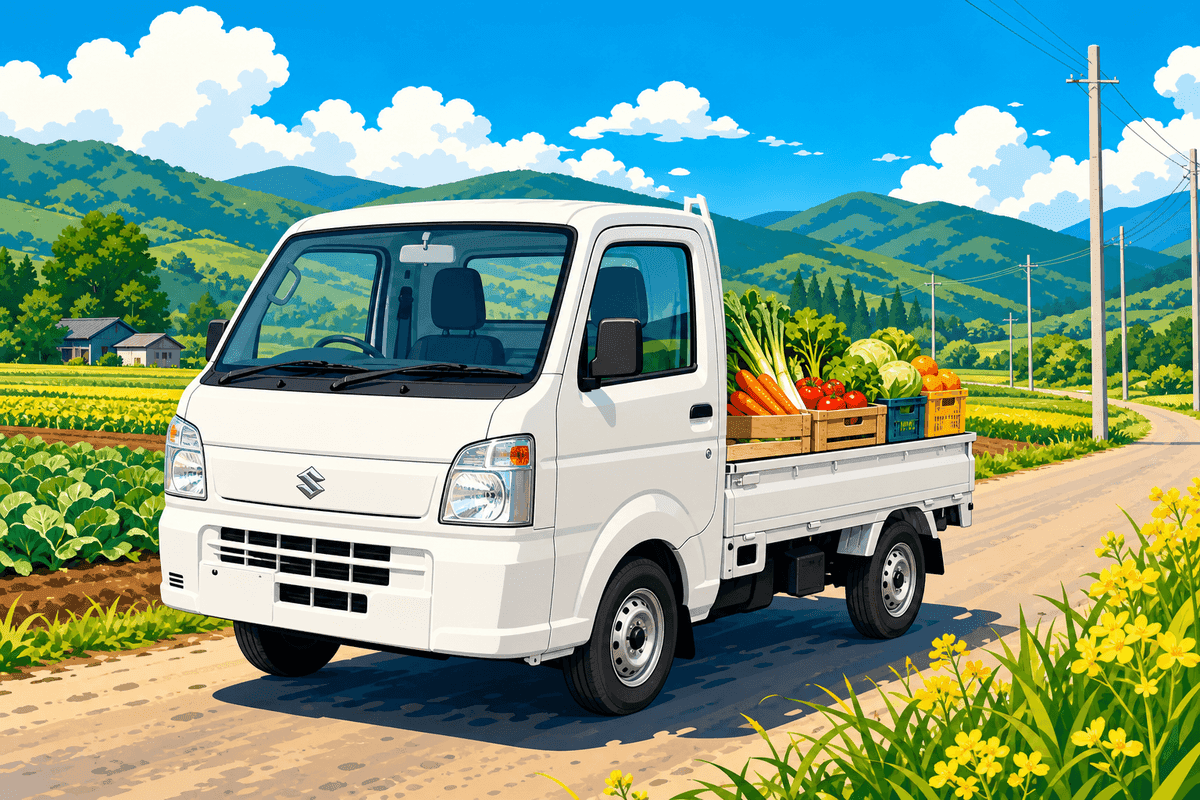
Japanese kei mini trucks are one of the fastest-moving categories in the used-vehicle export trade right now, and for good reason. These 660cc workhorses — the Suzuki Carry, Daihatsu Hijet, Honda Acty, Subaru Sambar and Mitsubishi Minicab — are cheap to buy, cheap to run, tough as nails, and increasingly in demand from importers in the USA, Africa and Asia. If you resell vehicles, a container of clean kei trucks can turn faster than almost anything else on the lot.
This guide breaks down the models, the drivetrain that makes them special, where they sell, what to look for when buying, realistic price ranges, and how to ship them cost-effectively.
Why kei mini trucks are booming#
A "kei" (軽, "light") vehicle is a Japanese regulatory class capped at a 660cc engine, roughly 3.4 m long and 1.48 m wide. The mini truck version puts a flat cargo bed on that tiny footprint. The result is a machine that:
- Carries 350 kg on a footprint smaller than a golf cart
- Returns 15–20 km/L in real-world use
- Fits down orchard rows, factory aisles and mountain tracks a full-size pickup can't
- Costs a fraction of a compact pickup to buy and maintain
Demand overseas is driven by two very different buyers: farmers, hunters and property owners who want a cheap off-road utility vehicle, and businesses in developing markets that need affordable last-mile cargo transport.
The five models compared#
All five share the same basic layout — cab-over, mid-mounted 660cc engine under the bed, rear- or four-wheel drive — but each has its own reputation.
| Model | Maker | Notable trait | Common drivetrain |
|---|---|---|---|
| Carry | Suzuki | Best parts availability, huge global volume | 2WD / 4WD, 5MT or auto |
| Hijet | Daihatsu | Refined, comfortable cab, strong resale | 2WD / 4WD, 5MT or auto |
| Acty | Honda | Mid-engine balance, revvy engine, keen following | 2WD / 4WD (Honda "Real Time") |
| Sambar | Subaru | Rear-engine, supercharged options, cult status | 2WD / 4WD, symmetrical layout |
| Minicab | Mitsubishi | Rugged, simple, later EV "MiEV" variants | 2WD / 4WD, 5MT or auto |
For a first container, the Suzuki Carry and Daihatsu Hijet are the safe bets — the highest supply, the easiest parts, and the names your customers already know. The Acty and Sambar attract enthusiasts who will pay a premium; the Minicab is a value pick.
The drivetrain that sells them#
The single feature that makes kei trucks so desirable off-road is the selectable 4WD with low range. Higher-spec trims add:
- 4WD — engaged via a lever or dash switch, sending power to all four wheels
- Hi/Lo range transfer case — a low-range gear set that multiplies torque for steep, muddy or loaded work
- Locking or limited-slip rear diff on some trims — keeps you moving when one wheel lifts
A 4WD, low-range Carry or Hijet will climb terrain that embarrasses much larger trucks, simply because it's light and geared down. For farm, orchard, hunting-camp and trail buyers, 4WD + Lo range is the spec to prioritise — it commands a clear resale premium over a 2WD automatic.
Export markets: USA, Africa and Asia#
USA. This is the headline market. Kei trucks generally can't be registered as new road vehicles, but under the federal 25-year exemption a truck becomes freely importable once it passes its 25th birthday — no FMVSS or EPA compliance required. That opens up 1990s–2000 Carrys, Hijets and Actys as legal imports. Many US buyers also run them purely off-road (farm, ranch, hunting) where road registration is irrelevant. See our guide on the USA 25-year rule before quoting American customers, and note that a few states have their own registration quirks.
Africa. Markets across East and West Africa buy kei trucks as affordable commercial haulers — produce runs, market delivery, water and building-material transport. Fuel economy and cheap parts matter more than off-road spec here, though 4WD sells well in rural regions.
Asia. Southeast and South Asian importers use them for tight urban delivery, agriculture and light construction. Right-hand-drive markets are a natural fit since the trucks are already RHD.
Buying tips for importers#
Kei trucks lived hard working lives, so inspect accordingly:
- Check the bed and frame for rust — Japanese "snow-country" trucks were salted heavily; underbody corrosion is the number-one killer
- Confirm 4WD actually engages and the transfer case shifts into Lo without grinding
- Prefer manual (5MT) — simpler, tougher, and easier to repair in most export markets
- Mind the mileage vs. age — a low-km farm truck can be better than a high-km urban delivery unit
- Verify the build date for USA 25-year eligibility — month and year both matter
- Insist on a documented pre-export inspection so your customer knows exactly what's arriving
Price ranges#
Prices move with the yen and auction supply, but as a working guide (FOB Japan, before freight):
- Rough/older 2WD (auction-grade): roughly USD 1,500–3,000
- Clean 4WD 5MT, mid-1990s–2000s: roughly USD 3,500–6,500
- Low-km, tidy, desirable trim (Sambar supercharged, clean Acty): USD 6,500–9,000+
Add freight, your margin and any destination duties on top. Even at the higher end, a kei truck lands far cheaper than a used compact pickup.
Shipping: they love a shared container#
Here's a commercial edge unique to kei trucks: they're small. A standard 40ft high-cube container fits three to four kei trucks with careful loading. That makes them ideal for:
- Container-shared / consolidated loads — split the box with other buyers to cut per-unit cost
- Full containers of mini trucks — a dealer can move a mixed 4-truck box efficiently
For a single unit or mixed cargo, weigh container against RoRo — our RoRo vs container breakdown covers the trade-offs. Container protects the vehicle better and suits high-value or multi-unit kei shipments; RoRo can be cheaper for a lone truck.
Ready to source a container?#
Kei mini trucks combine low cost, genuine off-road ability and superb container efficiency — a hard combination to beat for resale. If you want to line up a load of Carrys, Hijets or Actys for the US, African or Asian market, browse vehicles in our current stock or request a quote and we'll build a container to your spec.