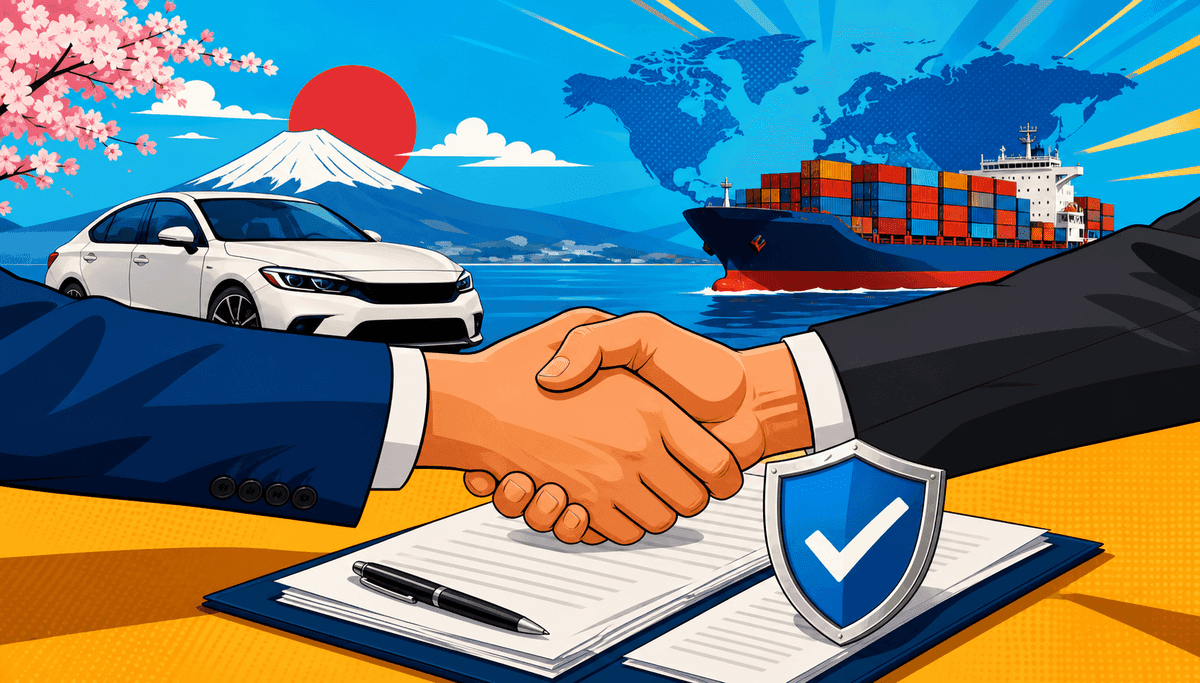
Learning how to pay safely when importing a car from Japan is the single most important skill for a first-time B2B importer. The vehicle is thousands of kilometres away, the seller is in another jurisdiction, and money usually moves before the car does. Get the payment when importing a car from Japan right and the rest of the deal is straightforward. Get it wrong and you can lose a deposit — or an entire shipment — to a fraudster. This guide walks through the real payment methods used in the trade, how deposits line up with shipping documents, and the warning signs that separate a legitimate exporter from a scam.
Start With a Proforma Invoice#
Before any money changes hands, insist on a proforma invoice (PI). This is the exporter's formal quotation and the contract backbone of the transaction. A proper PI should state:
- The exact vehicle: make, model, year, chassis/VIN number, mileage, and grade.
- The commercial terms: FOB or CIF, the destination port, and the Incoterm.
- A full price breakdown — vehicle price, inland transport, inspection, freight, and insurance.
- The exporter's registered company name, address, and bank details.
- Payment schedule (deposit vs balance) and estimated shipping window.
If a seller cannot produce a clean PI with a chassis number, stop there. The chassis number ties the money to a specific, verifiable car.
T/T Bank Transfer — the Industry Standard#
The overwhelming majority of used-vehicle exports from Japan are paid by T/T (telegraphic transfer), a SWIFT bank-to-bank wire. It is fast, cheap, and universally accepted. The key safeguard is who you are paying: the money must go to the exporter's registered corporate bank account, matching the company name on the proforma invoice, at a Japanese bank.
Typical T/T structure:
- A deposit (often 30–50%, or sometimes the full amount for a single unit) to secure the car and begin export processing.
- The balance paid against shipping documents — ideally once the Bill of Lading is issued.
T/T is safe when the counterparty is verified. Its weakness is that a wire is hard to reverse, so verification (covered below) matters more than the method itself.
Letter of Credit (L/C) — for Larger Orders#
A Letter of Credit is a bank-backed payment instrument. Your bank promises to pay the exporter only when the exporter presents a specified set of documents (B/L, invoice, inspection certificate, etc.) that exactly match the L/C terms. The bank — not you — controls the release of funds.
L/C shifts risk to the banks and is well suited to large or multi-unit orders, or to new relationships where neither side fully trusts the other yet. The trade-offs:
- Bank fees and paperwork make it uneconomic for a single cheap vehicle.
- Terms must be drafted precisely; a document mismatch can delay payment.
- It requires a cooperative bank on both ends.
For container loads or ongoing supply, an L/C is often worth the cost.
Deposits, Balance, and B/L Timing#
The Bill of Lading (B/L) is the document that controls the cargo. Whoever holds the original B/L controls the car at the destination port. Aligning your payments with the B/L is the core of safe importing:
- Pay the deposit after signing the PI — this commits the exporter to source, inspect, and book shipping.
- Pay the balance once the vehicle is loaded and the B/L is issued — the exporter then releases (couriers or telexes) the original B/L to you.
- You use the B/L to clear customs and collect the vehicle.
Never pay 100% up front to an unknown counterparty and then wait for shipping. On a first deal, tie the balance to the B/L so the exporter has to perform before receiving the bulk of the money.
Escrow — Neutral Middle Ground#
Escrow places funds with a neutral third party that releases them only when agreed conditions (e.g. B/L issued and verified) are met. It removes the "who moves first" standoff between a new buyer and seller. Some Japanese exporters and trade platforms offer escrow or third-party inspection-and-release services. Escrow costs a fee and adds a step, but for a first transaction with a new partner it can be money well spent.
Payment Method Comparison#
| Method | Best for | Cost | Buyer protection | Speed |
|---|---|---|---|---|
| T/T bank transfer | Most single-unit deals | Low | Medium — relies on verifying the exporter | Fast |
| Letter of Credit | Large / multi-unit orders | High | High — bank-controlled release | Slow |
| Escrow | First deals, new partners | Medium | High — conditional release | Medium |
| Credit card | Rarely offered | High | Medium — chargeback possible | Fast |
| Crypto | Avoid | — | None — irreversible, untraceable | Fast |
Red Flags — How to Spot a Scam#
Fraudsters imitate real exporters. Walk away if you see any of these:
- Payment to a personal account. Legitimate exporters invoice from and receive to a registered corporate account matching the company name. A request to pay an individual's name is a classic scam.
- Crypto-only or "crypto for a discount." Irreversible and untraceable — never the primary channel for a legitimate car export.
- WhatsApp-only sellers with no real website, no registered address, and no landline. Chat apps are fine for convenience, but a real company has a verifiable footprint.
- Prices far below market. A too-good deal is bait to rush your deposit.
- Pressure and urgency — "another buyer is paying now," "the price rises tomorrow."
- Changed bank details mid-deal, or an emailed request to wire to a "new" account — often a hijacked-email fraud. Always re-confirm by phone.
- No chassis number or refusal to share inspection reports or photos of the actual unit.
How to Verify an Exporter#
Before you wire anything:
- Confirm the company registration. Japanese exporters have a registered corporate number; ask for it and check the company name matches the bank account exactly.
- Check trade-association membership (e.g. JUMVEA for used-vehicle exporters) and any auction-house affiliations.
- Match the bank account name to the company name on the PI. They must be identical.
- Verify a physical address and landline, not just a mobile and a chat handle.
- Read our payment methods & anti-fraud policy so you know exactly how a legitimate transaction with us looks.
Safe-Payment Checklist#
- Proforma invoice with chassis/VIN number in hand
- Exporter's company registration verified
- Bank account name matches the company name
- Paying a corporate account at a Japanese bank — never a personal one
- Deposit terms and balance-on-B/L schedule agreed in writing
- No crypto-only, no pressure, no last-minute bank changes
- Inspection report and photos of the actual vehicle received
Closing#
Safe payment is not complicated — it is disciplined. Use a proforma invoice, pay a verified corporate account by T/T or L/C, tie your balance to the Bill of Lading, and treat personal-account, crypto-only, or WhatsApp-only requests as an immediate stop. When you are ready, request a quote, review the import process, and see the full CIF cost breakdown so you know exactly what you are paying for — and to whom.