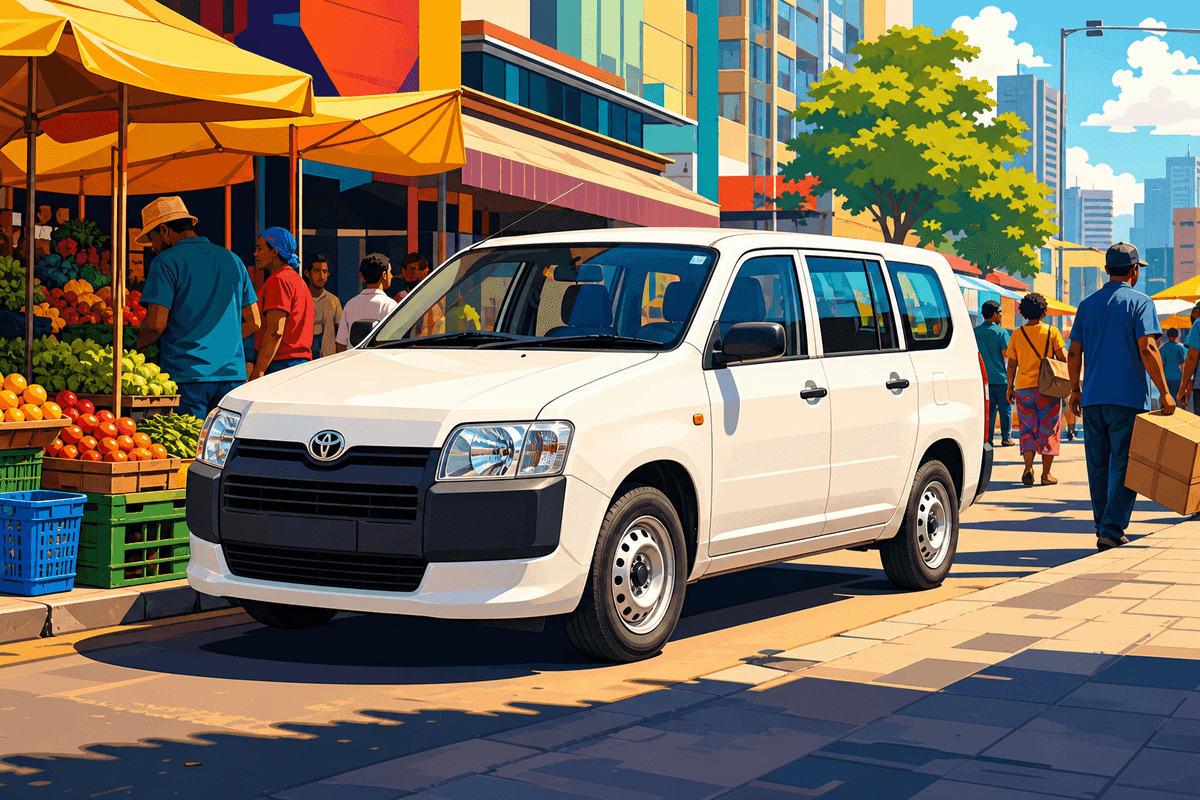
The Toyota Probox is arguably the most important commercial wagon in the used-Japanese-vehicle export trade. Cheap to buy, cheap to run, and almost impossible to kill, the Probox has become the default taxi and delivery vehicle across East Africa — and demand from importers in Kenya, Tanzania and Uganda has kept its resale value stubbornly high. If you move people or goods for a living, few vehicles return more profit per dollar. This guide walks through the generations, engines, drivetrains, reliability and pricing you need to know before you buy for export.
Why the Probox dominates East Africa#
The Probox was designed as a Japanese domestic commercial van — built for couriers, tradesmen and salespeople who needed to cover long distances cheaply while carrying stock. Those exact qualities made it a natural fit for the East African market.
- Payload over comfort: a flat, reinforced load floor and van-rated rear suspension swallow sacks of produce, crates and passengers alike.
- Cheap parts everywhere: it shares components with the Toyota Corolla and Vitz, so mechanics in Nairobi, Dar es Salaam and Kampala can fix it with common spares.
- Fuel economy: the small 1.3L and 1.5L engines sip fuel, which matters enormously when it is used as a matatu-feeder or "boda" alternative.
- Ground clearance and toughness: it tolerates rough, unpaved roads that would break softer wagons.
In practical terms, a Probox pays for itself as a shared taxi, a parcel-delivery vehicle, or a market-run workhorse faster than almost anything else in the sub-$10,000 bracket.
Generations at a glance#
There have been two main generations. The first (2002–2014) is the one most East African buyers picture; the second (2014–present) modernised the platform and added a hybrid.
| Generation | Years | Chassis codes | Engines | Notes |
|---|---|---|---|---|
| 1st gen | 2002–2014 | NCP50/51/55, NLP51 | 1.3L 2NZ-FE, 1.5L 1NZ-FE, 1.4L diesel | The classic workhorse; huge parts supply |
| 2nd gen | 2014–present | NCP160/165, NSP160, NHP160 | 1.3L 1NR-FE, 1.5L 2NR-FKE, 1.5L hybrid | Refined, safer, hybrid option added |
A quick way to read the chassis code: NCP/NSP = conventional petrol models, while NHP = the petrol-electric hybrid introduced on the second generation.
NCP/NSP petrol vs NHP hybrid#
Most exported Proboxes are conventional petrol NCP or NSP cars, and for good reason — they are simple, cheap and easy to service anywhere.
- NCP/NSP (petrol): the safe default. No high-voltage battery to worry about, familiar mechanicals, and rock-bottom running costs. Ideal where hybrid parts and technicians are scarce.
- NHP (hybrid): excellent fuel economy and low emissions, but the traction battery is a genuine consideration for buyers in regions without hybrid support. Battery health matters, and replacements are not always locally available.
For a first-time importer selling into a rural or upcountry market, an NCP/NSP petrol car is usually the smarter, lower-risk choice. Hybrids suit urban fleets where fuel savings and servicing infrastructure justify the premium.
Engines: 1.3 vs 1.5#
The two petrol displacements cover slightly different jobs.
- 1.3L (2NZ-FE / 1NR-FE): the most economical option, perfect for city delivery and light loads. Slightly underpowered when fully loaded or climbing hills.
- 1.5L (1NZ-FE / 2NR-FKE): the sweet spot for most buyers. Noticeably more pulling power for full loads, highway cruising and hilly terrain, with only a small fuel penalty.
If your buyers regularly run heavy or hilly routes — common in Uganda and western Kenya — steer them toward the 1.5L.
2WD vs 4WD#
The Probox is offered in both front-wheel drive (2WD) and part-time four-wheel drive (4WD).
- 2WD: lighter, cheaper, more fuel-efficient. The right choice for tarmac cities and most delivery work.
- 4WD: valuable for rural routes, wet-season roads and rough tracks where traction is at a premium. It commands a price premium and uses slightly more fuel, but resells well in upcountry regions.
Reliability and what to check#
The Probox's reputation for durability is earned, but every exported unit is a used commercial vehicle that has often worked hard. Inspect carefully:
- Underbody and load floor: check for rust, cracks and evidence of chronic overloading, especially around the rear suspension mounts.
- Suspension: sagging rear springs and worn shocks are common on ex-fleet cars.
- Engine: listen for chain noise on the 1NZ/2NZ, check for oil leaks, and confirm a clean cold start.
- CVT (2nd gen): verify smooth, judder-free acceleration; CVT repairs are costly.
- Hybrid battery (NHP): request a battery health reading; a failing pack is expensive.
- Odometer and records: match the auction sheet mileage to service history where possible.
A professional pre-export inspection is the single best way to avoid buying a tired unit sight-unseen.
Export price ranges#
Prices vary with year, mileage, grade and drivetrain, but as a rough guide for FOB Japan:
- Older 1st-gen NCP (2007–2013): roughly $2,500–$5,000.
- Late 1st-gen / early 2nd-gen (2013–2016): roughly $5,000–$8,000.
- Newer 2nd-gen NSP/NHP hybrid (2017+): roughly $8,000–$12,000+.
Add freight, insurance and inspection on top for a landed CIF figure — our quote tool estimates all of these for your destination port.
The bottom line#
The Toyota Probox remains the benchmark low-cost commercial wagon for East African importers: cheap to buy, cheap to fix, and relentlessly profitable as a taxi or delivery vehicle. Choose an NCP/NSP petrol 1.5L for the best balance of value and capability, add 4WD if your routes demand it, and always inspect before you commit.
Ready to source one? Browse used Toyota Probox stock, request a quote for your port, or read our guide on how to import to Kenya.