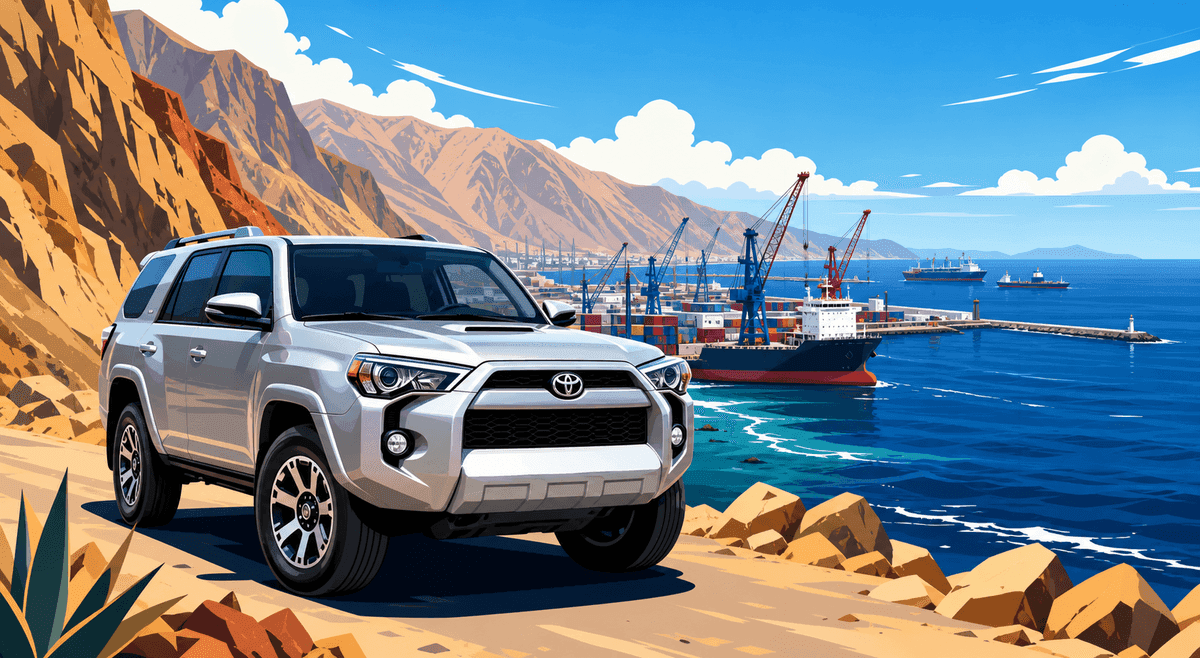
If you want to import a Japanese used car to Chile, the smartest route for most B2B buyers runs through the northern port of Iquique and the ZOFRI free-trade zone. Chile is one of Latin America's most open vehicle markets, and Japanese auction-direct stock — reliable, well-maintained, and competitively priced — dominates the used segment. This guide walks importers through how the Iquique + ZOFRI model actually works, the technical and legal requirements you must meet, the taxes you will pay, the models that sell, and how long the whole process takes.
Why Iquique and the ZOFRI free zone#
Iquique is Chile's primary gateway for used-vehicle imports, and its advantage is ZOFRI (Zona Franca de Iquique) — a duty-free zone where vehicles can be landed, stored, displayed, and sold without immediately triggering Chilean import duties. For importers, this creates two powerful options:
- Re-export: Bring stock into ZOFRI and re-export it to Bolivia, Peru, Paraguay, or other regional markets — often with no Chilean duty or IVA at all, because the vehicle never formally enters Chilean customs territory.
- Nationalize into Chile: Move the vehicle out of the free zone and through customs, paying duty and IVA to register and plate it for domestic use.
This flexibility is why so many regional dealers base their operations in Iquique. You can hold inventory tax-deferred, sell across borders, and only nationalize the units that stay in Chile. Our Iquique shipping guide covers routing, transit times, and port handling in more detail.
Left-hand drive: the non-negotiable rule#
Chile drives on the right, so it requires left-hand-drive (LHD) vehicles. Japan is a right-hand-drive (RHD) market, which means the vehicles you export must be LHD units. In practice, Japanese exporters supply Chile from:
- LHD stock at Japanese auctions — export-grade sedans, SUVs, and pickups originally built LHD for other markets and re-sold through Japan.
- LHD-configured trucks and commercial units common in the export channel.
Do not ship RHD units to Chile expecting to nationalize them for road use — they cannot be registered. (RHD units are sometimes moved through ZOFRI purely for re-export to RHD countries, but that is a separate play.) Confirm the steering side of every unit before you commit. A quality pre-export inspection verifies steering configuration along with mechanical condition.
Homologation and revisión técnica#
Before a vehicle can circulate on Chilean roads, it must pass homologation and the revisión técnica (technical inspection):
- Homologation confirms the model meets Chilean safety and emissions standards. Newer models with an existing homologation code clear faster; unusual or older units may require additional documentation.
- Revisión técnica is the periodic roadworthiness test (brakes, lights, emissions, alignment). Vehicles for domestic use must pass at an authorized plant.
- Emissions standards are stricter in Santiago and central Chile than in the north — a factor if the end buyer is in the capital.
For re-export out of ZOFRI, homologation is generally the destination country's problem, not Chile's — one more reason the free-zone model is efficient for regional distribution.
Duties, IVA, and landed cost#
When you nationalize a vehicle into Chile, the headline charges are:
| Charge | Typical rate | Notes |
|---|---|---|
| Import duty | 6% | On CIF value; reduced/zero under some trade agreements |
| IVA (VAT) | 19% | On CIF + duty |
| ZOFRI handling / storage | Variable | Waived-duty while inside the free zone |
| Homologation & revisión técnica | Fixed fees | Required for domestic registration |
| Plating & registration | Fixed fees | Registro de Vehículos Motorizados |
A rough nationalized landed cost works like this: start from CIF (vehicle FOB + freight + insurance), add 6% duty, then apply 19% IVA on the duty-inclusive value. Because IVA compounds on top of duty, the effective tax load is meaningful — always quote clients on a fully landed basis, not FOB. Note that Chile has trade agreements that can reduce duty for certain origins, but Japanese-origin used vehicles are typically dutiable at the standard rate. Run the numbers with our request a quote tool to get a CIF estimate to Iquique before you buy.
Popular Japanese models in Chile#
Chilean and regional buyers favor durable, parts-friendly, resale-strong Japanese vehicles:
- Pickups & work trucks: Toyota Hilux, Nissan Navara, Mitsubishi L200 — mining and agriculture demand keeps these strong.
- SUVs: Toyota RAV4, Nissan X-Trail, Toyota Land Cruiser Prado, Mitsubishi Montero.
- Compact & family cars: Toyota Corolla, Nissan Sentra, Suzuki Swift, Kia/Hyundai crossovers.
- Commercial vans & minibuses: Toyota Hiace remains a regional workhorse.
Low-mileage, well-documented units command the best resale margins, especially diesel pickups headed for the north and for re-export to Bolivia and Peru.
Shipping: RoRo vs container to Iquique#
Most vehicles to Iquique move by RoRo (roll-on/roll-off) — the cheapest option for running, driveable units. Container shipping suits high-value cars, non-running units, or consolidated multi-unit loads where extra protection or theft prevention matters. The trade-offs are covered in depth in our RoRo vs container comparison.
Realistic timeline#
| Stage | Typical duration |
|---|---|
| Auction purchase & payment | 2–5 days |
| Domestic transport & booking | 5–10 days |
| Ocean transit Japan → Iquique | 35–50 days |
| ZOFRI landing & storage | 1–7 days |
| Nationalization / homologation | 5–15 days |
| Registration & plating | 3–7 days |
End to end, budget roughly 8–12 weeks from auction win to plated vehicle if you nationalize into Chile. Pure re-export through ZOFRI is faster, since you skip homologation and Chilean registration.
Pay safely and start your import#
Japan-to-Chile is a high-volume, well-established lane, but only work with exporters who invoice transparently and never ask for payment to personal accounts. Review our payment & anti-fraud guidance before sending any funds.
To sum up: ship LHD stock, land it at Iquique through ZOFRI, decide up front whether you are re-exporting or nationalizing, and quote every deal on a fully landed CIF basis including 6% duty and 19% IVA. Do that, and Chile is one of the most profitable Japanese-vehicle lanes in Latin America. When you are ready, request a quote and we will build your CIF estimate to Iquique.