
Every week our team answers the same question from buyers in Ireland: the auction price looks great, but what will the car actually cost once it is registered and on the road? It is the right question to ask. Ireland taxes imported vehicles in more layers than almost any market we ship to — customs duty, VAT, VRT, a NOx levy and motor tax — and the gap between a well-planned import and a careless one can run to thousands of euro. As a licensed Japanese used-vehicle exporter based in Tokyo (licence No. 431310063715), we have written this guide the way we walk our own customers through the process: step by step, from the Japanese auction hall to an Irish number plate.
A right-hand-drive market made for Japanese cars#
Ireland and Japan both drive on the left, so every car we buy at auction is already in the correct configuration for Irish roads. There is no steering conversion, no headlamp adjustment, no compromise on resale value — the car you see on the auction sheet is exactly the car you will drive in Dublin or Cork. Add Japan's famously gentle ownership culture — low annual mileage, strict shaken inspections and meticulous service history — and it is easy to see why Japanese imports have such a loyal following in Ireland.
The auction system is the other half of the appeal. Instead of buying blind from a dealer's stock list, you bid on independently graded cars with detailed inspection reports. If you have never bought this way, start with our guide to reading auction sheets, then let our auction agent service handle the bidding, paperwork and export preparation on your behalf.
The journey at a glance#
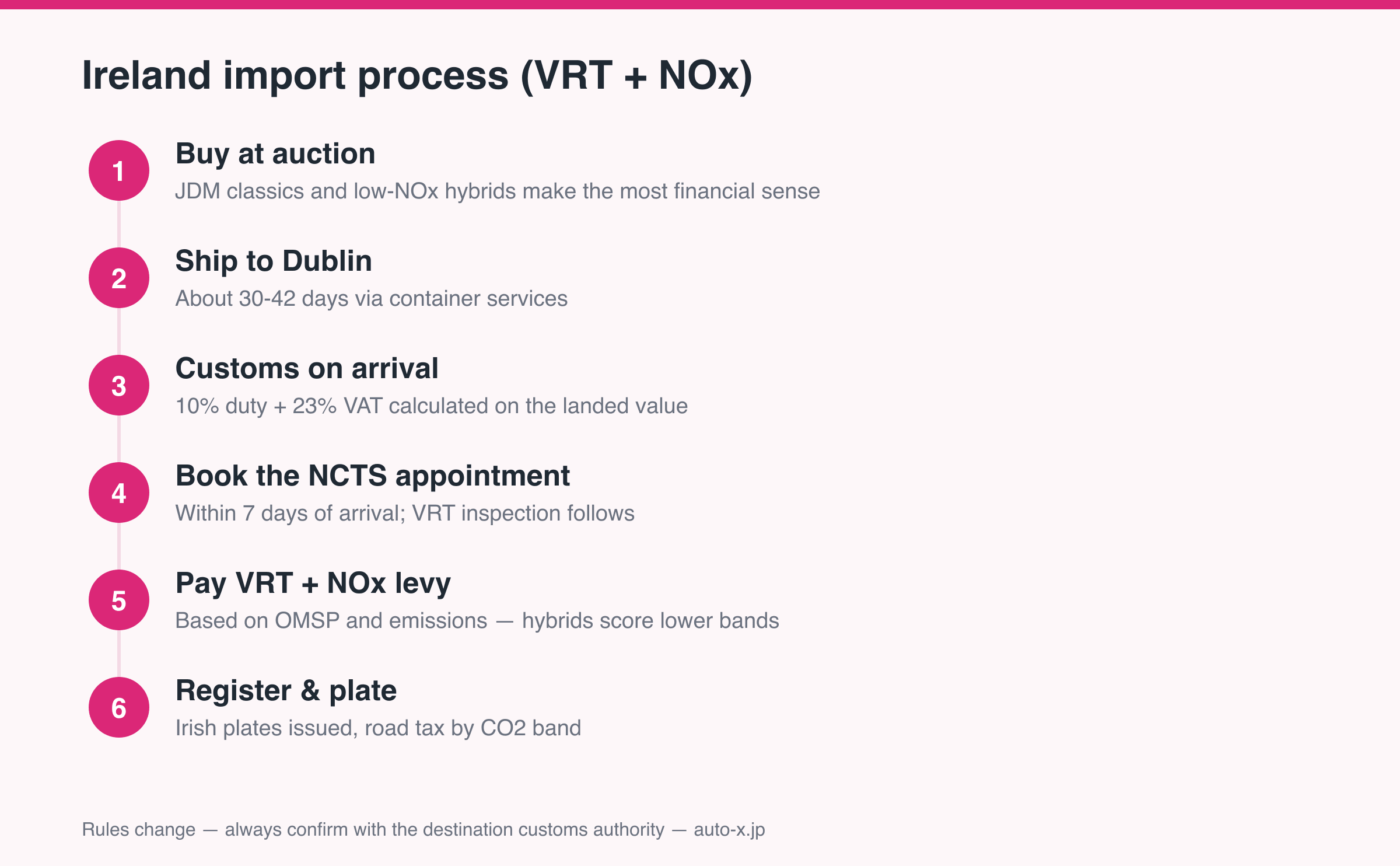
There are six stages, and they always run in the same order: we buy the car at auction and prepare it for export; it sails to Dublin in roughly 30–42 days; Irish customs assesses duty and VAT on arrival; you book an NCTS appointment; VRT and the NOx levy are calculated and paid; and finally the car is registered on Irish plates. Each stage carries its own paperwork and its own deadlines, so let us take them one at a time.
Shipping from Japan to Dublin#
Almost all of our Ireland-bound cars travel by container. Depending on the routing and any transhipment in a European hub port, the voyage typically takes 30 to 42 days from Japan — you can read more about routes and current schedules on our shipping to Dublin page. Container shipping keeps the car locked and protected for the whole crossing, and sharing a container with other vehicles keeps the freight cost sensible.
Before the vessel departs, we complete Japanese deregistration and hand you the export certificate with an English translation, the commercial invoice and the bill of lading. Keep these safe: Irish customs and the NCTS centre will both ask for them. We also recommend marine insurance for the crossing — it is a small line item compared to the value it protects.
Customs on arrival: VAT, duty — and the EPA advantage#
When the car lands in Dublin, Revenue collects two amounts before it leaves the port. The first is customs duty. Passenger cars imported from outside the EU can attract duty of up to 10% of the customs value — but, and this is the detail too many importers discover only after paying, the EU–Japan Economic Partnership Agreement allows vehicles with a valid Japanese proof of origin to qualify for a reduced or zero preferential duty rate. The key document is the statement on origin, normally issued by the exporter on the commercial invoice. Ask for it before the car ships; trying to obtain it retrospectively is far more painful. We prepare origin documentation for eligible vehicles as standard.
The second amount is VAT at 23%, charged on the landed value — broadly the price paid for the car plus shipping and insurance, plus any duty due. Because VAT is calculated on top of duty, securing the preferential EPA rate shrinks both lines of your customs bill at once. On a mid-priced car that difference alone can decide whether the import makes sense.
The NCTS appointment: a seven-day clock#
Clearing customs does not make the car Irish. Revenue requires you to book an appointment at an NCTS centre within 7 days of the vehicle arriving in the State, and to complete the registration within 30 days. Miss the window and you invite penalties and interest, so we tell every customer the same thing: book the appointment as soon as you have an arrival date.
At the appointment the vehicle is examined and Vehicle Registration Tax is calculated. VRT is not based on what you paid in Japan — it is a percentage of the OMSP, the Open Market Selling Price, which is Revenue's own assessment of what the car is worth on the Irish market. The percentage applied depends on the car's CO2 emissions band. On top of VRT sits the NOx levy, charged according to the car's NOx emissions per kilometre. This is where hybrids shine: their NOx output is low, so the levy stays modest, while older diesel engines sit at the punishing end of the scale.
Once VRT and the NOx levy are paid, you receive the registration number, order your plates, and the final running cost — annual motor tax — is set by the car's CO2 emissions. Again, the cleaner the car, the smaller the bill, year after year.
What an import actually costs#
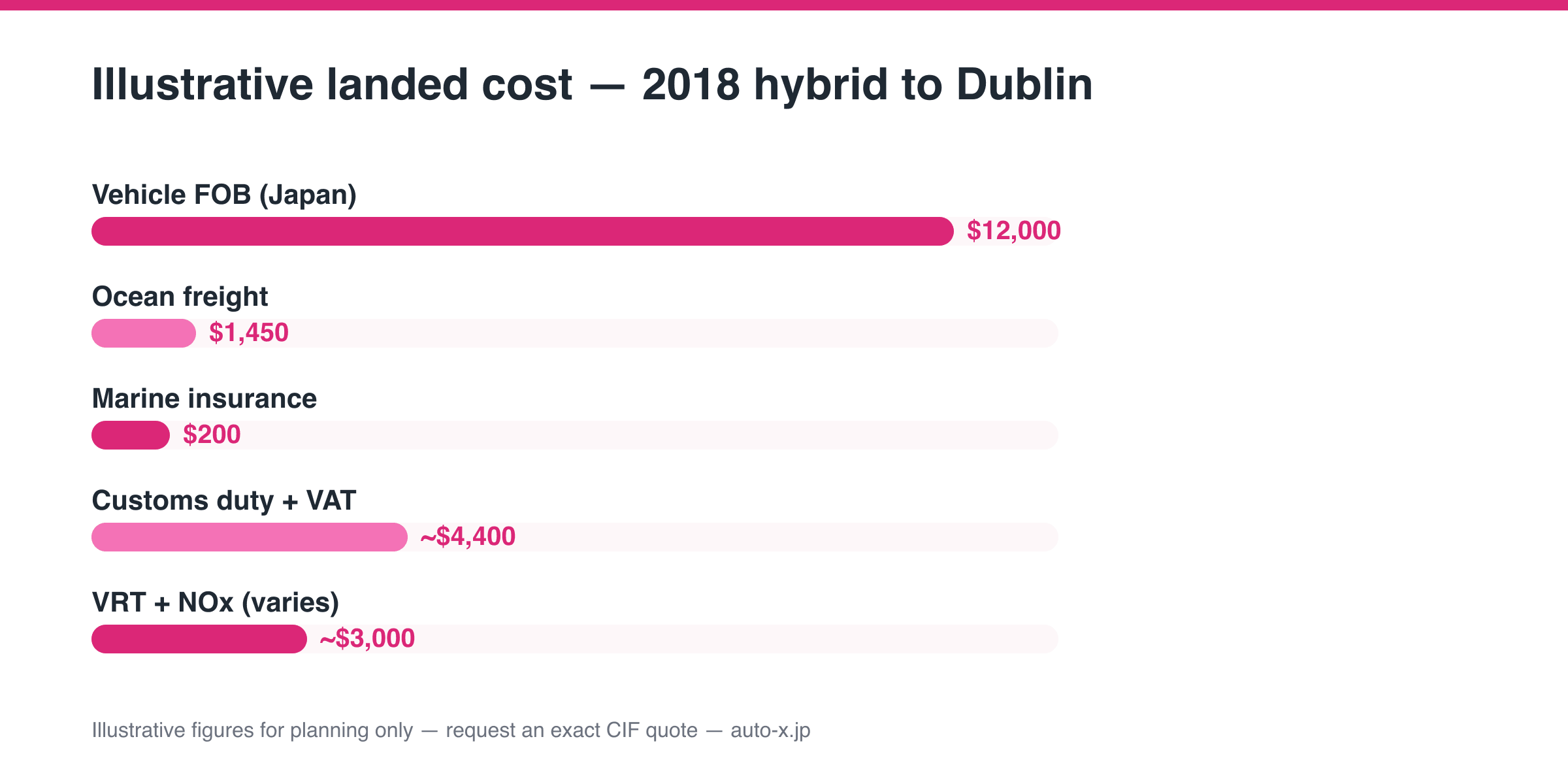
Here is an illustrative breakdown for a 2018 hybrid bought through us at auction: FOB price $12,000, container freight to Dublin $1,450, marine insurance $200, customs duty and VAT roughly $4,400, and VRT plus the NOx levy roughly $3,000 — call it $21,050 before local delivery. Treat the last two bars with care: your customs line falls if the EPA zero-duty rate applies, and VRT always depends on Revenue's OMSP for your exact car, not on this example. The point of the chart is the shape of the stack, not the precise figures — and it is why we quote CIF Dublin with the Irish taxes estimated up front, so there are no surprises at the port.
The imports that make financial sense#
After the tax layers are understood, two categories consistently come out ahead.
JDM classics. Ireland treats vehicles over thirty years old generously — a low flat-rate VRT and inexpensive road tax — which makes Japan's back catalogue very attractive: clean-body Skylines, Silvias, Land Cruisers and kei-era icons with verifiable auction history. These cars also tend to hold or grow their value, which softens every other cost in the stack.
Low-NOx hybrids. A Prius, Aqua or Corolla hybrid ticks every Irish box at once: low NOx levy, a friendly CO2 band for VRT, cheap annual motor tax and Japan's excellent hybrid maintenance culture. They are the easiest cars we ship to Ireland to justify on pure arithmetic.
The mirror image is also true: an older high-mileage diesel gets hit by the NOx levy, a high CO2 band and dear motor tax all at once. Run the numbers before you fall in love.
FAQ#
Do I pay both customs duty and VRT? Yes — they are separate charges collected at separate moments. Duty and VAT are settled at customs when the car lands; VRT and the NOx levy are paid at the NCTS appointment when you register. The EPA origin statement can reduce or remove the duty, but it never affects VRT.
How do I get the Japanese proof of origin? Ask your exporter before the car ships. Under the EU–Japan EPA it usually takes the form of a statement on origin on the commercial invoice. We issue it for eligible vehicles as a standard part of our export paperwork.
Can I drive the car while I wait to register it? The rules are strict and the clock is short — the NCTS booking must be made within 7 days of arrival and registration completed within 30. Arrange transport and insurance in advance and register promptly rather than risking penalties.
Thinking about a specific model? Tell us what you want to import and where in Ireland it is headed, and request a free CIF quote — we will reply with the landed cost to Dublin and an honest view on whether the numbers work for that car.