
Australia and Japan drive on the same side of the road, share a taste for turbocharged coupes and diesel 4WDs, and are linked by some of the busiest RoRo lanes in the Pacific. Yet Australia also runs one of the strictest vehicle-import frameworks we deal with as an exporter. Prepare properly and the process is smooth. Get it wrong and your car can sit on the wharf accumulating storage fees — or, in the worst biosecurity cases, be ordered back onto a ship.
We are MOBIC Co., Ltd., a licensed Japanese used-vehicle exporter based in Tokyo (licence No. 431310063715), and we ship vehicles to Australian buyers year-round. Here is how the two legal routes work, what the border actually checks, what the money looks like, and which JDM models are worth the effort.
Two doors in: SEVS or the 25-year classic route#
For a private buyer, almost every Japanese import enters Australia through one of two schemes.
Route 1 — SEVS. The Specialist and Enthusiast Vehicle Scheme covers eligible newer vehicles that appear on the SEVS register. A SEVS car cannot simply be driven off the wharf: it must be complied by a RAW — a Registered Automotive Workshop — which carries out the required inspection and compliance work before the vehicle can be registered. RAW slots for popular models can book out, so we tell buyers to line up their workshop before the car leaves Japan, not after it lands.
Route 2 — the 25-year classic route. Vehicles manufactured 25 or more years ago can come in under the older-vehicle pathway without RAW compliance. If you have read the USA 25-year rule guide, the logic will feel familiar — but Australia's scheme is its own system with its own paperwork, so never assume US eligibility carries over.
Under both routes you must hold a vehicle import approval before the car ships. Eligibility lists and conditions change, so confirm the current rules for your exact chassis code with the Department of Infrastructure before you bid on anything.
Biosecurity: the inspection that catches first-timers#
Australia's border is guarded less against cars than against what rides in on them: soil, seeds, insects, plant matter. Every imported vehicle is inspected for cleanliness, and the standard is genuinely strict — underbody, wheel arches, engine bay, chassis rails, spare-wheel well, interior carpets, even the air-conditioning intake.
A car that fails does not get waved through with a warning. It is ordered off for professional cleaning at the importer's expense, re-inspected, and in serious contamination cases it can be directed for re-export. Either outcome adds weeks and real money.
This is why we steam-clean every Australia-bound vehicle before it goes to port — underbody and engine bay included — and photograph the result. A hundred dollars of preparation in Japan is far cheaper than a quarantine-cleaning order in Brisbane.
From auction hall to Brisbane wharf: the six steps#
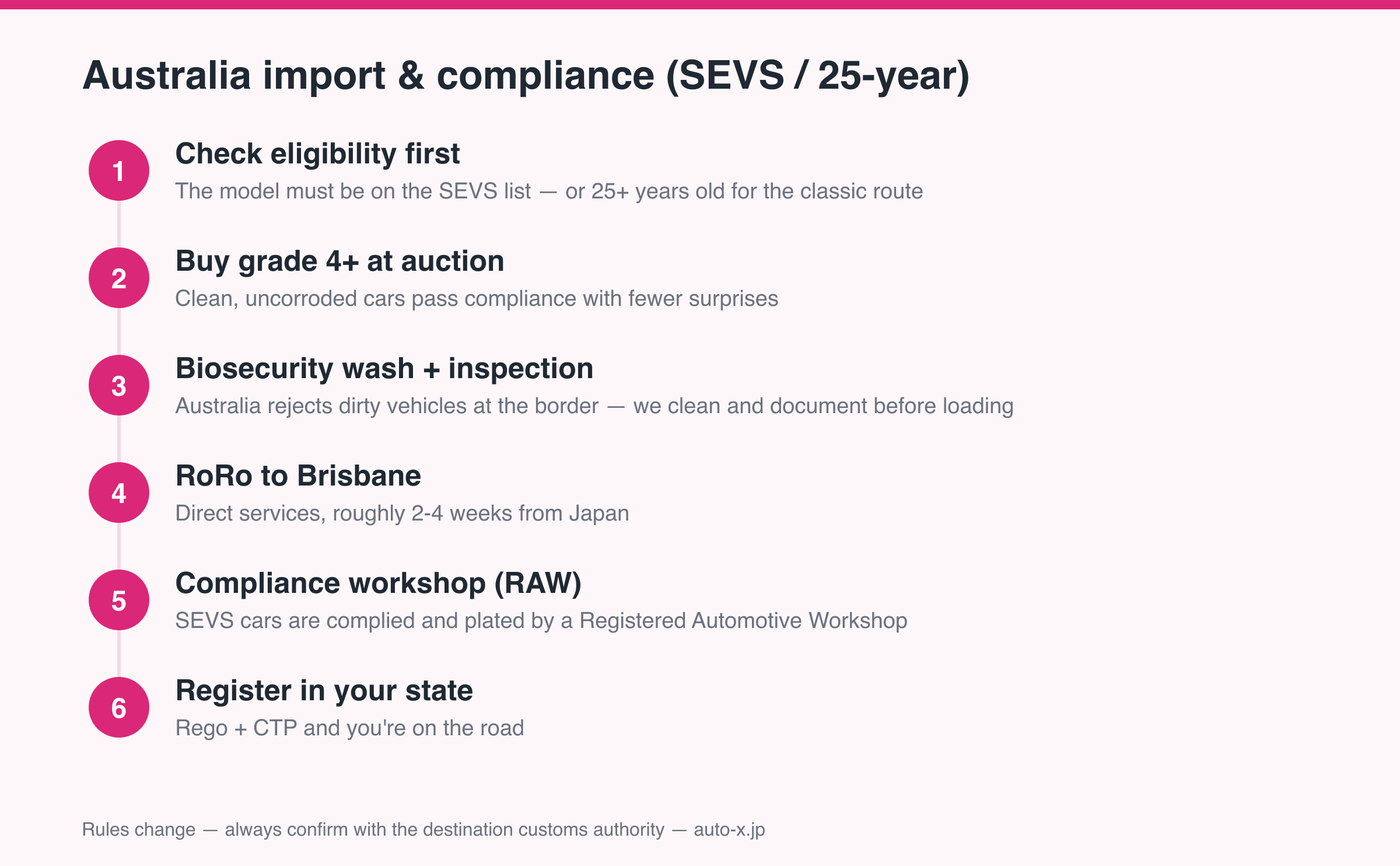
- Confirm eligibility first. Check the SEVS register or the manufacture date, and secure your import approval.
- Buy well at auction. We bid at USS and other auction houses through our auction agent service. For Australia we recommend grade 4 or better — compliance and rego are easier on a clean car, and resale is stronger. Learn to decode the grades in our guide to reading auction sheets.
- Biosecurity wash. Full steam clean, documented with photos.
- RoRo to Brisbane. Sailing time from Japan is roughly two to four weeks depending on port and schedule. See our dedicated page on shipping to Brisbane.
- RAW compliance (SEVS route only) once the car clears the border.
- State rego + CTP and the car is on the road.
The numbers: an honest landed-cost picture#
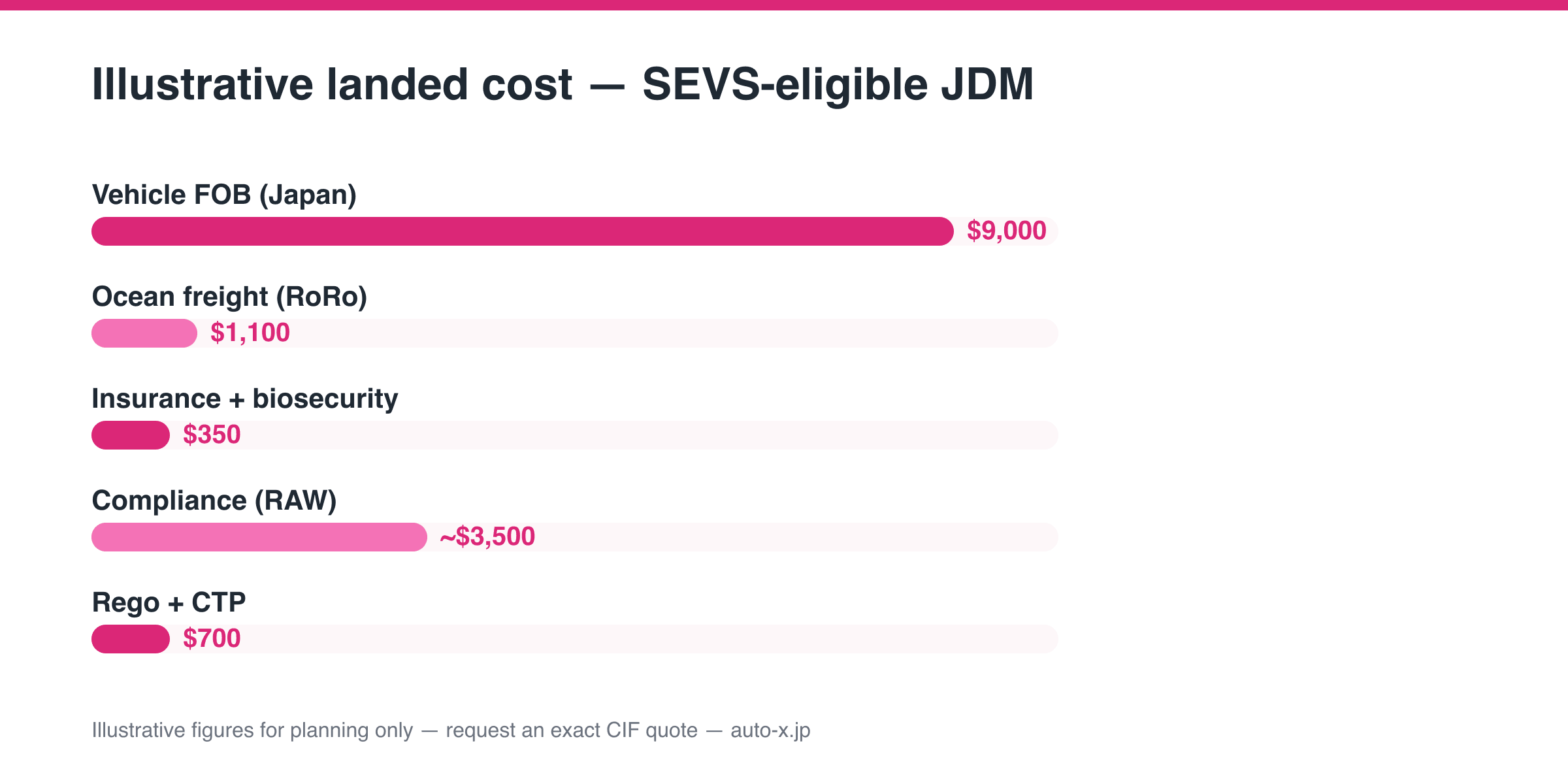
Every car is different, but here is an illustrative budget for a mid-1990s sports model bought at auction:
- FOB Japan: ~USD 9,000 — the car, auction fees and our export handling.
- RoRo freight to Brisbane: ~USD 1,100.
- Marine insurance + biosecurity preparation: ~USD 350.
- RAW compliance: ~USD 3,500 if you use the SEVS route (zero on the 25-year route — a major reason older cars are so popular).
- Registration and CTP: ~USD 700, varying by state.
On top sit Australian taxes at import — GST, and for high-value vehicles potentially Luxury Car Tax. We deliberately don't quote rates here because they are set on the Australian side and can change; confirm current figures with the Department of Infrastructure and your customs broker before committing.
Which JDM models actually pencil out#
The ~USD 3,500 compliance line is the key to the maths. It's a flat-ish cost, so it destroys the economics of cheap SEVS cars and barely dents expensive ones.
Strong on the 25-year route (no compliance cost): 1990s Toyota Chaser and Mark II turbos, Nissan Silvia S14, Skyline R33/R34 variants as they age past 25, early Land Cruiser 80s and Delica Space Gears for the touring crowd. Australia's love of diesel 4WDs makes well-kept Land Cruisers and Hiluxes some of the safest money in the business.
Worth SEVS compliance: genuinely special vehicles with strong local demand — performance and enthusiast models on the register where the Australian market price comfortably exceeds Japan cost plus ~USD 5,000 of freight and compliance. Check the register for your exact variant before bidding; eligibility is by model and specification, not by nameplate.
Rarely worth it: ordinary commuter cars. Australia has plenty. Import cars Australia can't buy locally.
Rego and CTP: the last mile#
Registration is state business. Each state or territory sets its own inspection requirements (roadworthy or safety certificate), fees and process, and you'll pay CTP — compulsory third-party injury insurance — as part of it; in some states it's bundled into rego, in others chosen separately. Budget several hundred dollars and a trip to an inspection station, and check your own state's rules before the car lands so the last mile doesn't stall.
FAQ#
How long does shipping from Japan to Brisbane take?
RoRo sailings typically take about two to four weeks port-to-port, depending on the departure port and the line's schedule. Add time for auction purchase, biosecurity prep and export customs in Japan — a realistic auction-to-driveway timeline is two to three months.
Can I import any car once it turns 25?
Age makes the older-vehicle route possible, but it doesn't remove the paperwork: you still need import approval before shipping, and the car must still pass biosecurity and meet your state's registration requirements. Check the current rules with the Department of Infrastructure for your specific vehicle.
What happens if my car fails the biosecurity inspection?
It is directed for cleaning at your cost and re-inspected; heavily contaminated vehicles can be ordered for re-export. This is entirely preventable — a documented pre-shipment steam clean in Japan is the cheap insurance.
Ready to run the numbers on a specific car? Send us the model you're chasing and request a free CIF quote — we'll come back with auction pricing, freight to Brisbane and a realistic landed estimate.