Jamaica has been one of the busiest Caribbean destinations on our shipping schedule for years. The island drives on the left, runs on right-hand-drive vehicles, and has a deep-rooted trust in Japanese cars — so a clean, auction-grade Fielder or Fit lands in Kingston with a ready market waiting. But Jamaica is also one of the more regulated import markets we serve: there is a licence you must obtain before the car ships, strict age limits, and a duty structure that can surprise first-time importers. This guide walks through the full process the way we actually run it with our Jamaican buyers, from Trade Board paperwork to plates on the car.
Paperwork Comes First: TRN and the Trade Board Import Licence#
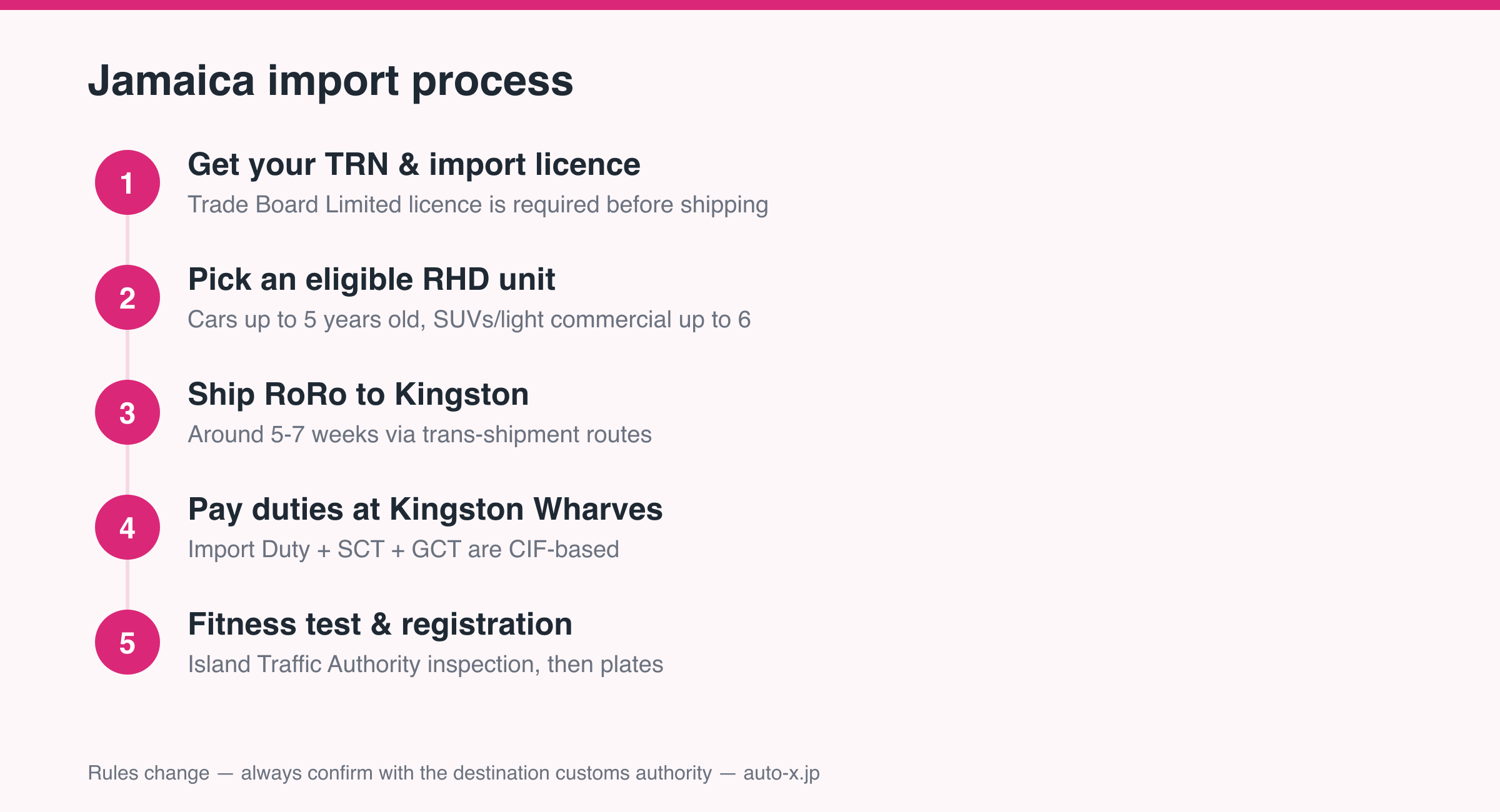
Every motor vehicle imported into Jamaica needs an import licence issued by Trade Board Limited, the government agency that regulates vehicle imports. Applications go through the Trade Board's online system, and to use it you need a Taxpayer Registration Number (TRN) from Tax Administration Jamaica — if you don't have one yet, get it first, because nothing else moves without it.
The critical point is sequencing. Apply for the licence before the vehicle sails — ideally before you even pay for the car. The application needs the vehicle's details (chassis number, engine capacity, year of manufacture), which is why we send buyers the export certificate details and photos immediately after an auction purchase. A car arriving in Kingston without a valid licence sits on the wharf accruing storage charges while the paperwork catches up. Individuals are also limited in how many vehicles they can import within a set period — dealers hold separate authorisation — so confirm your entitlement with Trade Board before committing to a unit.
The Age Limit Decides What You Can Buy#
Jamaica enforces some of the clearest age restrictions in the Caribbean: passenger cars must generally be no more than five years old, while SUVs and light commercial vehicles get six years, counted from the year of manufacture. As of this writing that keeps most of the Japanese auction catalogue in play — Japan's used market is dominated by three-to-seven-year-old vehicles coming off leases and first ownership — but it rules out the very cheapest stock.
Two practical notes from our side. First, the year on a Japanese auction sheet is the first-registration year, which is not always the manufacture year; we verify manufacture dates from the chassis number before invoicing so a borderline unit doesn't get refused a licence. Second, the limits have been revised several times over the years, so confirm the current policy with Trade Board Limited before you budget. Every unit we ship also goes through pre-export inspection so the certificate the ITA examines later matches the car in front of them.
What It Costs: Import Duty, SCT and GCT on the CIF Value#
Jamaica calculates all vehicle taxes on the CIF value — the car's cost plus freight plus insurance. Three charges stack on that base: Import Duty, Special Consumption Tax (SCT), and General Consumption Tax (GCT). The SCT is the variable that matters most: it scales with engine size, so a 1.5-litre Fielder attracts a far lighter aggregate rate than a 3.0-litre SUV. Depending on engine capacity, the combined burden commonly ranges from roughly half of CIF to well over 100 per cent — rates change, so confirm current figures with the Jamaica Customs Agency before you commit.
Here is an illustrative breakdown for a typical 1.5-litre wagon, using round numbers rather than a live quote:
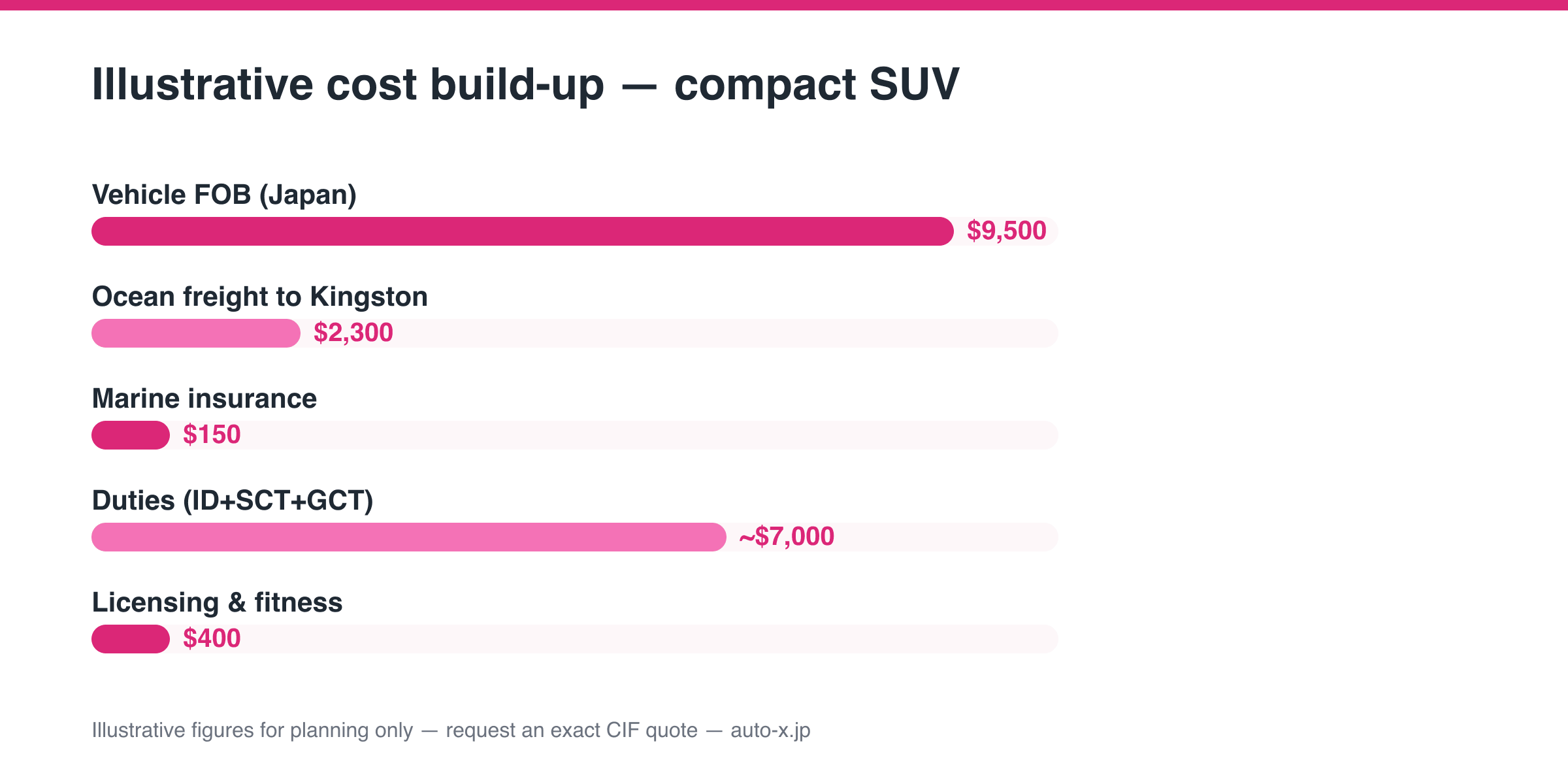
- FOB vehicle price: $9,500
- RoRo freight to Kingston: $2,300
- Marine insurance: $150
- Duties and taxes (ID + SCT + GCT): about $7,000
- Licence, fitness and registration fees: about $400
That puts the landed, registered cost near $19,350 — roughly double the FOB price, which is normal for Jamaica and worth internalising before you fall in love with a listing. These figures are illustrative only; your actual duty depends on the customs valuation and the rates in force on the day of clearance.
Shipping: RoRo to Kingston in Five to Seven Weeks#
There is no frequent direct RoRo service from Japan to Kingston, so vehicles trans-ship: they sail on a main-line carrier to a hub port and transfer to a Caribbean feeder vessel. From vessel departure to the wharf, we tell buyers to plan on five to seven weeks, and we track the connection so you are never guessing where the car is. (For a comparison of transit times across our markets, see our import timeline by country.)
Before arrival you should have in hand: the original bill of lading, the Japanese export certificate with an English translation, the commercial invoice, and your Trade Board licence. Nearly all of our Jamaican buyers use a licensed customs broker in Kingston — for a first import especially, the broker's fee pays for itself in avoided storage days.
After the Wharf: ITA Fitness Test, Then Plates#
Once customs releases the vehicle, two steps remain. First, the car goes to an Island Traffic Authority examination depot for a fitness inspection — brakes, lights, tyres, structure. Vehicles fresh out of the Japanese auction system pass routinely; this is one reason auction grades matter. Second, with the certificate of fitness, your customs documents and valid insurance, you register the vehicle at a Tax Administration Jamaica collectorate and receive your plates. From vessel arrival to driving legally, most of our buyers complete this inside two weeks.
The Models Kingston Keeps Asking For#
Demand from Jamaica is remarkably consistent. The Toyota Corolla Fielder is the island's default family wagon — cheap parts, hybrid economy, and resale value that holds. The Corolla Axio offers the same mechanicals in sedan form. In the compact segment, the Honda Fit hybrid and Nissan Note e-POWER dominate on fuel economy — a real consideration at Jamaican fuel prices. And for business use, the Toyota Probox is close to a national institution: route taxis, delivery fleets and tradesmen run them because they are nearly indestructible and every mechanic on the island knows them. All five sit comfortably inside the age limit and the small-engine duty bands, which is exactly why they dominate.
FAQ#
Do I need the Trade Board licence before the car ships from Japan?
Formally the licence is required to clear the vehicle, but in practice you should have it before the car sails. If the car arrives first you will pay wharf storage while you wait, and if the vehicle turns out to be ineligible you own a car you cannot clear. We hold vehicles at our yard until buyers confirm the licence is in hand.
Can I import a car older than five years?
Generally no. Narrow exceptions have existed for categories such as returning residents or vintage vehicles, but they are specific and change over time — put your case to Trade Board Limited directly rather than relying on forum advice.
How much duty will I pay on a 1.5-litre car?
It depends on the CIF value and the rates in force on clearance day. Small-engine cars sit in the lighter SCT bands, which is why 1.5-litre models dominate the trade. Ask the Jamaica Customs Agency for a current estimate before you buy.
We have been putting cars on the water to Kingston long enough to know where the process bites first-time importers — and it is almost always sequencing, not cost. Get the TRN, get the licence, then buy the car. If you want real numbers instead of illustrations, tell us the model you are considering and request a free CIF quote — we will come back with FOB, freight and a landed estimate for Kingston.