

Spend an afternoon in any car park in Port of Spain and you will see the story of Trinidad & Tobago's car market told in badges: Toyota Aqua, Corolla Fielder, Honda Fit, Nissan Note — row after row of "foreign-used" imports from Japan. T&T buyers are some of the most knowledgeable we deal with at AUTO-X. They rarely ask us whether to import; they ask how to get the licence, what the tax bill will look like, and how long the boat takes. This guide answers those questions the way we walk our own customers through them, as a licensed Japanese exporter (MOBIC Co., Ltd., licence No. 431310063715) shipping to the Caribbean.
The Licence Comes Before the Car#
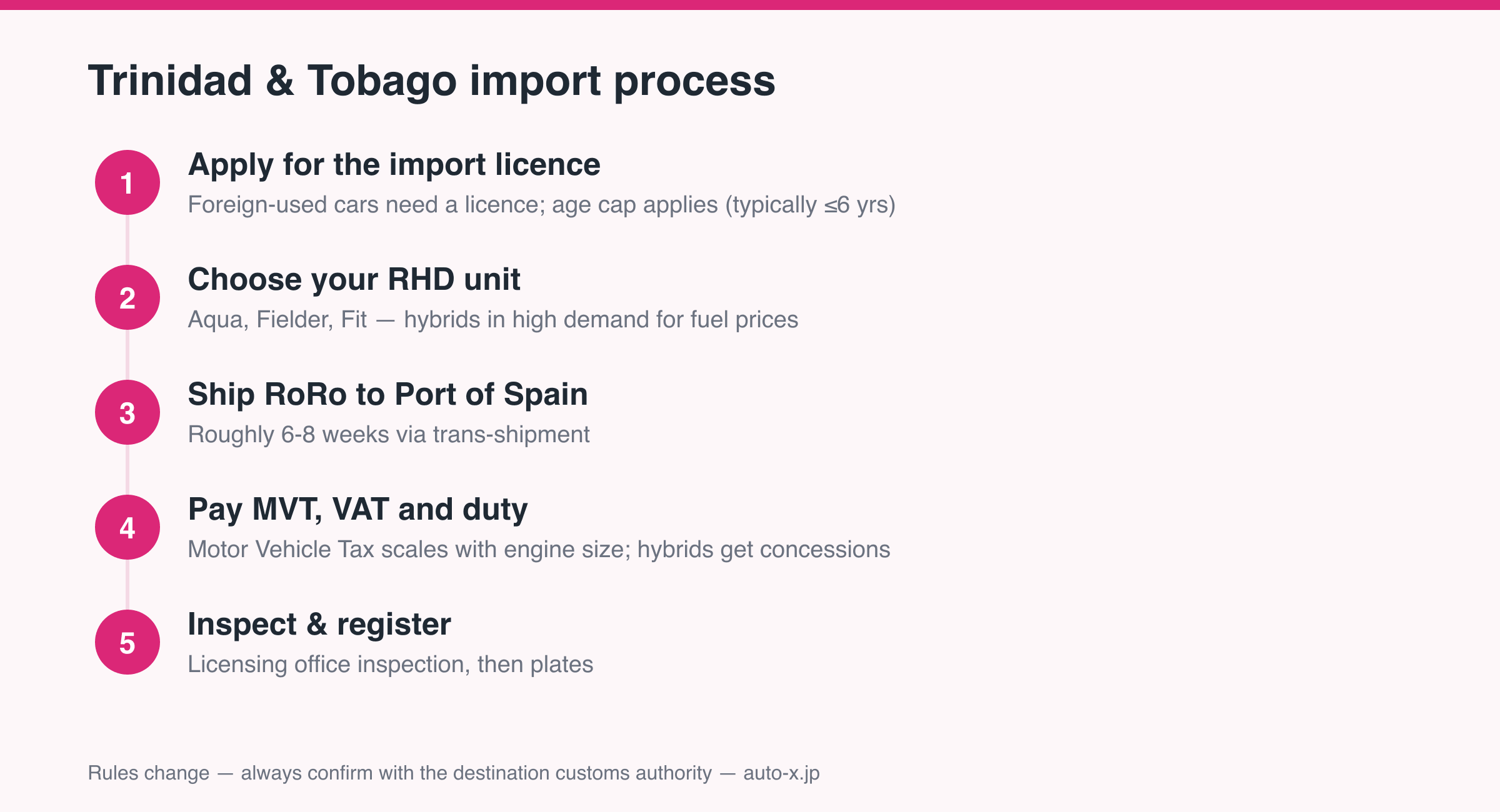
Trinidad & Tobago treats foreign-used vehicles as a licensed import. Before your car ships — ideally before you even pay for it — you apply to the Trade Licence Unit of the Ministry of Trade and Industry for a licence to import a used right-hand-drive vehicle. Applications go through the TTBizLink online portal, and you will typically need your ID, the vehicle's details (chassis number, year of manufacture, engine capacity) and, depending on the category, proof that the car falls within the age limit.
Two practical notes from our side of the water. First, the chassis number on the licence must match the car we ship, so lock in your unit before you finalise the application. Second, processing times vary; we have seen licences come back quickly and we have seen them take weeks. Do not put a car on a vessel hoping the licence catches up with it — Customs can and does hold cargo that arrives without one.
The Six-Year Rule (Check It Twice)#
T&T caps the age of foreign-used cars. For ordinary passenger vehicles the widely applied limit in recent years has been six years from the year of manufacture at the time of import — but this is exactly the kind of rule that gets revised. The cap has been tightened and adjusted before, and different vehicle categories (commercial, CNG, electric) have carried different limits. Before you commit to a specific car, confirm the current limit with the Trade Licence Unit for your vehicle category.
One trap we warn every buyer about: Japanese auction sheets show the first registration date, which can be a year after the manufacture date. If a car is close to the cap, we verify the actual production date before you bid, not after.
"Roll On Roll Off" — the Trade, Not Just the Ship#
Here is a bit of local vocabulary that confuses first-timers. Internationally, RoRo (roll-on/roll-off) is a shipping method — cars are driven onto a vessel rather than packed into containers. In Trinidad, "roll on roll off" is also the everyday name for the foreign-used dealer trade itself: the local dealers who import Japanese cars in volume and sell them off their lots.
Buying from a local roll-on-roll-off dealer means driving away this week and paying a margin for the convenience. Importing directly through an exporter like us means you choose the exact unit — auction grade, mileage, service history — and typically keep a chunk of that margin, in exchange for waiting for the boat and handling clearance (most of our T&T customers hire a clearing agent for a few hundred US dollars). Neither route is wrong; it depends on whether you value speed or value.
What Customs Will Ask For: Duty, MVT, VAT#
Import charges are assessed by the Customs and Excise Division on the CIF value (car + freight + insurance), and they stack in three layers:
- Customs duty — a percentage of CIF that varies with the vehicle type and engine size.
- Motor Vehicle Tax (MVT) — T&T's signature charge, scaled to engine capacity: a per-cc rate that climbs in bands, so a 1,500 cc car is taxed far more gently than a 2,500 cc one.
- VAT — charged on the duty-inclusive value, at 12.5% at the time of writing.
We deliberately avoid quoting exact duty tables here because they change, and because hybrid and electric vehicles have at various times enjoyed partial or full concessions on MVT, customs duty and VAT, subject to engine-size and age conditions. Those concessions have been introduced, lapsed and reinstated over the years — they are the single biggest variable in your landed cost, and the reason small hybrids dominate the trade. Confirm current rates with the Customs and Excise Division or your clearing agent before you buy, not at the port.
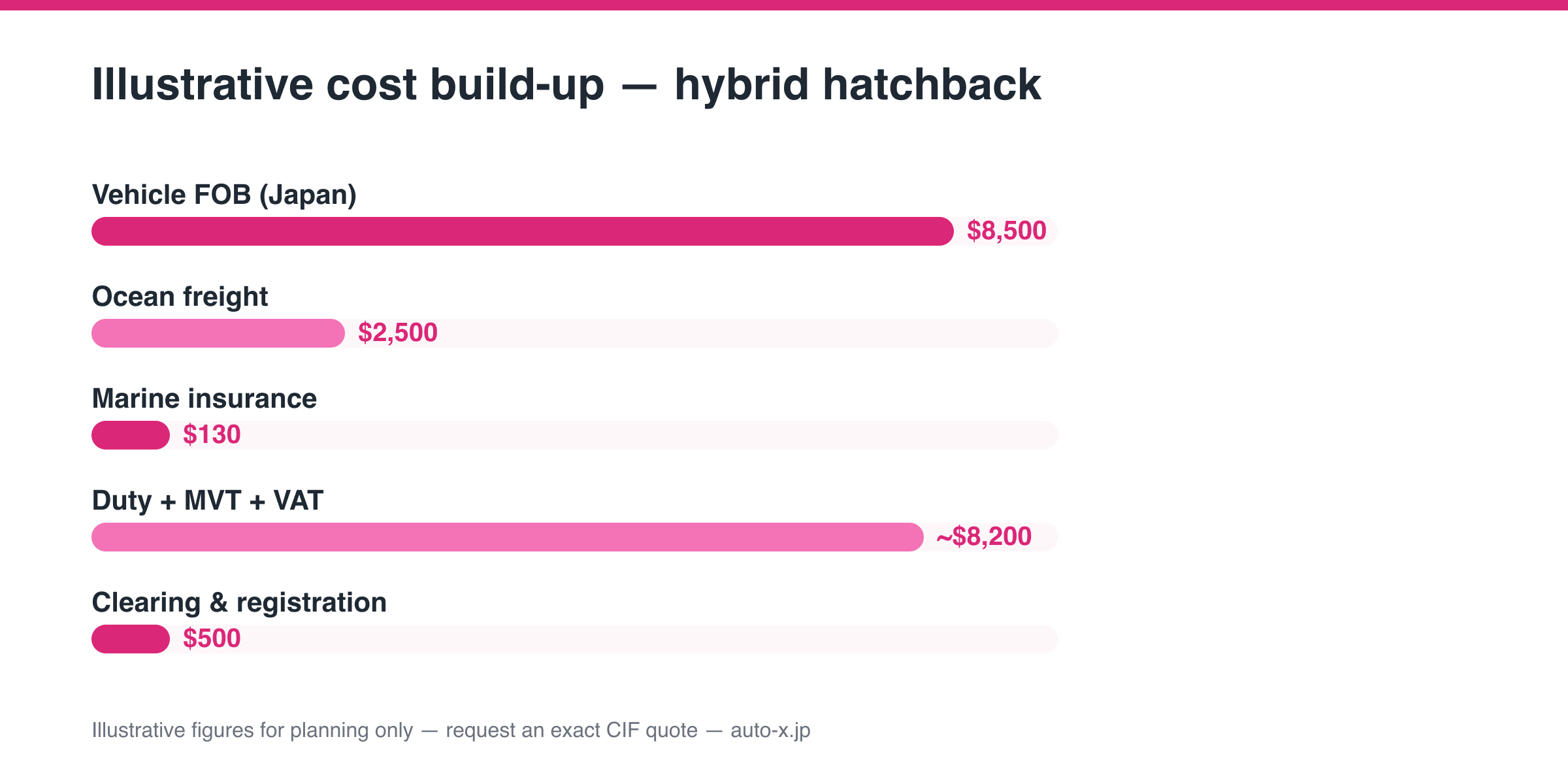
To make that concrete, here is an illustrative breakdown for a typical hybrid hatchback — treat the tax line especially as a placeholder, since concessions can move it dramatically:
- FOB price in Japan: $8,500
- RoRo freight to Port of Spain: ~$2,500
- Marine insurance: ~$130
- Customs duty + MVT + VAT: ~$8,200 (engine-size dependent; hybrid concessions can reduce this substantially)
- Clearing agent and port charges: ~$500
The Voyage: RoRo with Trans-shipment, Six to Eight Weeks#
There is no direct RoRo service from Japan to Port of Spain, so vehicles trans-ship — typically moving on a main-line vessel to a hub port and transferring to a Caribbean feeder. Port-to-port, we tell customers to plan on roughly six to eight weeks, and to build in buffer for hub congestion. Container shipping is also possible and can make sense when sharing a container with other buyers; we compared the two honestly in our RoRo vs container guide.
While the car is at sea you will receive the bill of lading, the export certificate with English translation, and the commercial invoice — the documents your clearing agent needs. And a standing warning we repeat everywhere: pay only against verifiable company details. Our safe payment guide covers how to check you are paying a licensed exporter and not an impostor.
Landing in Port of Spain: Clearance, Inspection, Plates#
Once the vessel berths, your clearing agent lodges the entry with Customs, duties are paid, and the car is released. From there the final stop is the Licensing Division: the vehicle is inspected — chassis number verified against your documents, roadworthiness checked — then registered, after which you receive your T&T number plates. Arrange local insurance before you drive off. From vessel arrival to plates, an organised week or two is a realistic expectation, assuming the paperwork is clean.
The Cars That Keep Getting Asked For#
Year in, year out, the same shortlist tops our Trinidad enquiries: the Toyota Aqua (hybrid economy plus concession eligibility makes it the default choice — browse our current Toyota Aqua listings), the Corolla Fielder wagon for families and small businesses, and the Honda Fit and Nissan Note as roomy, frugal hatchbacks. All four are compact-engine cars that sit at the gentle end of the MVT scale, and all four have deep parts support in T&T — which is exactly why the local roll-on-roll-off lots stock them too.
FAQ#
Do I need the import licence before the car leaves Japan? Formally the licence is required for customs clearance in Trinidad, but in practice you should have it approved before the vessel sails. If a licence is refused or delayed while your car is mid-ocean, you face storage charges — or worse. We hold cars at our yard until customers confirm their licence.
Can I import a car older than the age cap? For standard foreign-used passenger cars, generally no — that is the point of the cap. Limited exceptions have existed for certain categories, and returning nationals have had special provisions at times. Ask the Trade Licence Unit directly rather than relying on forum posts.
How much should I budget overall? As a very rough shape: CIF (car + freight + insurance) plus duties that can range from modest — for a small concession-eligible hybrid — to more than the CIF value for larger-engine petrol cars. That spread is why we quote per-vehicle rather than publishing a table.
Ready to put numbers against a specific car? Tell us the model and year you have in mind and request a free CIF quote — we will confirm the age cap, estimate freight to Port of Spain and flag any concession your choice may qualify for.