
For nearly five years, bringing a car into Sri Lanka was simply not possible. Vehicle imports were suspended in March 2020 to protect the country's foreign-currency reserves, and the ban outlived the crisis that created it. That changed in 2025, when the Ministry of Finance began a phased reopening and passenger cars became importable again under a new set of gazette rules. Demand came back fast: at AUTO-X we went from zero Sri Lanka enquiries to Colombo being one of our busiest lanes within months of the announcement. This guide explains how the process actually works today — who may import, what the age and payment rules require, what the duty bill really looks like, and how a car moves from a Japanese auction hall to a Department of Motor Traffic (DMT) number plate.
Five closed years, one cautious reopening#
The 2020 suspension began as an emergency measure to stop foreign exchange leaving the country, and successive extensions kept the ports closed long after the initial shock. When liberalization finally came, it was deliberately staged: buses and commercial vehicles first, then passenger cars from early 2025. The government also paired the reopening with heavy, revenue-focused taxation, so the market is open but tightly filtered — the rules themselves decide which cars make commercial sense, which is why a small group of Japanese hybrids dominates the order books.
Two things are worth fixing in mind before you look at a single auction listing. First, the framework is set by gazette notification and has already been amended since reopening; always confirm the current position with Sri Lanka Customs and the Ministry of Finance before committing money. Second, three constraints shape every other decision — the age limit, the Letter of Credit requirement and engine-capacity excise — so we will take them in that order.
The three-year rule and who may import#
Under the current rules, an imported used passenger car must generally be no more than three years old from its date of manufacture. This is far stricter than most markets we serve: instead of the five-to-seven-year-old cars that dominate exports to East Africa, Sri Lanka-bound purchases are near-new — typically low-mileage vehicles from the last three model years with strong auction grades.
Importers must also satisfy the licensing side. Commercial importers register with the authorities and obtain the applicable import licence; private buyers usually work through a licensed clearing agent in Colombo who handles the Sri Lankan paperwork. We routinely coordinate with the buyer's agent so that the Japanese-side documents match exactly what Customs expects to see.
What Sri Lankan buyers ask us for first is remarkably consistent: the original auction sheet with a translation, and evidence of hybrid battery health. Both requests make sense — the value of a near-new hybrid depends heavily on each.
Payment: why the Letter of Credit is not optional#
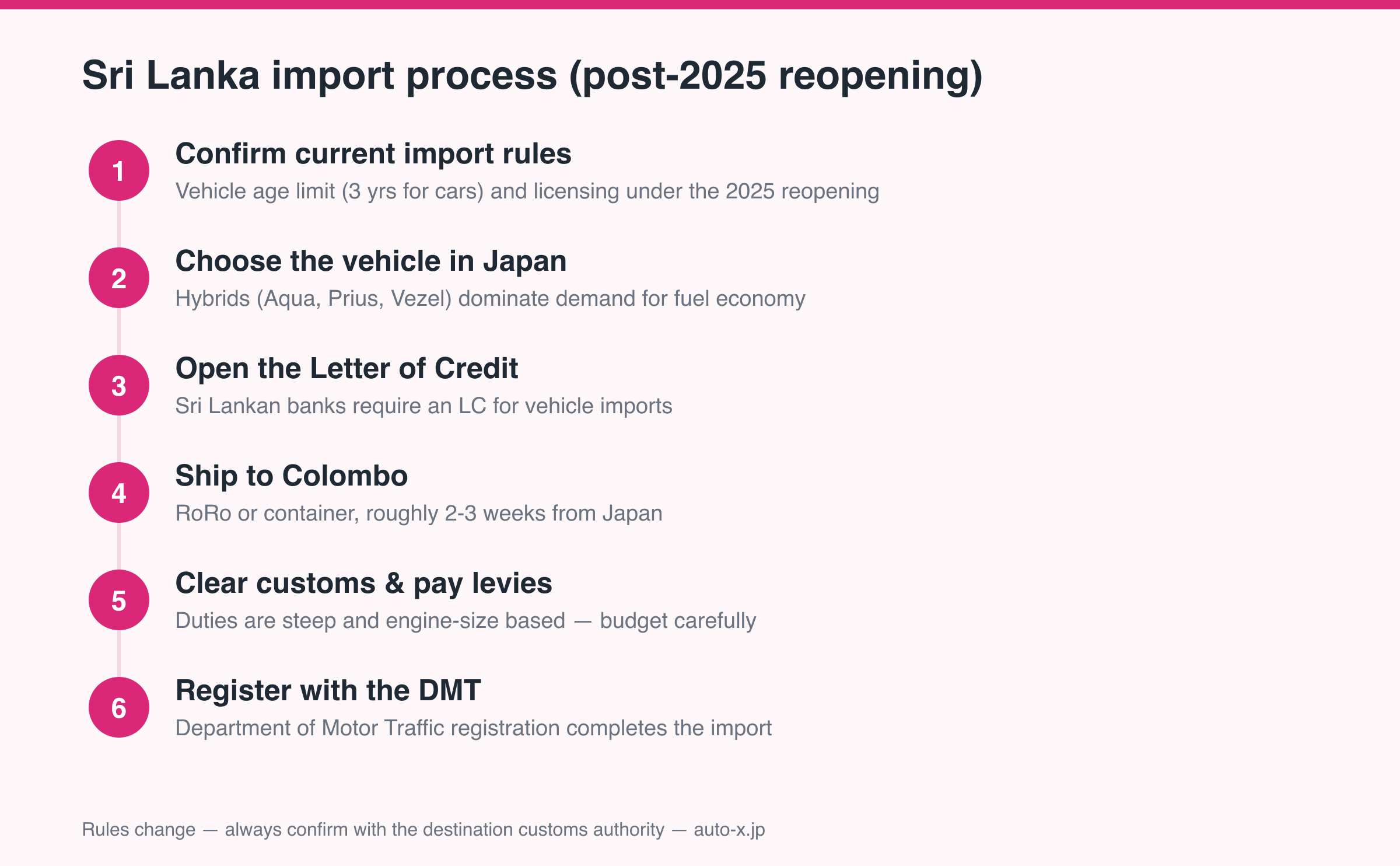
Sri Lanka currently requires vehicle imports to be paid through a Letter of Credit (LC) opened at a licensed commercial bank in Sri Lanka. A simple telegraphic transfer to the exporter is not an accepted route for the vehicle itself under the present rules. In practice this means three things:
- You need an account and an LC facility with a Sri Lankan bank before you order the car.
- The proforma invoice must match the LC terms exactly — chassis number, description, amount, port. Banks reject documents over tiny discrepancies, so at AUTO-X we draft the invoice together with the buyer and their bank's requirements before the LC is opened, not after.
- The shipping documents — commercial invoice, bill of lading, export certificate and insurance certificate — are presented through the banking channel, and payment is released against them.
Used well, the LC protects both sides: you do not pay a stranger in advance, and we ship knowing payment is secured. If you are new to international car payments, our safe payment guide covers the wider fraud patterns to avoid.
The duty bill is the real price tag#
Sri Lanka's vehicle taxes are among the steepest of any market we ship to. Levies are layered on the CIF value: customs duty, an excise duty scaled by engine capacity, VAT, and a luxury tax above certain value thresholds. For many petrol cars the combined levies come to a multiple of the car's own value. Small-displacement hybrids sit in gentler excise bands — which is precisely why they dominate demand.
Here is an illustrative build-up for a compact hybrid landed in Colombo:
- FOB vehicle price in Japan: $12,000
- Ocean freight to Colombo: $1,200
- Marine insurance: $180
- Duties and levies: $14,000+
- Clearing and local charges: about $600
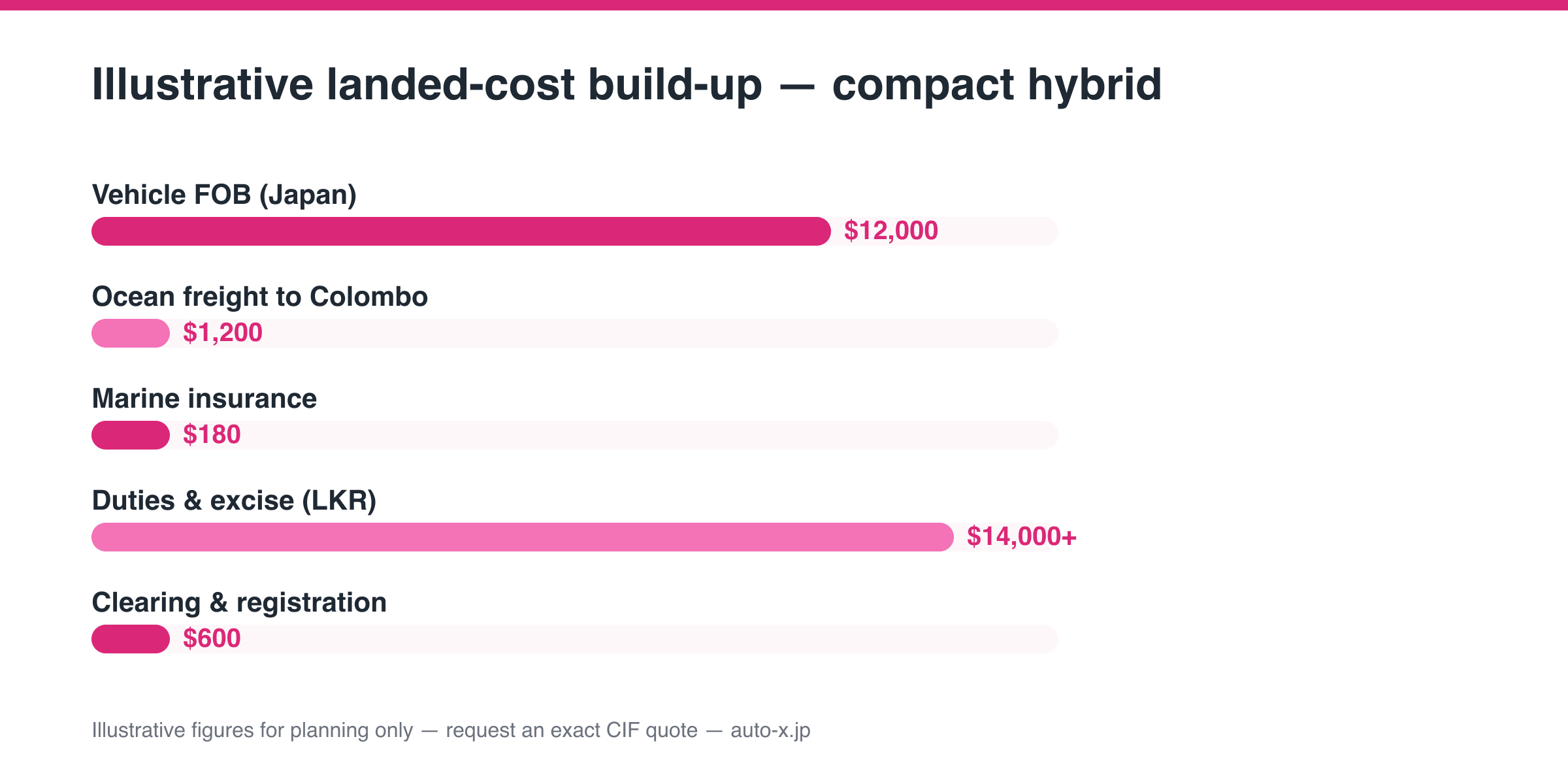
Read that duties line again: even for a modest hybrid, the state's share can exceed the price of the car itself. And these are illustrative figures only — rates are revised by gazette and vary by engine size, fuel type and value band, so confirm the current schedule with Sri Lanka Customs before ordering. We provide a CIF estimate with every quote, but the final duty calculation belongs to your clearing agent and Customs, not to any exporter.
Why the Aqua, Prius and Vezel rule the order books#
Three forces converge on the same shortlist. Excise scales with engine capacity, so a 1.5-litre hybrid is taxed far more gently than a 2.5-litre petrol SUV. Fuel prices in Sri Lanka make hybrid economy genuinely valuable rather than a nice-to-have. And resale liquidity matters in a market where the duty regime makes every car expensive — familiar models hold their value.
The result: the Toyota Aqua, the Prius and the Honda Vezel (with the Fit close behind) account for the bulk of what we ship to Colombo. All three are abundant at Japanese auctions inside the three-year window, so supply meets the rule set neatly. When we bid for Sri Lankan customers we prioritise grade 4.5 and above, verified mileage and — for hybrids — service records that support battery condition, because those are the cars that clear registration and resell without argument.
From a Japanese port to a DMT number plate#
Colombo is well served from Japan. RoRo sailings from Yokohama, Kawasaki and Nagoya typically reach Colombo in around two to three weeks; container shipping is the alternative when buyers consolidate two or more cars or want extra protection. The trade-offs are covered in our RoRo vs container shipping guide. Before any car leaves Japan it must pass pre-export inspection by an approved agency, and we deregister the vehicle and obtain the export certificate that Sri Lanka Customs will later require.
On arrival, your clearing agent lodges the customs declaration with Sri Lanka Customs, the levies are paid, and the car is released. Registration then goes through the Department of Motor Traffic. The documents we prepare on the Japanese side — export certificate with English translation, commercial invoice, bill of lading and inspection certificate — are exactly the set the DMT process consumes, so we assemble them as one pack and route the originals through the LC bank channel.
End to end, a typical Sri Lanka shipment runs four to eight weeks from auction win to number plate, with the LC opening and customs clearance being the two stages most likely to add time.
FAQ#
Can I import a car older than three years?
Not under the current passenger-car rules — the age limit is enforced at licensing and clearance, so an over-age car risks being refused entry regardless of condition. The limit is set by gazette and can change, so check the current position with Sri Lanka Customs before you buy.
Can I skip the LC and pay the exporter directly by bank transfer?
No. The Letter of Credit through a licensed Sri Lankan commercial bank is a regulatory requirement of the import, not an exporter preference. Treat any seller who proposes bypassing it as a red flag.
How long does the whole process take?
Plan for four to eight weeks in total: roughly one to two weeks from purchase to sailing, two to three weeks at sea to Colombo, and the remainder for customs clearance and DMT registration.
Planning an import to Colombo? Tell us which model you have in mind and your bank's LC requirements, and we will reply with current auction availability inside the three-year window plus a full cost estimate — request a free CIF quote to get started.