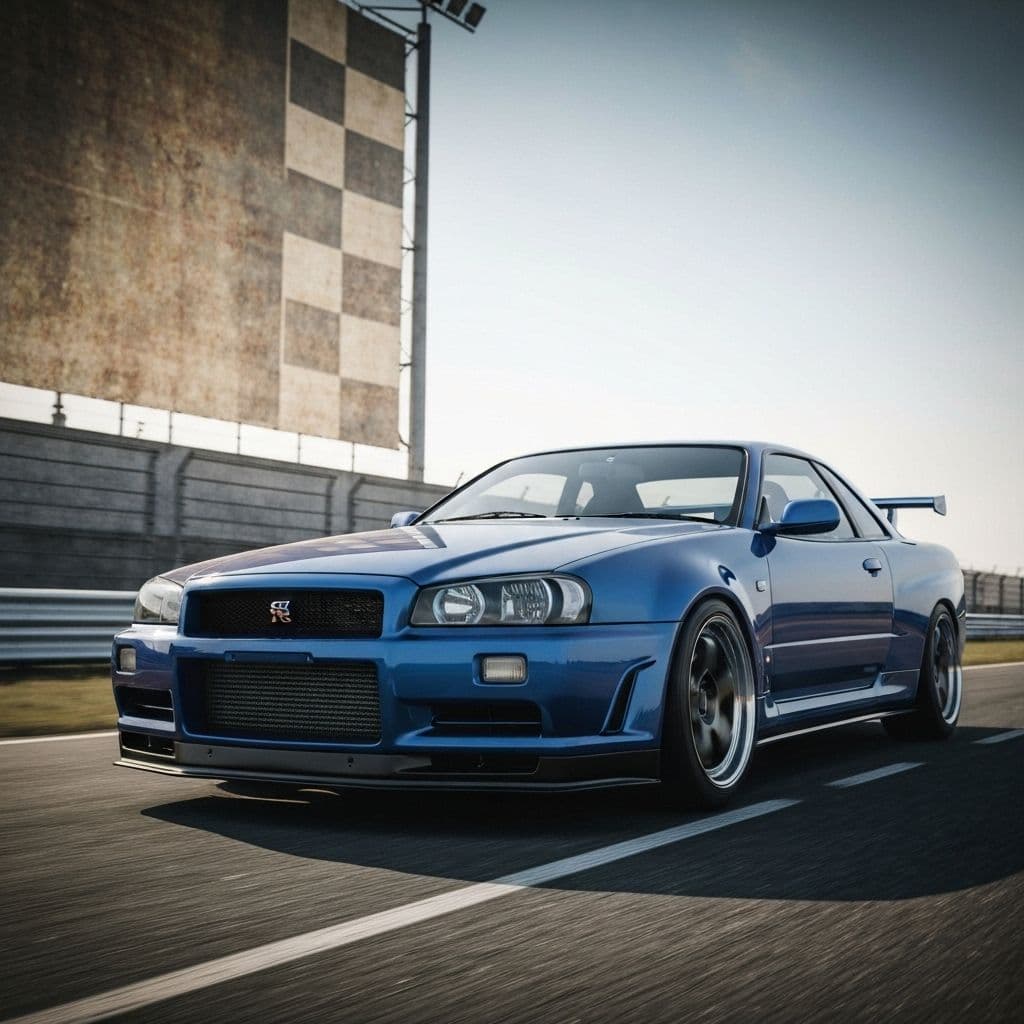
The United States is the largest single market in the world for collector and enthusiast JDM imports — but it's also the most regulated. Federal law prohibits the import of vehicles that don't meet US Federal Motor Vehicle Safety Standards (FMVSS), with one major exception: the 25-year rule. Vehicles manufactured 25 or more years ago are exempt from FMVSS and can be imported, registered, and driven legally on US roads. This rule is what brought the Skyline GT-R, Supra MK4, NSX, RX-7, Lancer Evolution and Subaru Impreza WRX STI to American driveways. This guide covers exactly how the 25-year rule works, what qualifies in 2026, the customs and EPA process, the state-by-state registration reality, and how to avoid the common scams in this niche but high-value trade.
What the 25-year rule actually says#
The 25-year rule (formally 49 CFR § 591.5(i)) exempts vehicles 25 years old or older from FMVSS compliance. The clock starts on the manufacture date stamped on the chassis, not the model year. So a vehicle "model year 2000" but actually manufactured in November 1999 qualifies in November 2024, not in January 2025.
This is the single most-misunderstood point in the JDM-USA trade. Always verify the manufacture date (production date) on the chassis or the export certificate. The model year on a Japanese title is often different from the manufacture month.
What's eligible to import in 2026#
As of 2026, vehicles manufactured before mid-2001 qualify. That includes:
| Vehicle | Years that qualify (build date) |
|---|---|
| Nissan Skyline GT-R R32 (BNR32) | All — fully eligible since 2014 |
| Nissan Skyline GT-R R33 (BCNR33) | All — eligible since 2018 |
| Nissan Skyline GT-R R34 (BNR34) | 1999–early 2001 build → eligible 2024–early 2026 |
| Toyota Supra MK4 (JZA80) | 1993–1998 build → eligible 2018–2023 |
| Honda NSX (NA1) | 1990–early 2001 → eligible 2015–early 2026 |
| Mazda RX-7 FD3S | All eligible (production ended 2002 in Japan) |
| Subaru Impreza WRX STI (GC8) | All eligible |
| Mitsubishi Lancer Evolution I–VI | All eligible |
| Nissan Silvia S13/S14 | All eligible |
R34 GT-R is the headline import — it became fully eligible in 2024 for the early-build cars and in early 2026 for the late-build cars. The R34 GT-R Nür (final-edition) won't be eligible until 2027.
The import process#
Step 1: Verify eligibility before paying anything#
Get the chassis manufacture date (build date) from the Japanese exporter. This is on the export certificate or the chassis plate. Cross-check against the import-eligibility cutoff date (today minus 25 years).
If the vehicle is borderline (build date within a few months of the 25-year cutoff), wait. Importing a vehicle that's 24 years and 11 months old gets you the vehicle seized by US Customs and Border Protection (CBP). Waiting a month is cheap; losing a $50,000 R34 is not.
Step 2: Choose your shipping method#
For high-value JDM, 20ft container is strongly preferred over RoRo. The container is sealed at the Japanese exporter's yard and only opened at the US port — no handling exposure for irreplaceable interiors, original wheels, or factory paint.
Cost: ~USD 1,800–2,500 for 20ft Yokohama → US West Coast (Long Beach, Oakland, Seattle), USD 2,500–3,500 to East Coast (NY/NJ).
Step 3: Customs entry (HS-3520-1 + EPA)#
Two key federal forms:
- HS-3520-1 (DOT) — declares the vehicle qualifies under one of the import exemptions (you'll check box (i): "25 years or older")
- EPA 3520-1 (or 3520-21) — declares EPA exemption; box "E" for vehicles 21+ years old in original-spec configuration
You'll also need:
- Bill of Lading
- Japanese export certificate (translation usually required)
- Commercial invoice
- ISF (Importer Security Filing) — must be filed 24h before vessel arrival; failure incurs penalties
Step 4: US duties and fees#
- Customs duty: 2.5% of vehicle value
- Harbor maintenance fee: 0.125%
- Merchandise processing fee: variable
For a USD 60,000 R34 import, federal duty is about USD 1,500. State sales tax applies separately at registration.
Step 5: Container unload and trucking#
Once customs releases the container, an unloading service or your forwarder transports it to your address. Add USD 300–800 for trucking depending on distance.
Step 6: State registration#
This is where the 50-state reality bites. Each state handles 25-year-rule imports differently.
State-by-state registration reality#
Easy states (25-year imports register without drama)#
- Florida — accepts Bill of Lading + Japanese title + import paperwork. No emissions for older imports in most counties.
- Texas — emissions exemption for 25+ year vehicles in most counties. Easy registration.
- Arizona — antique / classic plate options simplify registration
- Nevada — accepts imports straightforwardly
- Most Midwest and Southern states — generally manageable
Medium states#
- Washington / Oregon — accept imports but emissions inspection in certain counties
- Pennsylvania, North Carolina, Georgia — varying county rules
Hard states (proceed with caution)#
- California — even 25+ year imports face SMOG check in most counties. Pre-1976 vehicles are smog-exempt; 1976–2000 require SMOG inspection where applicable. R34 (1999) and Supra MK4 (1997) face this. California-direct registration of R34 has been done but is documented to require additional emissions work.
- New York — strict on imports, emission inspection required in NYC metro
- Massachusetts — historically tough, easing recently
The "register out of state then transfer" path (commonly Montana LLC for collectors) is well-known but increasingly scrutinized — IRS and state DMVs are looking at residency claims more carefully.
Choosing a state of registration if flexible#
If you have flexibility (multiple residences, recently moved), Florida, Texas, and Arizona are the typical low-friction choices for 25-year-rule JDM imports. Verify with your state DMV before importing — rules change.
Common scams in JDM-to-USA trade#
The combination of high vehicle values + complex paperwork + buyer enthusiasm makes this a frequent fraud target.
1. Faked manufacture dates#
Some sellers represent a borderline-build-date vehicle as eligible when it isn't. Always verify the manufacture date independently — request the export deregistration certificate, not just the seller's word.
2. Stolen / VIN-cleansed vehicles#
A growing problem. Verify the chassis number against export registry. Reputable Japanese exporters are checked through the corporate registry.
3. "Will pass California SMOG" claims#
Almost never true for unmodified JDM vehicles. Walk away.
4. Wire fraud on payment#
The classic pattern: the actual exporter's email is spoofed and the buyer is given fake bank details. Always confirm bank details by phone with a number you find independently (not the one in the email).
5. Title-laundering#
Vehicle bought in Japan, shipped to a low-friction state, retitled, then sold cross-state. Verify any used-imported JDM's full chain of custody.
Costs to expect#
For a quality 1999 R34 GT-R at USD 80,000 FOB:
| Line item | USD |
|---|---|
| Vehicle FOB Yokohama | 80,000 |
| 20ft container freight | 2,200 |
| Marine insurance (1.5%) | 1,250 |
| Pre-export inspection | 250 |
| Exporter service fee | 800 |
| CIF Long Beach | 84,500 |
| US customs duty (2.5%) | 2,113 |
| Customs broker | 250 |
| Container unload + trucking | 600 |
| US-arrived total | ~87,500 |
| State sales tax (7%) | ~5,950 |
| State registration | 200 |
| Final landed cost | ~93,650 |
Plus any required emissions / smog work depending on state.
Bottom line#
The 25-year rule is genuine and well-trodden, but the paperwork and state-by-state registration reality requires attention. Verify build dates obsessively, ship by container for high-value JDM, choose your registration state with care, and verify every payment detail by phone. Done right, JDM imports to the US are a viable path to vehicles that simply aren't available domestically — and which appreciate, not depreciate, over time.
Next steps#
To request a sourced JDM vehicle for US 25-year-rule import, start a quote and we'll match auction listings against current eligibility dates. For background, see How importing works, JDM vs mass-market, and the auction sheet decoder.