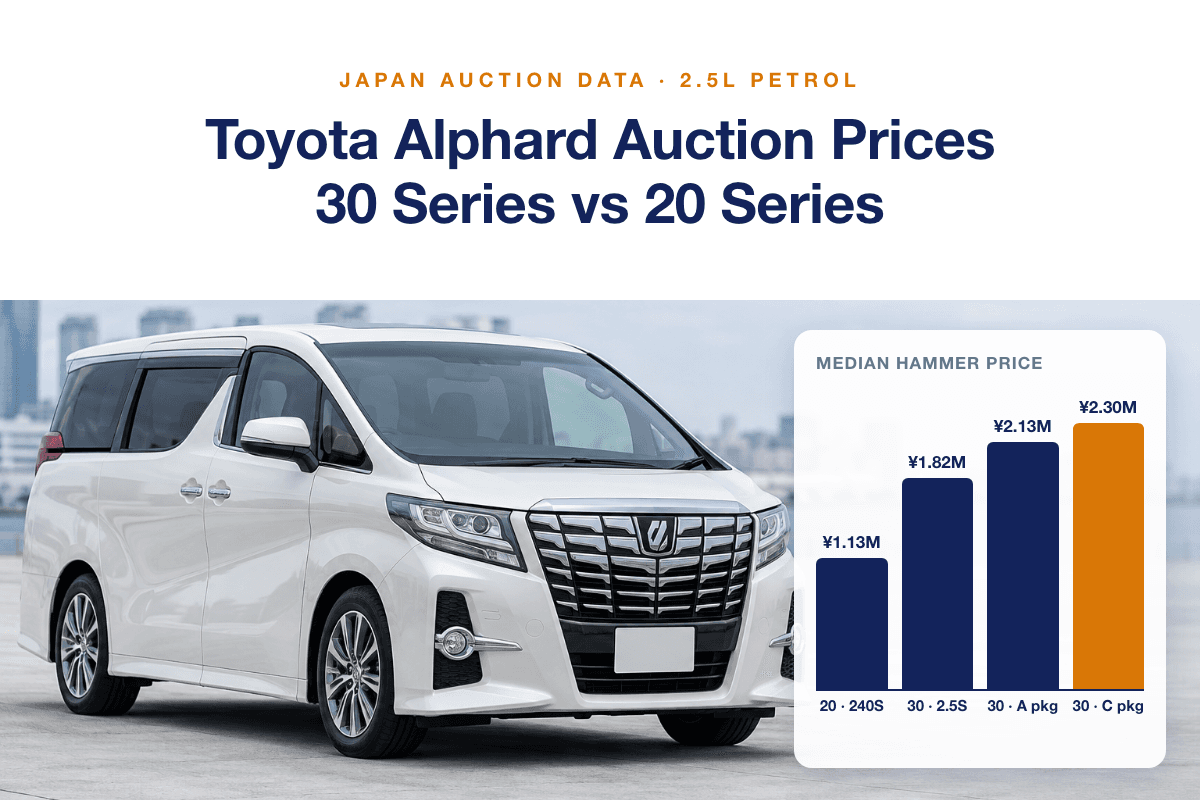

Ask a hotel fleet manager in Dubai, a charter operator in Bangkok or a wedding-car company in Nairobi what they want next from Japan, and one nameplate comes up again and again: the Toyota Alphard. We are AUTO-X, the export brand of MOBIC Co., Ltd., a licensed Japanese used-vehicle exporter in Tokyo (licence No. 431310063715), and the Alphard is one of the vehicles our buyers ask us to source at auction most often. What follows is the same advice we give our own customers before they put money on one.
Why the Alphard Owns the VIP Lane#
Japan builds a lot of minivans, but the Alphard was designed from day one as a first-class cabin on wheels. The second row is the whole point: captain seats with ottomans, generous legroom, a hushed cabin, twin power sliding doors and, in the top grades, seats that would not look out of place in a business jet. Japanese owners also tend to use them gently — school runs, golf weekends, company shuttle duty — so auction-grade Alphards routinely arrive with clean interiors and complete service records. That combination of genuine luxury and Japanese maintenance culture is exactly what executive-transport operators abroad are paying for.
Four Generations, Four Very Different Vans#
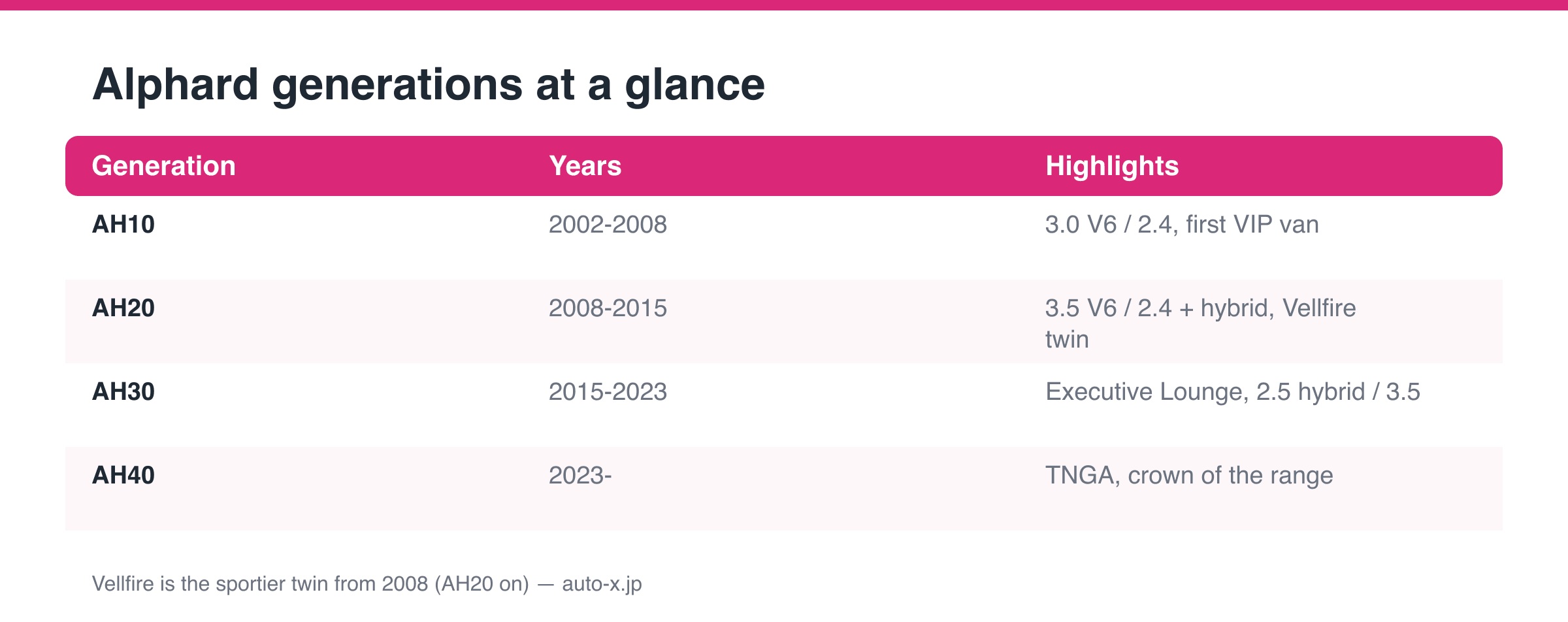
AH10 (2002–2008). The original. A 2.4-litre four-cylinder or a 3.0 V6, plus an early hybrid variant. Most survivors now carry high mileage and the cabins feel their age, but a clean AH10 is still the cheapest ticket into Alphard ownership.
AH20 (2008–2015). Sharper styling, a 2.4 or a 3.5 V6, and the debut of the Vellfire — the mechanically identical twin sold through Toyota's Netz dealer network. Auction supply is enormous, which keeps prices honest. This is the sweet spot for budget-focused buyers in Africa and Southeast Asia.
AH30 (2015–2023). The generation that turned the Alphard into a global status symbol. A 2.5-litre four, a 3.5 V6 and the hybrid E-Four, crowned by the Executive Lounge grade with its aircraft-style second row. When a client says "VIP", this is usually what they mean.
AH40 (2023–). The current platform: stiffer, quieter, hybrid-led and even more focused on the rear passengers. Used supply is still thin in Japan and prices reflect that.
Alphard or Vellfire — Does the Badge Matter?#
From 2008 onward the Alphard and Vellfire are the same van underneath. The Alphard wears elegant chrome and targets a conservative buyer; the Vellfire is the aggressive-looking twin aimed at younger owners. In most export markets the Alphard badge carries stronger recognition and resale value, so demand concentrates on it — and that is precisely why an identically specified Vellfire will sometimes hammer for less on auction day. If your passengers care about the seats rather than the grille, a Vellfire can be quiet value. When a client sends us a target spec, we bid on both.
Engines: 2.4, 2.5, the 3.5 V6 and Hybrid E-Four#
- 2.4 / 2.5 petrol four-cylinder — the workhorse choice. Adequate performance, the cheapest to run, and usually the friendliest engine size for import duty.
- 3.0 / 3.5 V6 — effortless and near-silent, the way an Alphard "should" feel with eight people aboard. The 3.5 in the AH20 and AH30 is the engine Gulf buyers love, but it is thirstier.
- Hybrid E-Four — a petrol engine up front and an electric motor driving the rear axle, giving all-wheel drive and strong city fuel economy. Attractive wherever fuel is expensive, provided the battery checks out.
One warning we repeat constantly: many countries band import duty by engine displacement, and a 3.5 V6 can land a full band above a 2.5 — in some markets that difference wipes out the V6's price advantage entirely. Confirm your duty band before you fall in love with the V6.
The Executive-Transport King: Gulf, Southeast Asia, Africa#
In the Gulf, the Alphard is the default airport-VIP and hotel shuttle — black or white Executive Lounge cars with tinted glass. If you are shipping to Dubai or elsewhere in the Emirates, our import to UAE guide walks through the process end to end. Across Southeast Asia the Alphard is a status symbol in its own right, helped by right-hand-drive compatibility in Thailand, Malaysia and Indonesia. In East and Southern Africa, vehicle-age rules shape the choice: markets with an eight-year limit tend to absorb late AH30s, while others take AH20s for hotel and charter work. And if the budget will not stretch to an Alphard at all, its smaller siblings are covered in our Toyota Noah & Voxy guide.
Our Auction Checklist Before We Bid#
- Power sliding doors. Cycle both doors fully, several times. Straining, slow or noisy motors are a known wear item on high-use vans, and replacements are not cheap.
- Hybrid battery. We look for warning lights, weak electric assist on the test course and gaps in the service record. A tired pack changes the economics of a cheap hybrid.
- Executive interior wear. On 7-seat Executive and Executive Lounge cars, the ottoman leather, seat rails and second-row electronics drive the price more than mileage does. Buyers pay for that second row — inspect it hardest.
- Rear air conditioning. A VIP van with a weak rear blower is not a VIP van. We test it at full load.
- The auction sheet. Grade, repair marks and accident history — we translate and explain the sheet for every vehicle before bidding.
- The duty math. For V6 cars, we re-check the destination's displacement bands before recommending a purchase.
What Alphards Actually Cost FOB Japan#
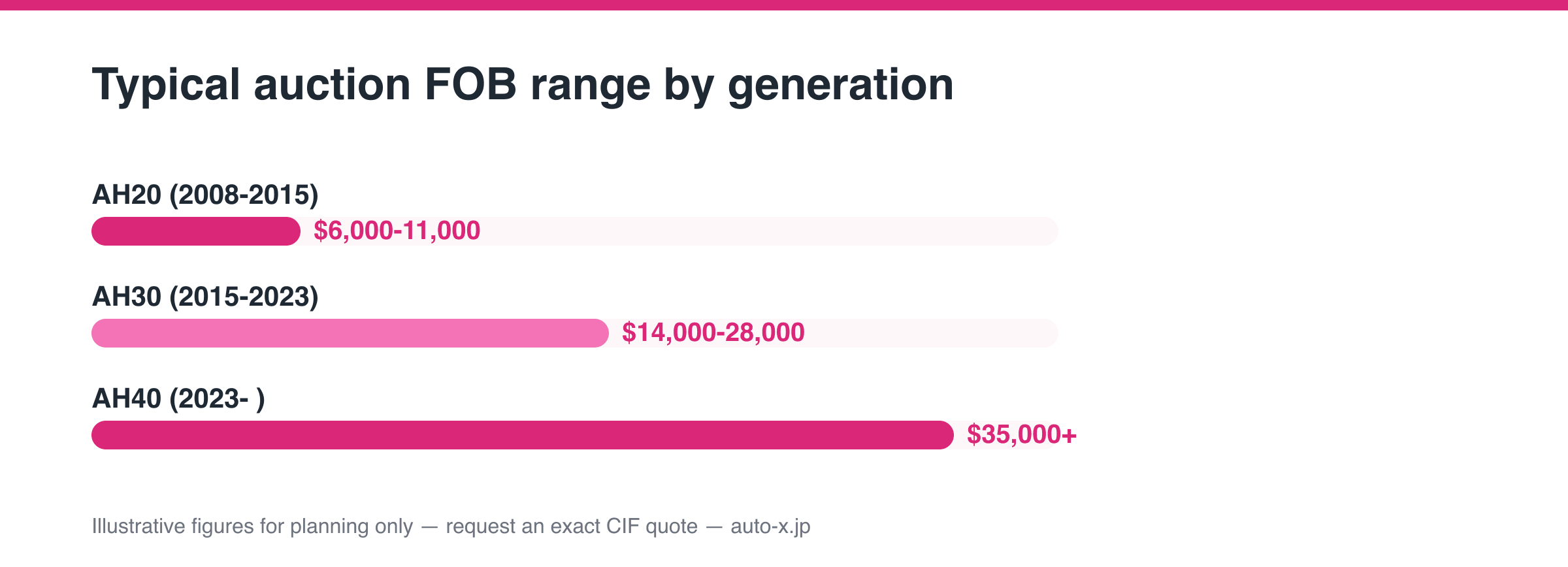
Illustrative FOB ranges we currently see at auction: an AH20 at roughly $6,000–11,000, an AH30 at $14,000–28,000 with Executive Lounge cars at the top of that band, and AH40s from about $35,000 upward. Hybrids, low-mileage units and high auction grades command premiums, and the yen exchange rate moves everything. Treat these as illustrative and ask us for live pricing on your exact spec.
FAQ#
Which generation is best for a shuttle or hire business? For pure economics, a good AH20: huge parts supply, simple engines and low buy-in. If your customers pay VIP rates, an AH30 Executive Lounge earns its premium back in what you can charge.
Is the hybrid worth exporting? In markets with expensive fuel and city-heavy driving, yes — the E-Four also adds all-wheel drive. But only with a verified battery. Where fuel is cheap, the petrol V6 is the simpler ownership proposition.
Are Vellfires really cheaper than Alphards? Often slightly, for identical spec, because overseas demand concentrates on the Alphard badge. Underneath they are the same vehicle, so a Vellfire can be a smart arbitrage buy.
Ready to put an Alphard on the water? Browse our vehicles to see what we have in stock, or send us your target generation, grade and destination port and request a free CIF quote — we will price your exact spec, duty band included.