
When Japanese families outgrow a hatchback, the next stop is almost always a Noah or a Voxy. Toyota has built these twin sliding-door minivans on the same production line since 2001, and Japan's roads are full of them — which means the auctions we bid at every week are full of them too. For export buyers that is very good news: huge supply, honest family-owned service histories, and a body style that works just as well as a shuttle in Kampala or a school-run van in Kingston as it did on the streets of Yokohama.
This guide covers what actually separates a Noah from a Voxy (less than you think), how the four generations differ, and exactly what our inspectors check before we bid on one for a customer.
One Van, Two Grilles: What Actually Separates Noah and Voxy#
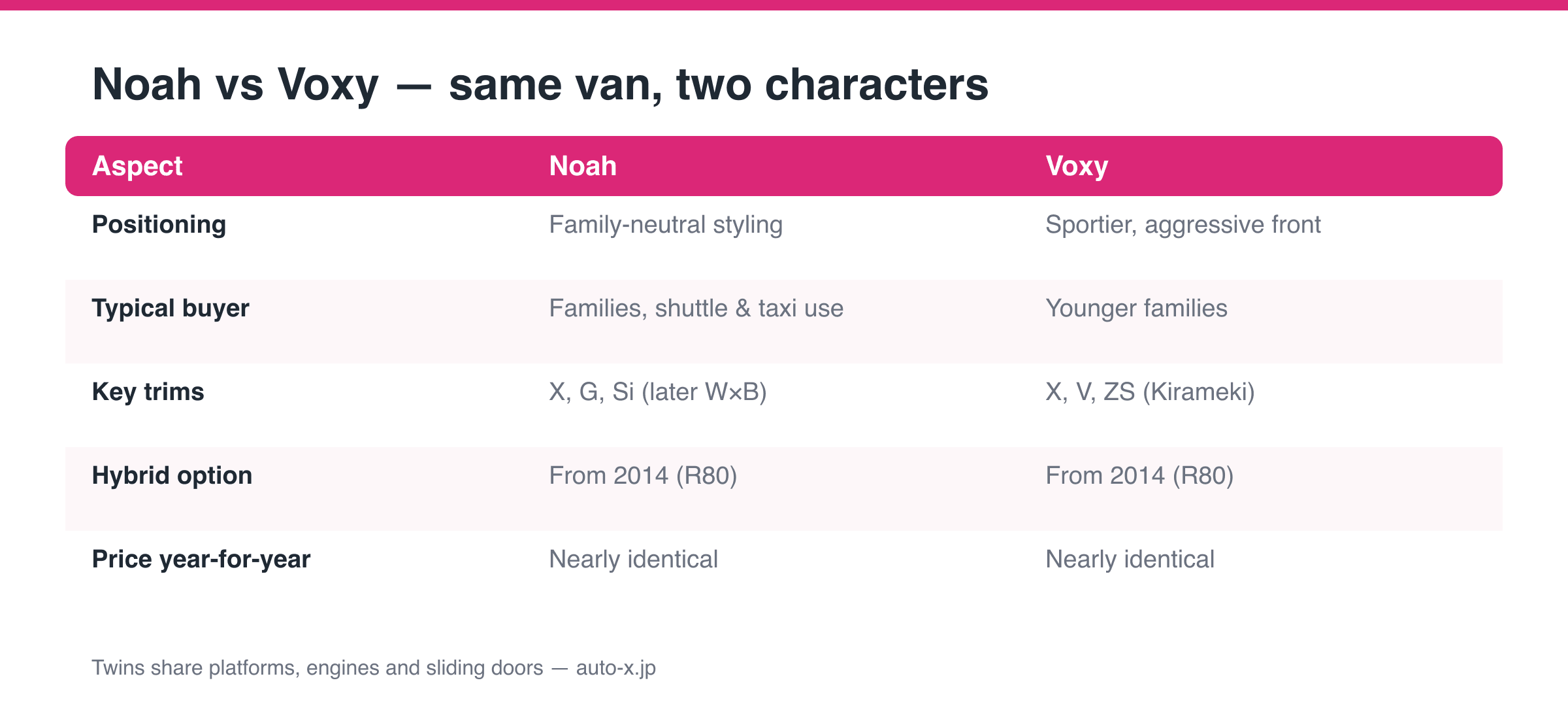
Mechanically, nothing separates them. The Noah and Voxy share the same platform, the same engines, the same gearboxes and the same body shell. The differences are cosmetic and deliberate: Toyota sold the Noah through one dealer network with a softer, family-friendly face — usually a chrome-heavy grille — and the Voxy through another with a darker, sportier front end aimed at younger fathers.
Trim names follow the same split. Noah buyers typically choose between X, G and the sporty Si; Voxy buyers between X, V and the aggressive-looking ZS. The Si and ZS aero trims carry body kits and alloy wheels, and they hold their value best at auction.
Our advice after years of exporting both: ignore the badge. Buy on condition, mileage and price. Resale values in most destination markets are near-identical, so when two similar vans cross the auction block in the same week, we simply bid on the better-kept one.
Four Generations, Twenty-Plus Years#
R60 (2001–2007). The first generation to carry the Noah/Voxy names on this platform. A 2.0-litre petrol with a conventional automatic — tough and simple. These are now the cheapest way into an 8-seat Toyota with sliding doors, and plenty are still working as shared taxis across East Africa.
R70 (2007–2014). Roomier, more refined, and the generation that introduced the 3ZR 2.0 petrol paired with a CVT. This is the sweet spot for budget buyers today: modern enough to feel current, old enough to be genuinely affordable.
R80 (2014–2021). A lighter body, a low flat floor, and — the big one — the first hybrid, a 1.8-litre system derived from the Prius. Seven- and eight-seat layouts, with power sliding doors widely available. The R80 hybrid is our most-requested configuration for city shuttle work.
R90 (2022–present). Built on Toyota's TNGA platform with a newer 2.0 petrol and an updated 1.8 hybrid, plus Toyota Safety Sense as standard. Still fresh, still expensive, and mostly bought by customers replacing an R80 they already trust.
Petrol 3ZR or 1.8 Hybrid: Which Should Leave Japan With You?#
The 3ZR 2.0 petrol (R70 and R80) is a chain-driven, unremarkable, thoroughly proven engine. It asks for nothing but oil changes and runs happily on regular fuel. Paired with the CVT it returns reasonable economy, and any Toyota-literate mechanic can service it — which is most mechanics in Africa, Asia and the Caribbean.
The 1.8 hybrid (R80 onward) uses Toyota's familiar Prius-family system with an e-CVT. In stop-start city traffic — exactly the duty cycle of a hotel shuttle or airport van — fuel savings are substantial. The trade-off is the high-voltage battery, which we address in the checklist below. Our rule of thumb: hybrid for cities and fleets with dealer access, petrol for upcountry and remote routes.
Why These Vans Keep Filling Containers#
Eight seats behind sliding doors is the simple answer. In crowded markets, school pickups and narrow taxi ranks, sliding doors do not clip the vehicle parked next to you — a feature drivers appreciate every single day. The floor is low, so elderly passengers step in rather than climb in. Fold the seats and there is a flat load bay that swallows luggage, produce or market stock.
Compared with a Toyota Hiace, the Noah/Voxy is more car-like to drive and cheaper to fuel, though it carries fewer passengers. Compared with an Alphard, it does 80% of the job at half the price. That middle position — family comfort, commercial usefulness — is exactly why demand from Kenya, Uganda, Tanzania, Sri Lanka, Pakistan, Guyana and Jamaica never slows down.
If you want to see what is available this week, browse our vehicles — Noah and Voxy stock rotates quickly.
What We Check at Auction Before We Bid#
These are the checks our inspectors run on every Noah/Voxy, beyond the standard auction-sheet review:
Power sliding-door motors. We cycle both doors from the dashboard switch, the key fob and the handles. A door that hesitates, grinds or needs a hand to finish closing means a worn motor or cable — a repair worth pricing in before, not after, shipping.
CVT behaviour. On R70 and R80 petrols we look for shudder on gentle acceleration and note whether fluid service appears in the history. A healthy CVT is smooth and quiet; judder at low speed is a walk-away signal at the prices these vans should sell for.
Hybrid battery health. On R80/R90 hybrids we check for warning lights, watch the charge/discharge behaviour on the energy monitor, and read the auction sheet for battery-related notes. Batteries can be replaced, but the cost must be in the purchase math from the start.
Rear air-conditioning. Most of our Noah/Voxy customers are in tropical countries, so we confirm the rear vents actually blow cold — not just the fronts. A failed rear evaporator is a common and annoying fault on well-used family vans.
The usual fundamentals. Auction grade and mileage verification, underbody rust on vans from snow-country prefectures, and interior wear — these were family cars, so we check seat rails, third-row condition and sliding-door tracks for the debris of a decade of school runs.
What You Should Expect to Pay#
Illustrative FOB ranges we currently see at auction, before freight and insurance:
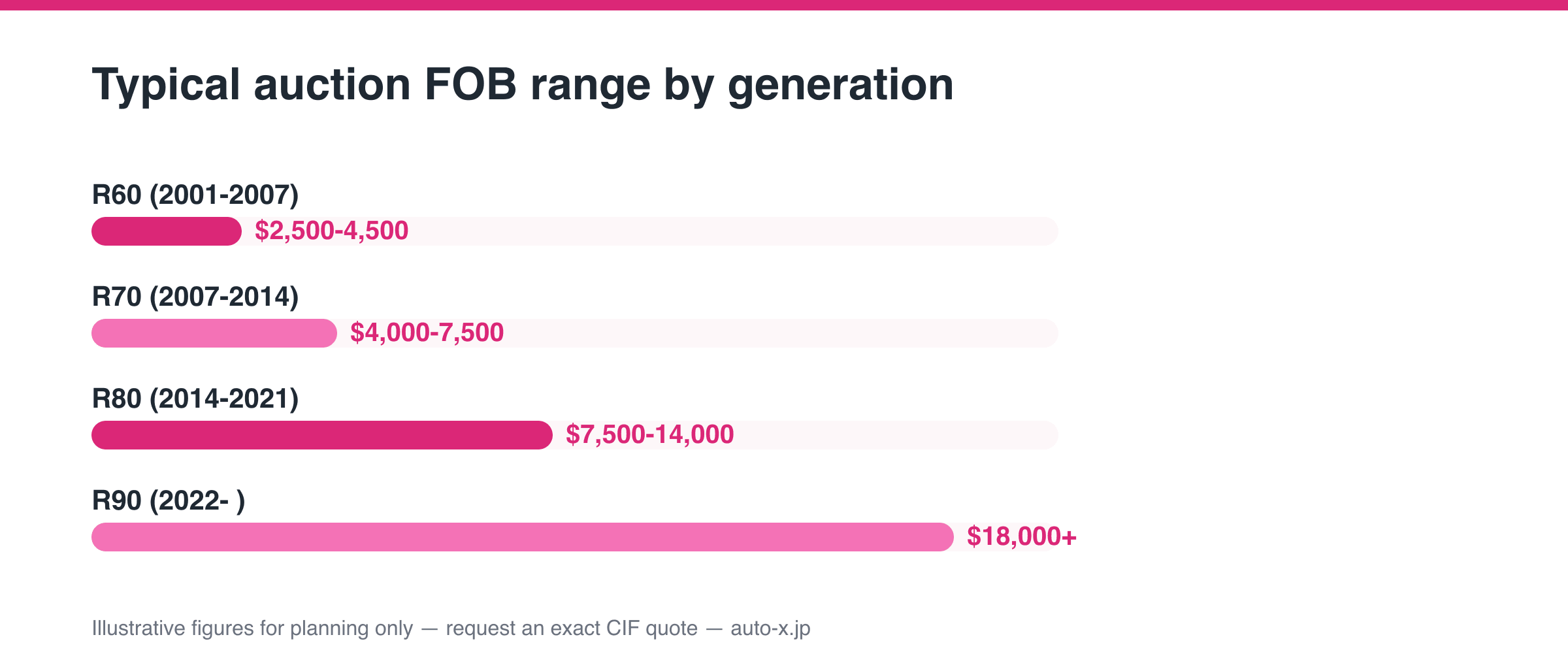
- R60: roughly $2,500–4,500
- R70: roughly $4,000–7,500
- R80: roughly $7,500–14,000 (hybrids and Si/ZS aero trims at the top)
- R90: from around $18,000
Grade, mileage, hybrid versus petrol and the aero trims move prices inside those bands. Treat the figures as a planning guide, not a quote — auction prices move week to week, and your final CIF cost depends on your port.
FAQ#
Noah or Voxy — which one should I import? Whichever example is in better condition. They are mechanically identical; only the styling and trim names differ. We regularly recommend a Voxy to a customer who asked for a Noah (and vice versa) simply because the better van that week wore the other badge.
Is the hybrid battery a risk on an older R80? It is a factor, not a dealbreaker. We screen battery condition before bidding, and replacement batteries are available if one eventually fades. If your van will work far from a city with hybrid-capable mechanics, the 3ZR petrol is the lower-maintenance choice.
Seven seats or eight — what is the difference? Eight-seaters use a second-row bench (maximum capacity, best for taxi and shuttle work); seven-seaters use two captain chairs (more comfort, popular with families). Both fold to a flat load floor.
Ready to Source Yours?#
We inspect Noah and Voxy vans at auction every week and ship them worldwide from Japan. Tell us your budget, preferred generation and destination port, and request a free CIF quote — we will reply with real landed numbers within one business day.