
Some cars need a sales pitch; the Toyota Harrier has never been one of them. Buyers in Nairobi, Kampala, Colombo and across the Caribbean contact us asking for it by name, and after years of loading Harriers into containers we understand exactly why. It carries the design and cabin quality of a Lexus, the running costs of a Toyota, and Japan's domestic auctions keep supplying well-kept, garage-stored examples every single week. What follows is the same advice we give our own customers before we bid on their behalf: how the generations differ, what actually goes wrong, and what realistic money looks like.
One Nameplate, Two Badges: The Harrier and the Lexus RX#
You cannot talk about the Harrier without talking about the Lexus RX, because for the first two generations they were the same vehicle wearing different badges. When Toyota launched the Harrier in Japan in late 1997, the identical car went overseas as the Lexus RX 300. The second generation repeated the arrangement as the RX 330 and later RX 350, and the Harrier Hybrid was the domestic twin of the RX 400h.
The split came later. Lexus arrived in Japan as a standalone brand in 2005, and from the third-generation Harrier of 2013 the two lines finally parted ways: the RX moved upmarket onto its own larger platform, while the Harrier remained a Japan-focused model with its own body, pricing and character.
For an export buyer this history has two practical consequences. First, parts: a great deal of early Harrier running gear interchanges with the RX, and any Toyota specialist from Mombasa to Bridgetown already knows how to service it. Second, image: you are getting genuine Lexus-grade engineering at a Toyota auction price — which is precisely why the Harrier became the value-for-status champion it is today.
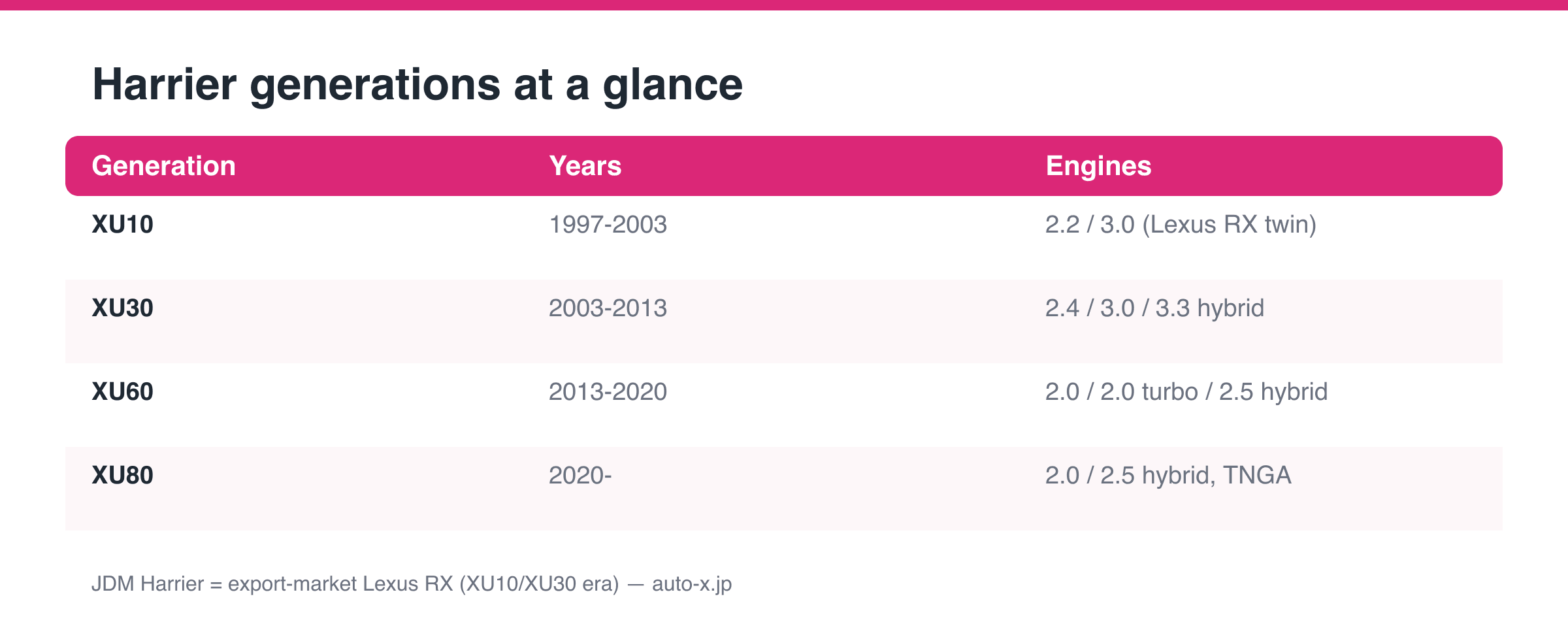
The Four Generations at a Glance#
Here is the family tree, followed by our notes from the auction floor.
XU10 (1997–2003): the original#
The first Harrier offered a four-cylinder (2.2, later 2.4 litres) or a smooth 3.0 V6, in front- or all-wheel drive. These cars are now well over twenty years old; a cherished example can still make a charming budget buy, but most of what we see at auction is showing its age. If you go this route, budget for suspension bushings and check the underbody carefully for rust.
XU30 (2003–2013): the long-runner#
The twin of the RX 330 stayed in production in Japan for a full decade, which means deep supply today. Engines were a 2.4 four-cylinder, a 3.0 V6 and — from 2005 — the Harrier Hybrid, pairing a 3.3-litre V6 with an electric rear motor for all-wheel drive. Because the run ended as late as 2013, a final-year XU30 can be a surprisingly fresh car for the money, and it remains the default choice for buyers who want the Harrier look on a tight budget.
XU60 (2013–2020): the independent Harrier#
The first Harrier developed purely for the Japanese market, and in our view the sweet spot of the range right now. The line-up covered a 2.0 petrol, a 2.5 hybrid and, from 2017, a punchy 2.0 turbo. The interior took a big step upmarket, and popular options — the panoramic roof above all — matter for both resale value and inspection, as we explain below.
XU80 (2020–): the TNGA flagship#
The current Harrier sits on Toyota's TNGA platform and feels a class above its price: coupé-like roofline, large touchscreen, an available digital rear-view mirror and an efficient 2.5 hybrid. Auction supply is growing as first owners trade in, but this is still premium money.
Why the Harrier Owns the Status Lane in Kenya, Uganda, Sri Lanka and the Caribbean#
Every market has its "you have arrived" car. Across East Africa, South Asia and the Caribbean, that car is very often a Harrier, and the reasons are as practical as they are about image:
- Lexus presence at a Toyota price. The chrome hawk emblem, the coupé stance and the hushed cabin read as premium everywhere in the world.
- The right ride height for real roads. Comfortable on tarmac, composed enough on rough urban surfaces and unpaved stretches.
- Toyota serviceability. Mechanics know the platform, and parts flow through the same channels as the Camry, RAV4 and RX.
- Hybrids suit expensive fuel. Where petrol prices bite, the 2.5 hybrid makes daily driving genuinely affordable.
- Import rules line up. Kenya's age limit currently puts the XU60 squarely in the import window — see our import to Kenya guide for the full process.
- Right-hand drive. Kenya, Uganda, Sri Lanka and much of the Caribbean drive on the left, so JDM stock fits with no conversion.
What We Check Before We Bid: Our Harrier Checklist#
1. Hybrid battery health. Age and usage pattern matter more than the odometer reading. Where we can, we road-test the car and watch how the battery cycles; a dust-clogged cooling vent beside the rear seat hints at overheating in the car's past. Toyota hybrid packs are among the most affordable to replace or refurbish anywhere, simply because so many exist — but you want to know the battery's state before you buy, not after.
2. AWD or 2WD? A large share of domestic Harriers are front-wheel drive. For city driving in Colombo or Kingston, 2WD is perfectly adequate and cheaper to buy and run. For up-country Uganda in the rainy season, we steer clients to AWD. Note that hybrid all-wheel drive is Toyota's E-Four system — an electric rear motor with no propeller shaft — so have it verified as working during inspection.
3. The XU60 panoramic roof. A desirable option that lifts resale, but its drain channels clog with debris, and blocked drains send water into the headliner. We check for water stains on the roof lining and pillar trim, a musty smell, and any corrosion notes on the auction sheet.
4. Service history. Japanese domestic cars frequently come with stamped service books and dealer records — insist on seeing them. The auction sheet is your first line of defence; if you are new to them, read our guide on how to read an auction sheet before bidding on anything.
5. Grade versus mileage. Condition should match the odometer. A "low-mileage" car with a shiny-worn steering wheel and a collapsed driver's seat bolster is telling you a different story — walk away.
What a Harrier Really Costs#
Auction prices move week to week with exchange rates and season, so treat the following FOB bands as illustrative rather than a quotation. They reflect what clean, mid-grade cars have typically been fetching through our channel:
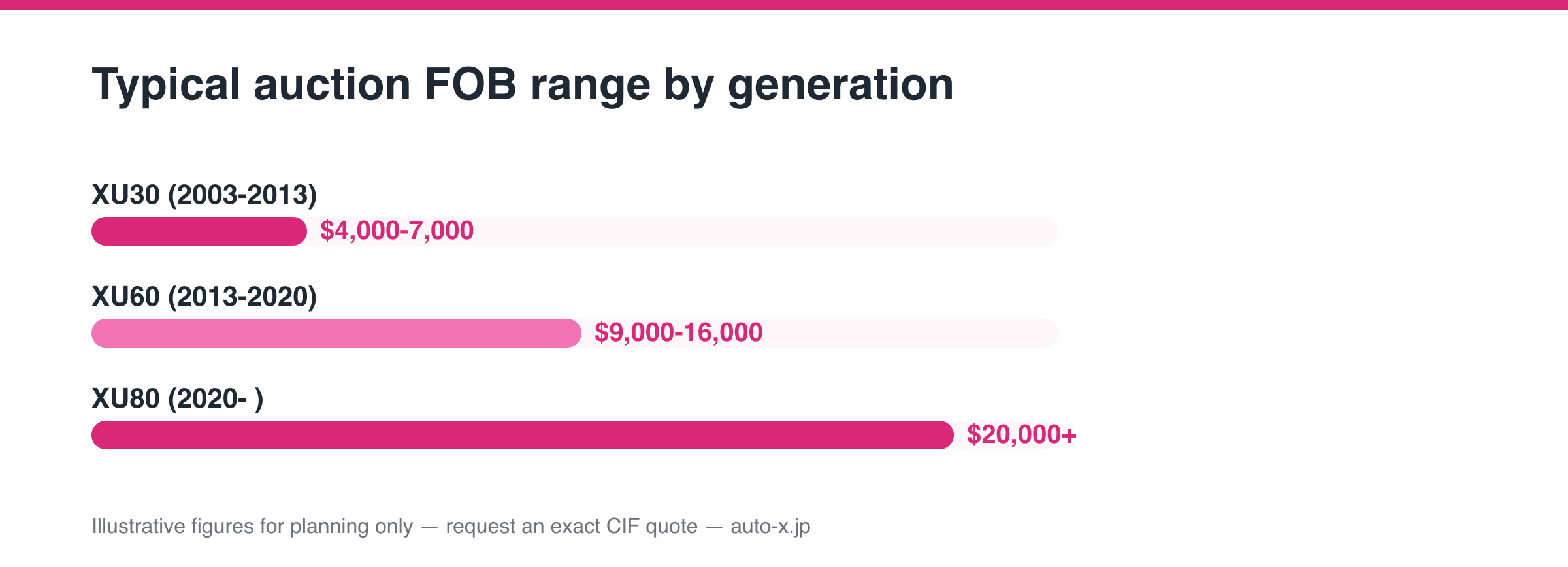
- XU30: roughly $4,000–7,000 FOB — the affordable entry into Harrier ownership.
- XU60: roughly $9,000–16,000 FOB depending on year, engine and grade, with hybrids and turbos at the top of the band.
- XU80: from about $20,000 FOB and climbing for late hybrids in high grades.
On top of FOB you add ocean freight, marine insurance and your country's duties and taxes, which vary enormously by destination and engine size. The only honest way to compare offers is a full CIF calculation for your port — something we prepare free of charge. In the meantime you can browse our vehicles to see current Harrier stock with photos and auction sheets.
FAQ#
Should I import a Harrier or a Lexus RX? For pre-2013 cars they are mechanically the same vehicle. The Harrier was the domestic version, so Japanese supply is deeper and prices are generally lower; the RX badge simply costs more. From 2013 onward they are genuinely different vehicles, with the RX larger and considerably more expensive.
Are hybrid Harriers a risky buy? Not when inspected properly. Toyota's hybrid system is one of the most proven drivetrains on the road, and replacement and refurbished packs are widely available worldwide. The real risk is buying a neglected example sight unseen — which is exactly what a pre-bid inspection prevents.
Which generation is the best value right now? For most of our clients, the XU60. It still looks current, fits Kenya's age limit, offers hybrid economy, and sits in a price band that is hard to beat for the years of service left in it.
Ready to Source Yours?#
As a licensed Japanese exporter (licence No. 431310063715), we inspect, bid on and ship Harriers for clients every month. Tell us your budget, your port and whether you want hybrid or petrol, and request a free CIF quote — we will come back with real cars and a complete landed-cost breakdown.