Odometer fraud — winding a car's displayed mileage back so it looks younger than it really is — is one of the oldest tricks in the used-car trade, and it is the single question we hear most often from first-time importers: "How do I know the kilometres are real if I can't see the car?"
The honest answer has two parts. First, if a car comes out of Japan's wholesale auction system, tampering is far harder to get away with than in most markets, because the mileage is recorded by independent inspectors before the car is ever offered for sale. Second, you should never rely on that alone. Real mileage can — and should — be verified through several independent layers of evidence, and a professional exporter will hand you most of them without being asked.
This guide explains how the Japanese system protects you, walks through the five verification layers we apply at AUTO-X on every car we ship, and lists the red flags that should make you walk away from an unknown seller.
Why Japan's auction system leaves little room for tampering#
Almost every export-quality used car in Japan passes through a wholesale auction. Before a car crosses the block, an auction-house inspector — who works for the auction, not for the seller — examines it and writes the odometer reading onto the auction sheet. That reading becomes part of the car's permanent record inside the auction network.
Two notations matter for mileage:
- The "$" mark — the odometer has been replaced or repaired, so the displayed figure does not tell the whole story.
- 走行不明 ("mileage unknown") — the inspector could not confirm the reading is genuine, usually because the history is inconsistent. Cars flagged this way sell at a clear discount, and the flag follows the car.
Because a suspicious reading destroys a car's auction value, and because auction databases retain earlier readings, there is a built-in economic penalty for tampering inside the system. The risk appears after the auction — in the retail and export chain — which is exactly where your own verification comes in.
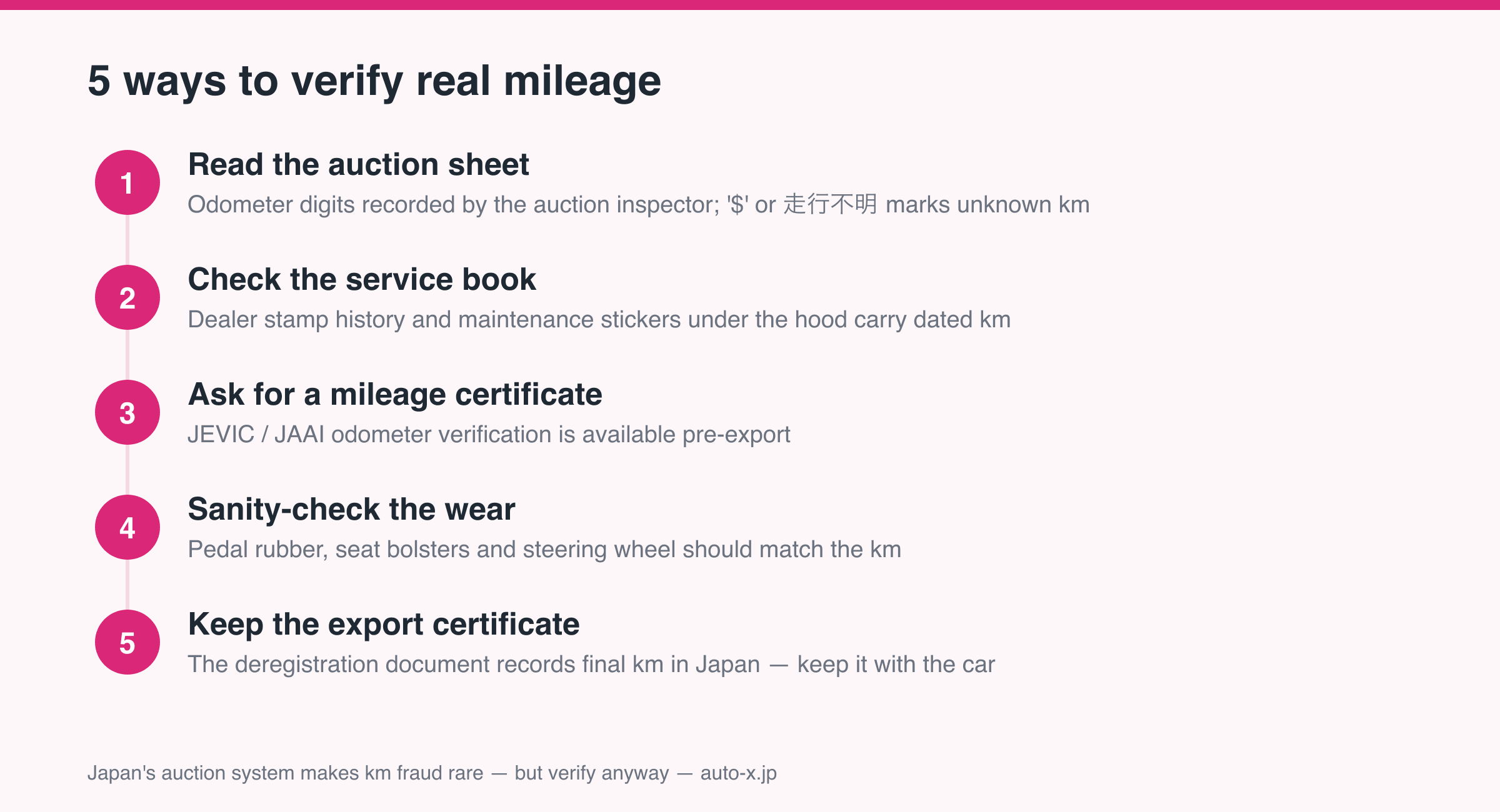
Layer 1: read the odometer line on the auction sheet#
The auction sheet is the anchor document. It states the odometer reading at inspection (usually in thousands of kilometres), the overall grade, and any "$" or mileage-unknown flags. When you receive a car's sheet:
- Check that the listing figure matches, or sits slightly above, the sheet — the car may be driven a short distance after inspection, never the other way round.
- Ask for a photo of the instrument cluster and compare it to the sheet.
- Make sure the mileage box is clean: no "$", no 走行不明, unless the price openly reflects it.
If auction sheets are new to you, start with our guide on how to read an auction sheet — it covers every symbol and grade.
Layer 2: the service book and maintenance stickers#
Japanese cars usually carry a maintenance record book (整備手帳) stamped at each shaken roadworthiness inspection with the date and the kilometres at that moment. Many also keep oil-change stickers inside the door jamb or on the windscreen, again with a date and a km figure.
Read these as a timeline. The kilometres should climb steadily and end below the current reading. A service stamp from a few years ago that shows more kilometres than the car displays today is the classic signature of a rollback — no further testing needed.
Layer 3: a third-party odometer certificate (JEVIC / JAAI)#
Independent inspection bodies such as JEVIC and JAAI issue odometer verification certificates: they cross-check the auction record, the registration history and the physical condition of the car, then certify the mileage as genuine. Several import markets require such a certificate before registration; in every other market you can simply request one.
This is the strongest single piece of paper you can hold, because it is issued by an organisation with no stake in the sale. See our pre-export inspection page for what these inspections cover and which destinations mandate them.
Layer 4: the wear points don't lie#
Documents can, in theory, be forged. Consistent physical wear across a whole interior is much harder to fake. On any car you are considering, look at — or ask for fresh close-up photos of:
- Pedal rubbers — a genuine 40,000 km car still has crisp tread on the pedals.
- The driver's seat bolster — the outer edge you slide across every time you get in wears first.
- The steering wheel rim and gear knob — smooth, shiny patches mean many hours of hands on them.
- Floor mats and the carpet under the driver's heel.
Any one item can be replaced. All of them replaced at once on a "low-mileage" car is itself a warning sign. What you want is a coherent picture: the wear should look like the kilometres claim.
Layer 5: the export certificate's km record#
When a car is deregistered for export, the Japanese government issues an export certificate (輸出抹消仮登録証明書). It carries the odometer reading captured in the official registration record — figures logged at roadworthiness inspections over the car's life. This is a state document, not a seller's claim, and it is the paper your destination customs and registration authority will see. The reading on it should sit comfortably in line with everything above.
What an honest exporter gives you without being asked#
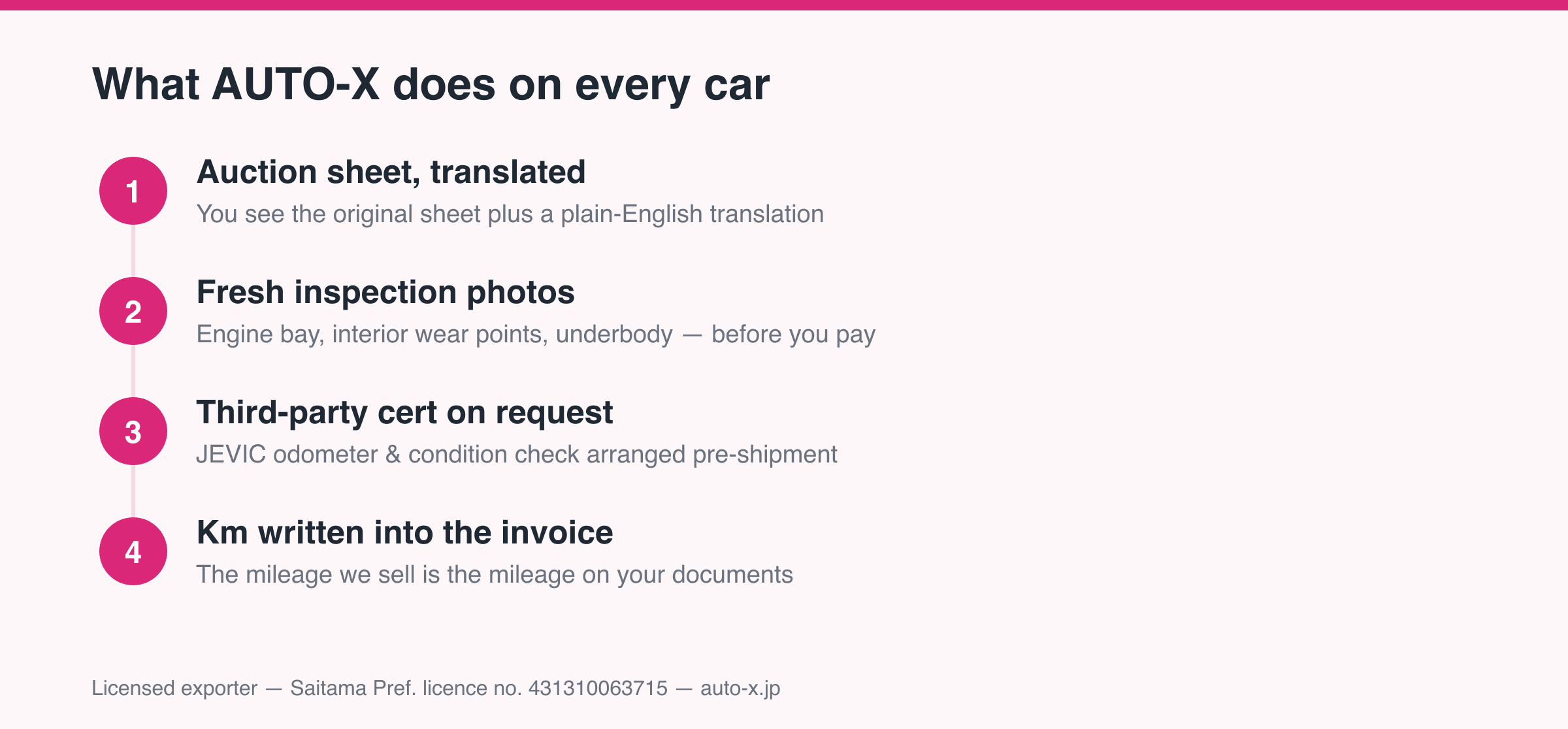
You should not have to fight for any of this. On every vehicle we sell, AUTO-X — operated by MOBIC Co., Ltd., Tokyo, a licensed secondhand dealer (Saitama Pref. licence No. 431310063715) — provides as standard:
- the original auction sheet with a full translation, flags included;
- fresh inspection photos taken after purchase, including the instrument cluster and the wear points listed above;
- a JEVIC odometer certificate on request, at cost, for any destination;
- the mileage written into the sales invoice, so the figure you were promised is part of the contractual record you pay against.
If a seller cannot match that list, ask why. You can read more about who we are on the about AUTO-X page.
Red flags when buying from an unknown seller#
- No auction sheet — "lost", "confidential", or only a cropped corner shown. The sheet exists for any auction-sourced car.
- Listing mileage that doesn't match the cluster photo, or photos with the cluster carefully out of frame.
- A fleet of older cars all advertised with implausibly similar low mileage.
- No verifiable company identity — no physical address in Japan, no dealer licence number, no company registration.
- Payment pressure toward personal bank accounts or untraceable channels — a separate scam pattern we cover in the safe payment guide.
- Refusal of a third-party inspection. An honest exporter has nothing to lose from a JEVIC check; a dishonest one has everything.
FAQ#
Can an auction sheet itself be faked?#
Forged and "improved" sheets do circulate, which is why you should ask the exporter for the auction house name and lot number. A genuine sheet can be re-verified against the auction system's own record. A seller who volunteers those details is inviting scrutiny — a good sign.
Is a "$" mark always a deal-breaker?#
No. It means the odometer was replaced or repaired, so the displayed figure alone is not the full history. Such cars are honestly sold as mileage-unverified and priced accordingly. The problem is not the mark — it is a seller who hides it and advertises the car as genuine low-km.
Do I need a JEVIC certificate if my country doesn't require one?#
Strictly, no — but for the modest cost involved it is the cheapest insurance available on a four-figure purchase, especially if you are buying from an exporter for the first time.
Every kilometre on an AUTO-X car is documented from the auction hall to your invoice. If you'd like a specific vehicle checked and priced to your port, request a free CIF quote — we'll include the auction sheet translation with our reply.