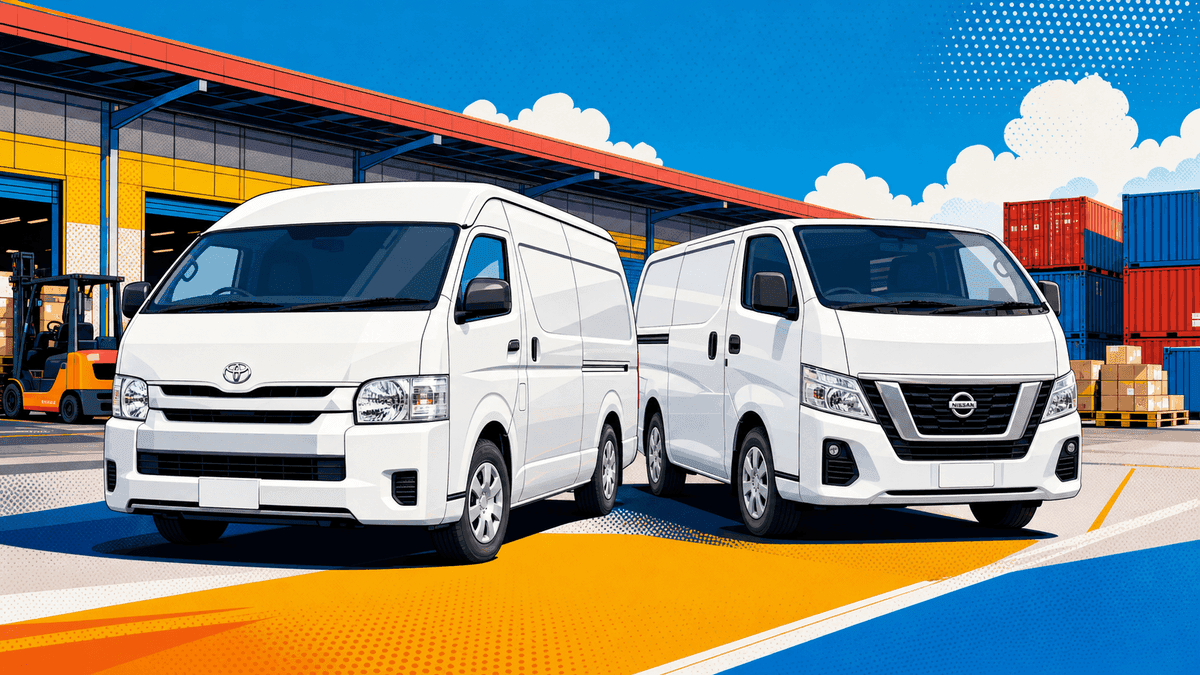
Quick verdict: if your market has an established Toyota parts ecosystem — and that covers most of Africa, the Caribbean and Southeast Asia — buy the Toyota Hiace. It costs more at auction, but it sells faster and holds its value like nothing else in the van segment. If your buyers are purely price-driven and you can solve parts supply yourself, the Nissan Caravan (NV350) gives you close to the same van for meaningfully less money. We load both out of Japan every month; here is how we actually call it for our customers.
Reliability#
The Hiace H200, in production since 2004, is the reason "Toyota van" is shorthand for indestructible in half the world. The diesel and petrol engines are understressed, the drivetrain is over-built for the payload, and the body shrugs off the kind of overloading that would finish lesser vans. The proof is in the field: across East Africa the H200 is the standard matatu and shuttle taxi, running 300–500 km a day on rough roads with basic maintenance. Vans with 300,000 km on the clock change hands and keep working.
The Caravan E26 — sold as the NV350 from 2012 — is a genuinely solid van. The YD25 diesel is proven and the petrol QR-series engines are simple and understressed. Where we see problems on auction stock, it is almost always neglect: stretched oil intervals show up in the turbo and injectors first. Buy a clean auction-sheet example with service history and the E26 will work for years.
Bottom line: this is not "reliable versus unreliable." It is "legendary versus good."
Parts availability#
This is where most import decisions should actually be made, and it is the Hiace's strongest card. Because the H200 has been the global workhorse for two decades, every parts market from Nairobi to Karachi to Port Moresby stocks it: filters, clutches, suspension arms, body panels, glass, plus a deep pool of used engines and gearboxes. Aftermarket manufacturers copy every wear part, which keeps prices down.
The Caravan's overseas parts network is thinner. Service items — filters, pads, belts — are easy enough. But model-specific body panels, lamps and electrical parts often have to be ordered from Japan or the UAE, and a van that sits waiting for parts is a van that is not earning. If you run your own workshop and parts channel, this is manageable. If your end buyer is a single-vehicle operator, it is a real drawback.
Load & space#
On paper the two vans are closer than most buyers expect. Both offer long-wheelbase and high-roof bodies, similar cargo floor lengths, and payloads in the roughly one-tonne class depending on configuration. The NV350's cargo area is arguably the smarter design — wheel-arch intrusion is modest and the tie-down points are well placed. Seating conversions for shuttle work exist for both, though the Hiace's 15-seat Commuter variant has no direct high-capacity Caravan equivalent in most markets, which matters if you are buying for licensed passenger routes.
Running costs#
Day to day, fuel consumption is similar between equivalent diesel variants. The gap opens at the workshop: Hiace wear parts are cheaper almost everywhere because the aftermarket is enormous, and any roadside mechanic has done the job before. Caravan labor is no harder, but OEM-equivalent parts typically cost more landed, and downtime waiting for them is the hidden cost. Resale is the running cost people forget — a five-year-old Hiace gives back far more of your money than a five-year-old Caravan.
Auction supply & price#
Both vans appear at Japanese auctions every week — the Hiace in huge numbers, the Caravan/NV350 in steady supply. The price gap is consistent: at typical recent auction levels, an NV350 of equivalent year, mileage and grade hammers noticeably below a comparable Hiace DX — often the difference is enough to cover a good part of your freight. Treat any fixed price quoted online with suspicion; auction levels move with season and exchange rates, and we quote live. And always read the auction sheet, not the photos: van odometers work hard, and the grade and underbody notes tell the real story.
Hiace vs Caravan at a glance#
| Toyota Hiace (H200) | Nissan Caravan / NV350 (E26) | |
|---|---|---|
| Production | 2004–present | 2012–present |
| Reputation | Global benchmark | Solid, less proven abroad |
| Overseas parts | Everywhere, cheap | Thinner network, slower supply |
| Load capacity | ~1-tonne class | ~1-tonne class, similar |
| Auction price | Premium | Usually cheaper like-for-like |
| Resale value | Exceptional | Moderate |
Which one should YOU buy?#
- Matatu, shuttle and PSV operators (Kenya, Tanzania, Uganda, Zambia): Hiace, no debate. Parts, mechanics and resale all line up in your favor.
- Budget cargo fleets with their own workshop: Caravan. The purchase saving is real, and you can absorb the parts logistics.
- Traders buying to resell: Hiace. It turns faster and the margin is safer.
- Owner-operators in markets with Nissan coverage (Caribbean, parts of Asia and the Pacific): Caravan is honest value — same work, less capital.
FAQ#
Is the Caravan diesel as durable as the Hiace diesel?#
Well maintained, it comes close. The real-world difference is that a Hiace gets fixed cheaply anywhere on earth, while a Caravan may wait for parts. Durability on paper and uptime in service are not the same thing.
Why does the Hiace cost more at auction if the vans are so similar?#
Global demand. Exporters from a dozen countries bid on every clean H200, and that competition prices in the resale premium you will later collect in your own market. You are not overpaying — you are pre-paying for liquidity.
Which van resells faster in Africa?#
The Hiace, clearly. In most East African markets a clean H200 sells in days; a Caravan can sit until a price-hunter arrives. If your business model is buy–ship–sell, that velocity is worth more than the auction saving.
Ready to import?#
For a deeper model-specific breakdown, read our Toyota Hiace buyer's guide. We only accept bank-to-bank payment to our corporate account — see how payment works for our anti-fraud policy. When you are ready, request a free quote and we will send you current auction levels and a CIF estimate to your port, usually within 24 hours.