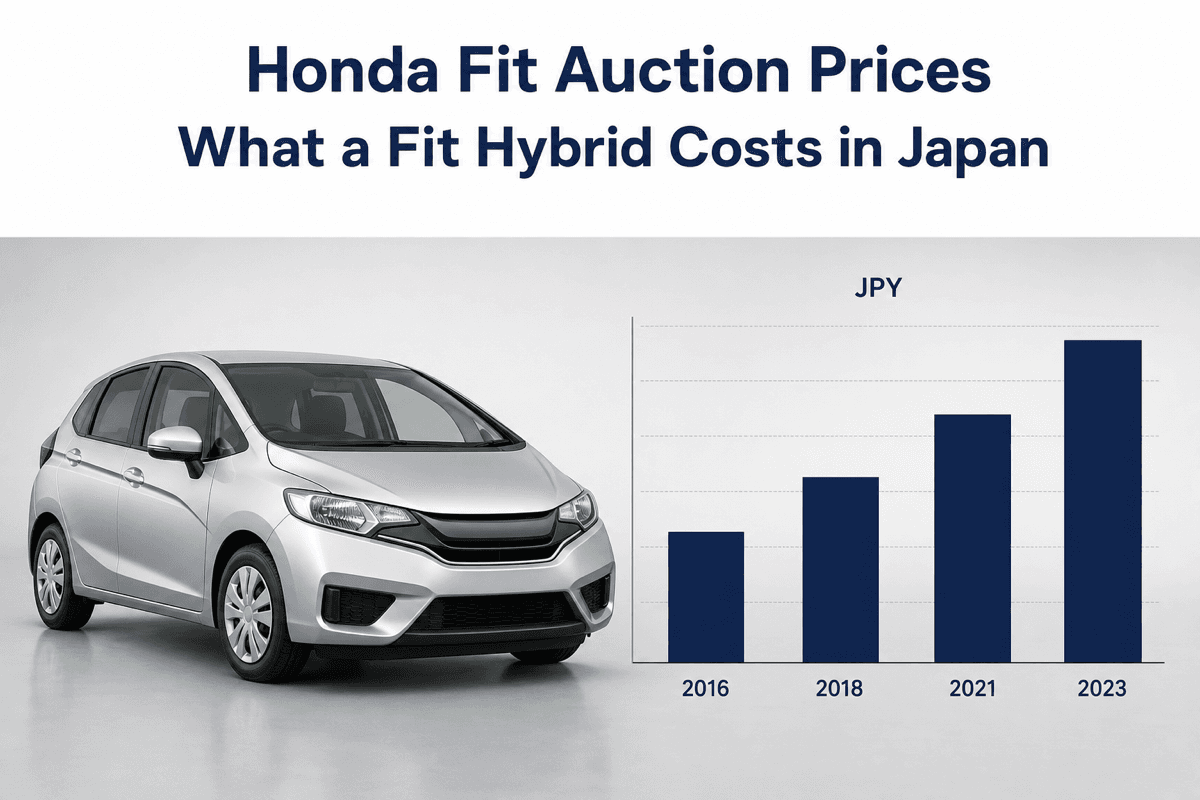
A clean 2017 Honda Fit hybrid typically hammers between ¥630,000 and ¥780,000 at a Japanese auction. A 2021 car runs ¥950,000 to ¥1,350,000. Almost all of that gap is model year — not mileage, not drivetrain.
Below are the ranges we actually bid into, drawn from roughly 900 Fit results across the Japanese auctions in the three months to August 2026. These are rounded typical ranges covering the middle half of the market; individual cars land outside them in both directions. Every car in this data is a hybrid — the GP-series and the fourth-generation e:HEV.
Honda Fit hammer price by model year#
| Model year | Typical range | Typical mileage |
|---|---|---|
| 2016 | ¥400,000 – ¥620,000 | ~69,000 km |
| 2017 | ¥630,000 – ¥780,000 | ~58,000 km |
| 2018 | ¥650,000 – ¥900,000 | ~60,000 km |
| 2019 | ¥750,000 – ¥980,000 | ~54,000 km |
| 2020 | ¥950,000 – ¥1,250,000 | ~48,000 km |
| 2021 | ¥950,000 – ¥1,350,000 | ~44,000 km |
| 2022 | ¥1,150,000 – ¥1,500,000 | ~38,000 km |
| 2023 | ¥1,250,000 – ¥1,600,000 | ~34,000 km |
Note how tight the 2017 band is compared with the years around it. Supply of that year is heavy right now, and the market has settled on a narrow price.
The 2020 generation change is the biggest single step#
The Fit moved to its fourth generation in 2020, bringing the e:HEV system. Third-generation hybrids — the GP5 and GP6 — average around ¥700,000. Fourth-generation e:HEV cars average around ¥1,280,000.
That is a step of roughly ¥580,000. The third-generation car is a proven, simple hybrid with parts everywhere. If your market does not specifically ask for the new body, a 2019 Fit is the value pick in this segment.
Auction grade: half a point costs about ¥150,000–200,000#
Every car at a Japanese auction carries a grade from the inspector. Across 2017–2020 Fits:
| Auction grade | Typical hammer price |
|---|---|
| 3.5 | around ¥680,000 |
| 4 | around ¥780,000 |
| 4.5 | around ¥1,000,000 |
The 3.5-to-4 step is smaller on the Fit than on most models — about ¥100,000 — while 4 to 4.5 costs closer to ¥220,000. In practice that makes grade 4 the sweet spot on a Fit: you clear the worst cosmetic damage without paying the premium the top grade attracts.
New to inspector marks? Start with our guide to reading a Japanese auction sheet.
Mileage: the cliff is at 60,000 km#
For 2017–2020 cars:
| Odometer | Typical hammer price |
|---|---|
| Under 30,000 km | around ¥1,060,000 |
| 30,000 – 60,000 km | around ¥890,000 |
| 60,000 – 90,000 km | around ¥760,000 |
| 90,000 – 120,000 km | around ¥670,000 |
The Fit holds value better than most at high mileage — the 90,000–120,000 km band still clears ¥670,000, noticeably firmer than comparable rivals. If your market resells on condition rather than odometer, high-mileage Fits are worth a look.
Four-wheel drive is close to free#
Among 2017–2020 Fits, 4WD cars hammer at about the same money as front-wheel drive — if anything slightly below. Snow-country 4WD hybrids are a niche most exporters ignore, and the auctions price them accordingly.
If your market has any use for four-wheel drive — highland routes, unsealed roads, wet-season access — this is one of the few genuinely free upgrades available at a Japanese auction.
Where you bid matters by about 10%#
The same specification runs roughly 10% cheaper at regional auction venues than at the largest Tokyo halls. Bidding nationwide rather than at a single venue is one of the few reliable ways to take money off a landed cost without compromising the car.
Fit or Aqua?#
The two track each other closely — usually within ¥50,000 at the same year and grade. The Fit gives you more boot space and the famous flat-folding rear seats; the Aqua is marginally cheaper to run and has broader Toyota parts coverage in most African and Caribbean markets. See Toyota Aqua auction prices for the other side, our Honda Fit buyer's guide for the model detail, and the hybrid buyer's guide for the segment.
The hammer price is not your FOB#
On top of the hammer price you pay:
- The auction house fee for the vehicle
- Inland transport from the auction hall to the port or vanning yard
- Export deregistration and document preparation
- Pre-shipment inspection, where your destination requires one
- Your agent's fee
Together these add a mid-five-figure yen amount per car before anything is loaded. Any quote that gives you a single "price" without separating the hammer price from the fees is hiding something. We disclose the hammer price on every car we buy and do not mark it up — the full structure is on our pricing page.
Currency#
Auctions settle in yen. Your budget almost certainly is not in yen, and the rate moves enough month to month to swallow a whole grade point. Treat the figures above as yen figures and convert on the day you set your ceiling.
Age limits decide your model year before your budget does#
Several import markets cap vehicle age, and a number of them measure that age at the moment customs clearance completes — not when the ship leaves Japan. With six to ten weeks of transit plus clearance time, a car that qualified on the day you bid can fail on arrival.
Work backwards from your own regulation, add a safety margin of a full model year, and only then look at the tables above.
How to set a bid ceiling#
Pick the model year from your age limit. Pick the grade from what your customers actually inspect. Pick the mileage band from what your market resells on. Then take the top of the relevant range, add the fees — that is your ceiling. Set it before the lane opens, not during it.
Frequently asked questions#
Is the Honda Fit the same car as the Jazz? Yes. The Fit is sold as the Jazz in Europe, Australia and parts of Asia. Japanese auction stock is badged Fit.
Is the third-generation Fit hybrid reliable? The early GP5 dual-clutch transmission had a difficult first two years, but cars from 2016 onward — the years in the table above — are the settled version. Check the auction sheet for transmission-related repair marks.
What is the cheapest usable Fit? A 2016 car at grade 3.5 with 80,000–100,000 km sits near the bottom of the market. Below that you are buying accident history.
Should I buy 4WD if my market does not need it? It costs nothing extra, so it does no harm — but it does add a little weight and marginally higher fuel consumption. Buy it where the roads justify it.
Tell us your year, grade and mileage band and we will search the week's auctions against it. Request a quote or browse the Honda Fit model page.