The Honda Fit — sold as the Honda Jazz in many markets — is one of the smartest packaging jobs in the compact class and one of the most exported used cars leaving Japan. If you supply overseas importers, the Fit is a volume mover: cheap to buy at auction, easy to sell, cheap to run, and trusted almost everywhere. This guide walks a B2B buyer through every generation, the drivetrains, what to check on a used unit, and where the money is.
Why the Honda Fit sells everywhere#
The Fit built its reputation on a single clever idea: Honda mounted the fuel tank under the front seats (the "center tank layout") instead of under the rear. That freed up an enormous, flat, deep cargo area for such a small car. Combine that with a low, wide tailgate opening and you get a subcompact that swallows cargo like a car a class above.
Key reasons importers keep ordering Fits:
- Interior space far beyond its footprint — genuine 5-seat practicality
- Low running costs — 20–27 km/L real-world on later models
- Honda reliability and cheap, widely-available parts
- Right-hand and left-hand drive history depending on generation and market
- Strong resale in Africa, the Caribbean, Oceania, and South/Southeast Asia
Generations at a glance (GD / GE / GK / GR)#
| Gen | Code | Years (JP) | Engines | Notes |
|---|---|---|---|---|
| 1st | GD | 2001–2007 | 1.3 / 1.5 i-DSI, 1.5 VTEC | CVT or 5MT; introduced Magic Seats |
| 2nd | GE | 2007–2013 | 1.3 / 1.5 i-VTEC | Roomier; RS sport trim; early hybrid (GP1) |
| 3rd | GK / GP | 2013–2020 | 1.3 / 1.5 i-VTEC, 1.5 i-DCD hybrid | New CVT; Honda Sensing later; GP5 hybrid |
| 4th | GR | 2020– | 1.3 i-VTEC, 1.5 e:HEV hybrid | e:HEV two-motor; premium cabin |
For export volume today, the GE (2nd gen) and GK/GP (3rd gen) are the sweet spot — plentiful auction supply, mature parts networks, and prices that leave margin.
Engines: 1.3, 1.5 i-VTEC and the hybrids#
Most Fits you will buy are gasoline four-cylinders:
- 1.3 L i-VTEC (L13) — the economy choice. Adequate for city work, excellent fuel numbers, lowest tax bracket in Japan. Best for markets where fuel price dominates.
- 1.5 L i-VTEC (L15) — noticeably stronger for loaded or hilly driving, still very economical. The 1.5 RS adds sportier gearing and trim.
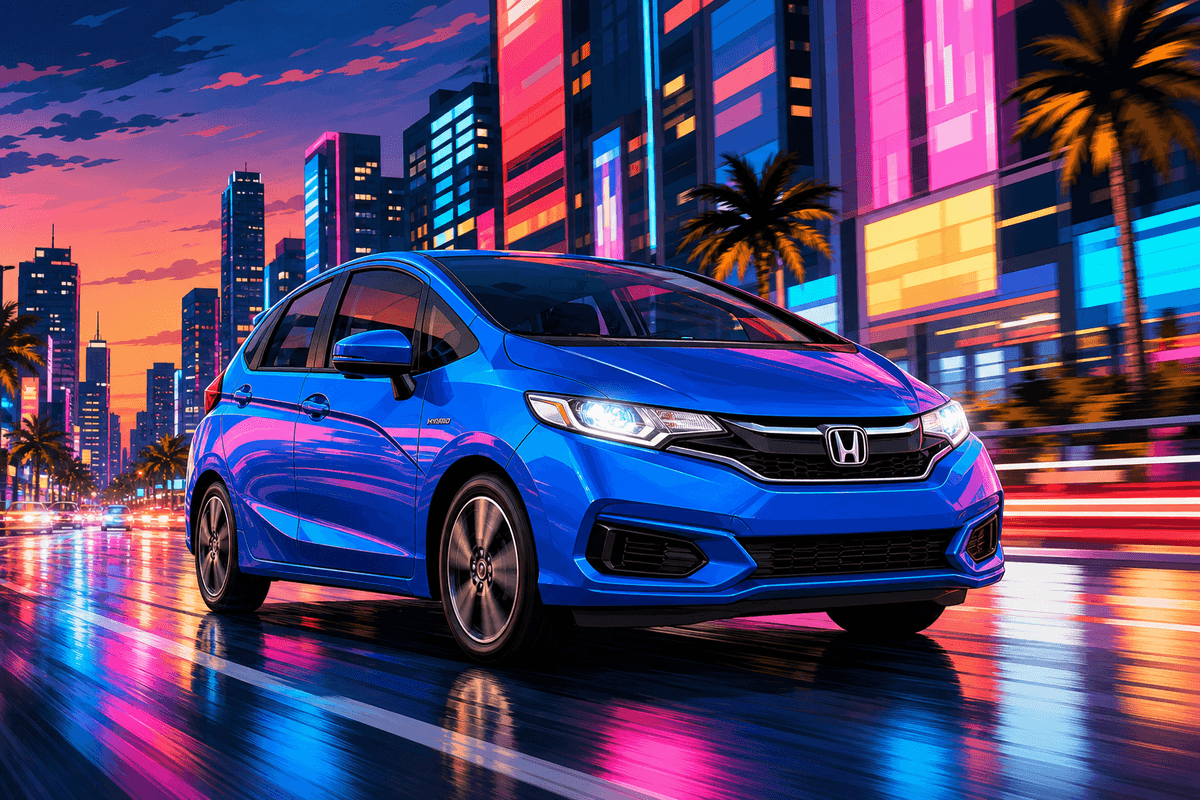
- Hybrids — the 2nd/3rd-gen i-DCD hybrid (GP1/GP5) pairs a 1.5 with a single-motor dual-clutch system; the 4th-gen e:HEV (GR) uses Honda's two-motor series-hybrid and is smoother and more efficient.
If your buyers want maximum economy and are comfortable with hybrid battery servicing, point them at the e:HEV. If they want simple, rugged, and repairable anywhere, the 1.3/1.5 i-VTEC gasoline is the safe order. See our hybrid buyer's guide for battery and warranty considerations.
The Magic Seats advantage#
Honda's Magic Seats are the Fit's signature feature and a real selling point overseas:
- Tall mode — rear seat bottoms flip up vertically, opening a full-height space behind the front seats for plants, boxes, or a bicycle
- Long mode — front and rear seats fold to create a near-flat load floor for long items
- Flat mode — rear seats fold flush for a big square cargo bay
For importers serving small businesses, tradespeople, and taxi/ride-hail operators, this flexibility is a closing argument — it lets one small car do the work of several.
CVT and transmission check points#
The Fit's biggest reliability variable is the CVT (continuously variable transmission). Most exported units are automatic, so inspect carefully:
- Test drive for judder or slipping on light acceleration — a shudder from a stop can mean a worn clutch pack or torque converter (3rd-gen early cars)
- Check the CVT fluid — it should be clean, not burnt-smelling or dark; ask for service history
- Listen for whine that rises with road speed — a failing CVT bearing
- 3rd-gen (GK) early builds (2013–2014) had recalls and software updates — confirm they were applied
- Manual (5MT) cars are bulletproof but rare in export grades
A clean, serviced CVT Fit is a great car. A neglected one is an expensive warranty claim — insist on records and a proper pre-export inspection.
Reliability and common issues#
The Fit is genuinely dependable, but a few known items are worth a buyer's checklist:
- CVT — as above, the number-one concern
- AC condenser / compressor — check cold-air output, especially for hot-climate destinations
- Suspension bushings and links — cheap to fix, common on high-km cars
- Hybrid IMA/i-DCD battery — test state of health on hybrid units; replacement is the main hybrid cost
- Body rust — Japanese cars are usually clean, but check the tailgate lip and wheel arches on snow-region cars
Overall, engine and electricals are strong. Budget your inspection time on the transmission and, for hybrids, the battery.
Export price ranges#
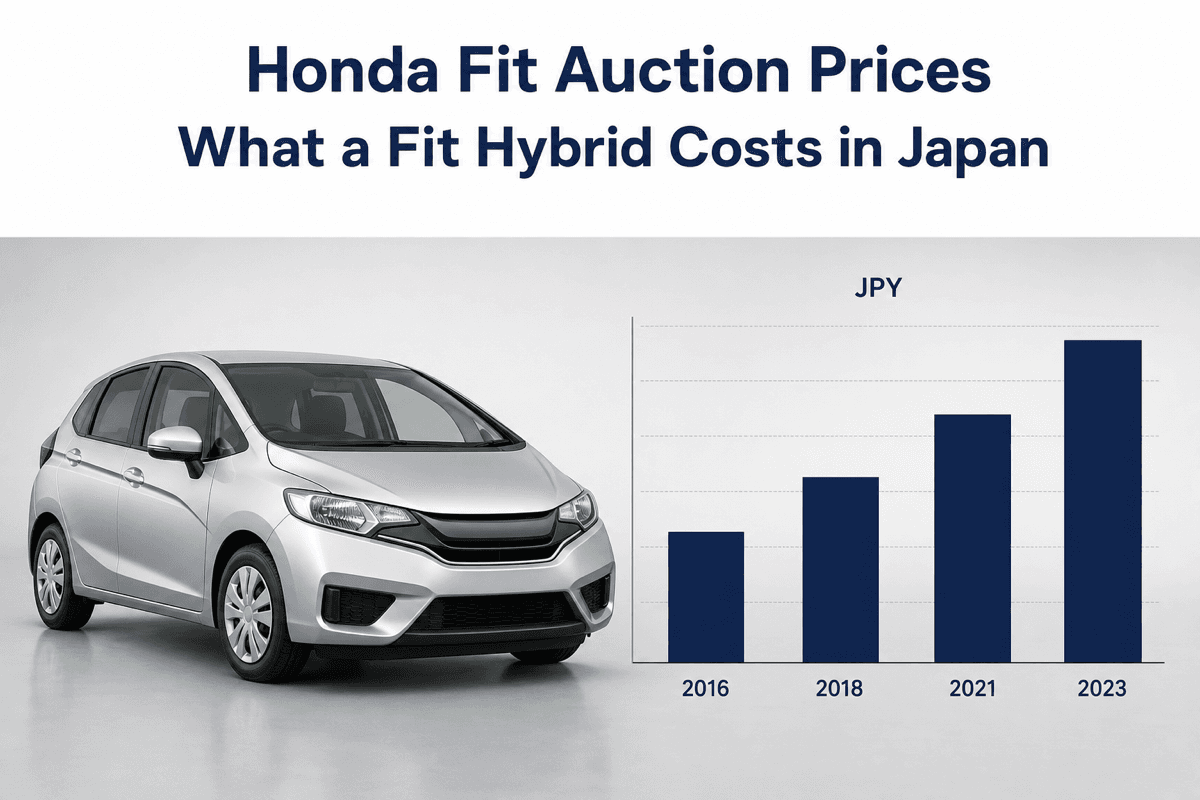
Prices vary with grade, mileage, and auction condition, but as a working guide (FOB Japan, indicative):
| Model / Gen | Typical age | Indicative FOB (USD) |
|---|---|---|
| GD 1st gen | 2004–2007 | $1,000–2,500 |
| GE 2nd gen | 2008–2013 | $2,000–4,500 |
| GK 3rd gen (petrol) | 2014–2019 | $4,500–8,500 |
| GP hybrid | 2014–2019 | $4,000–8,000 |
| GR 4th gen | 2020+ | $9,000–15,000+ |
Add freight, insurance and inspection to reach CIF — our team quotes those per destination port. Lower-grade, higher-km GE units are the classic entry point for price-sensitive markets; clean GK petrol cars are the best all-round value.
Buying tips for importers#
- Order by trim and grade code, not just year — a 1.5 RS and a base 1.3 look similar but sell to different buyers
- Specify auction grade 4 or above for retail-ready stock; grade 3.5 and repairables for parts/rebuild markets
- Confirm drive side matches your market's regulations before shipping
- Bundle inspections — a documented CVT and hybrid-battery report closes sales and reduces disputes
The Honda Fit remains one of the safest, most liquid choices in the Japanese used-car trade — small outlay, wide demand, fast turnover.
Ready to order? Browse used Honda Fit stock or request a quote and our team will source graded units to your destination.