Hybrid imports from Japan are growing in markets where fuel costs are high or environmental policy favors low emissions. Toyota's Prius, Aqua, and Camry Hybrid, and Honda's Fit Hybrid and Insight, dominate this segment. The headline appeal — fuel economy 50–80% better than the gasoline equivalent — is real, but only when the hybrid battery is healthy. A used hybrid with a degraded battery defaults to running on the gasoline engine alone with the additional weight of the dead battery on board, delivering worse economy than the gasoline-only version of the same chassis would have. This guide covers what to import, how to verify battery health, and the destination-specific tax considerations.
Why hybrid imports#
Fuel economy#
A 2017 Toyota Prius Gen 4 delivers ~25–30 km/L (60–70 mpg US) in real-world driving. The equivalent gasoline Corolla delivers ~12–15 km/L. In high-fuel-cost markets (UK, Caribbean, Sri Lanka, Bangladesh, increasingly East Africa), the difference is significant.
Used hybrid pricing#
Hybrids typically cost 15–25% more at auction than the equivalent gasoline model, but the fuel savings often pay this back within 50,000–80,000 km. The math depends on local fuel prices and your daily distance.
Environmental policy alignment#
Some destinations offer reduced import duty for hybrids (varies by country and changes). New Zealand, the UK and parts of the EU offer hybrid-specific incentives. Pakistan and Sri Lanka have specific hybrid duty bands.
The hybrid models worth importing#
Toyota Prius (Generations 3 and 4)#
The icon. Gen 3 (2009–2015) and Gen 4 (2016–2022) are both export-relevant. Gen 4 has better fuel economy (~30 km/L) but has more complex electronics. Gen 3 is the more reliable platform for first-time hybrid imports.
- FOB range: USD 7,000–18,000
- Mileage tolerance: up to 200,000 km on healthy batteries
- Destination fit: UK, Caribbean, Sri Lanka, Bangladesh, parts of Africa
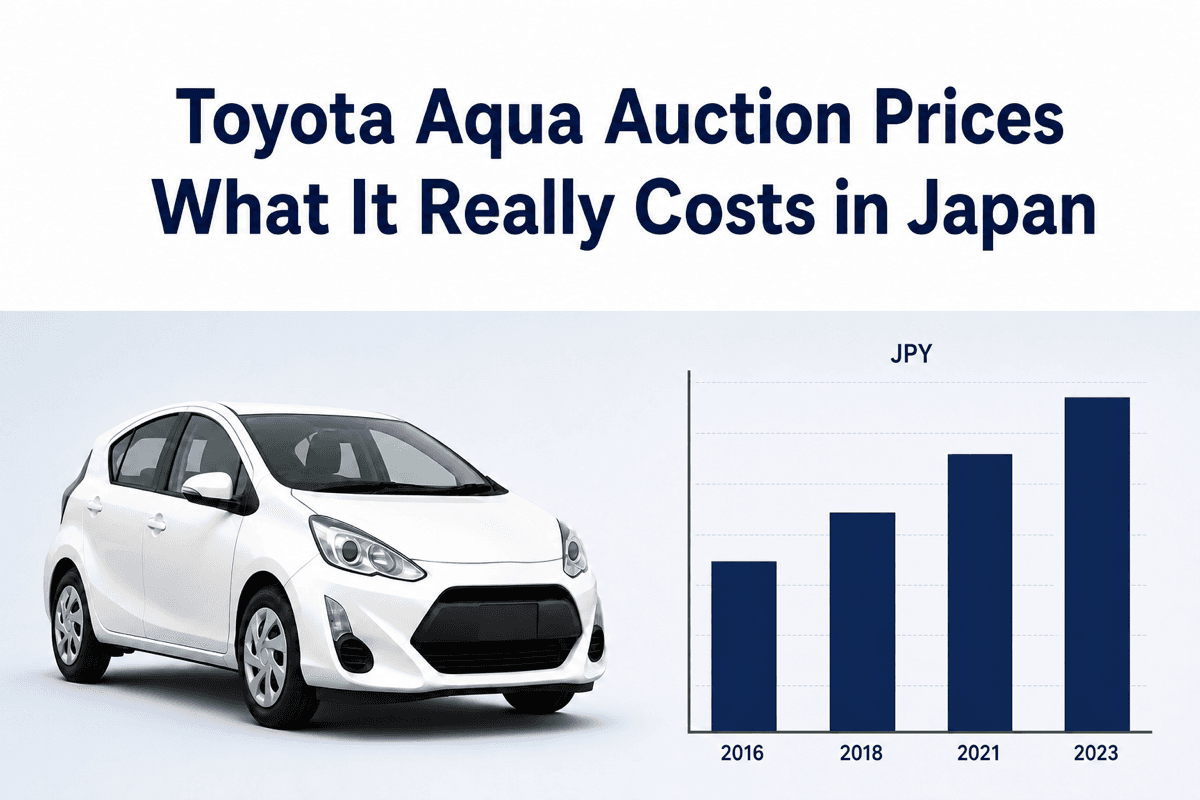
Toyota Aqua / Prius C#
Smaller, cheaper, simpler hybrid — same hybrid architecture as Prius but in a compact body. Massive in Pakistan, Bangladesh, Sri Lanka, and Caribbean markets. The default cheap-fuel-economy import.
- FOB range: USD 5,000–11,000
- Mileage tolerance: up to 150,000 km
- Destination fit: Pakistan, Bangladesh, Sri Lanka, Caribbean, parts of Africa
Honda Fit Hybrid (GP1, GP5, GP6)#
Honda's compact hybrid alternative to Aqua. The third-generation GP5/GP6 (2013–2020) uses Honda's i-DCD dual-clutch hybrid system — more sophisticated than Toyota's THS-II but with documented reliability quirks (DCT software updates).
- FOB range: USD 5,500–12,000
- Mileage tolerance: up to 130,000 km on verified-update DCT
- Destination fit: same as Aqua, plus Singapore (where Honda has historic strength)
Toyota Camry Hybrid#
Mid-size sedan hybrid for buyers who want more space than Prius. The XV70 generation (2018–) is the relevant export.
- FOB range: USD 18,000–28,000
- Mileage tolerance: up to 180,000 km
- Destination fit: GCC, US (over 25 years for older), Australia (with conversion)
Toyota Crown Hybrid#
Premium hybrid sedan, mostly relevant for the JDM-enthusiast or executive Asian market. Not a high-volume export.
- FOB range: USD 15,000–30,000
- Destination fit: Singapore, Hong Kong, GCC
Honda Insight (Gen 2, ZE2/ZE3)#
Honda's smaller hybrid, has its niche but generally less popular than Aqua / Fit Hybrid.
- FOB range: USD 4,000–8,000
Battery health: the critical check#
The hybrid battery (HEV battery, distinct from the 12V starter) is the single most important thing to verify on a used hybrid. A new traction battery costs USD 1,500–3,500+ depending on model — easily wiping out the bargain.
State of health (SOH) signals#
- Odometer mileage — high mileage correlates with battery wear, but isn't the only factor
- Geographic origin — vehicles from hot climates (Okinawa, Kyushu) wear batteries faster than cooler regions
- Service history — Toyota dealer-serviced hybrids occasionally have battery health checks documented
- Capacity test by inspection — JEVIC and similar can test battery capacity if equipped (not all do)
Symptoms of a degraded battery#
- ICE running more frequently when at idle
- Fuel economy noticeably below spec (Prius averaging 18 km/L instead of 28)
- Hybrid system warning light
- Acceleration that "skips" between electric and gasoline phase
- Battery cycles full discharge / recharge unusually fast
What to ask the exporter#
- "Do you have a battery health check option for this vehicle?"
- "Is there a service history showing battery checks?"
- "Where in Japan was this vehicle registered?" (cooler regions = better)
What it costs to fix#
If a battery is dead on arrival, expect:
- Toyota Prius / Aqua: USD 1,500–2,500 for a refurbished battery, USD 2,500–4,000 for new
- Honda Fit Hybrid: similar range, plus DCT software update may be needed
A reliable exporter offers battery testing as part of the inspection — pay the extra USD 100 for it.
Destination-specific duty considerations#
Pakistan#
Pakistan has specific hybrid duty rates. Sub-1500cc hybrid + EV vehicles get reduced rates compared to equivalent gasoline. Confirm current Pakistan-side rules with your clearing agent before sourcing.
New Zealand#
NZ offers a feebate scheme — hybrids get reduced fees compared to high-emission gasoline equivalents. The exact amount changes annually with policy.
UK#
Used hybrids face VED (Vehicle Excise Duty) similar to other vehicles by emissions, but inheriting the lower-emission band of the original registration. Check the V5C against current VED tables.
Sri Lanka#
Sri Lanka has hybrid-specific tax bands. The exact rates change frequently with import policy and currency conditions.
Kenya / Tanzania#
Hybrid duties are calculated on engine cc, similar to gasoline. The hybrid system itself doesn't change the tariff calculation — only the engine displacement does. Aqua's 1.5L is still classified as 1.5L for duty purposes.
Common hybrid scams#
- Sold as "battery just replaced" without documentation — verify with serial number
- DCT-related claims on Honda Fit Hybrid without referenced software update history
- "Hybrid" tag on regular gasoline vehicle in seller listings — verify the badge against the chassis number
- Pre-export inspection that doesn't actually check the hybrid system — explicitly request hybrid battery diagnosis
Bottom line#
Hybrids deliver real fuel-economy savings when the battery is healthy. Pay for the battery test ($100), accept that high-mileage hybrids carry battery replacement risk, and prefer cooler-climate registered vehicles where possible. For pure cost-sensitive buyers, the Aqua delivers the best value-per-unit. For more space, Prius. For luxury sedan: Camry Hybrid.
Next steps#
Request a quote for a specific hybrid model with battery testing included. Browse our Toyota inventory for current stock. For the underlying import process, see How importing works.