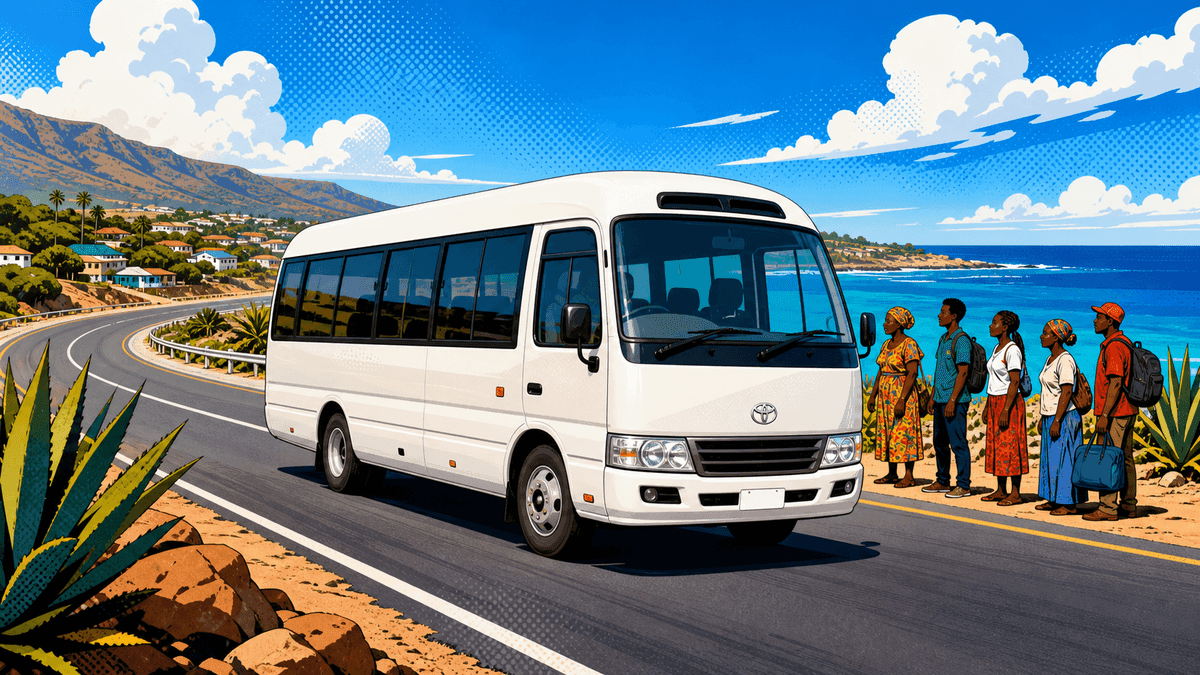
Ask anyone who runs passenger transport in Africa, the Caribbean or the Pacific what the safe choice of minibus is, and you will hear the same answer: the Toyota Coaster. Church groups, hotels, schools and tour operators worldwide have standardised on it, and for good reason — it is Japan's benchmark minibus, built to shrug off exactly the kind of duty cycle that kills lesser vehicles. Here is how we evaluate Coasters at the Japanese auctions, and what importers should know before ordering one — or a fleet of them.
Why the Coaster dominates#
The Coaster's reputation rests on three things: a simple, proven diesel drivetrain, a body that seats a full group in comfort, and parts availability in practically every country on earth. A used Coaster from Japan typically arrives with a documented service history and the kind of mechanical condition that lets it start a second working life of a decade or more.
The two families you will see at auction#
| Series | Years | Key engine | Our take |
|---|---|---|---|
| B40/B50 | 1993–2016 | Incl. the 4.2L 1HZ diesel | The value workhorse — huge supply, legendary engine |
| B60/B70 | 2017–present | 4.0L diesel | Modern cabin and safety, higher landed cost |
B40/B50 (1993–2016): the value workhorse#
This long-running series is what most of our buyers import, simply because supply is deep and prices are sensible. The engine to look for is the 4.2-litre 1HZ diesel — closely related to the engine that powers the Land Cruiser, and carrying the same reputation: unstressed, mechanically simple, and capable of enormous mileages when maintained. For operators in regions with rough fuel quality and thin dealer networks, that simplicity is the whole argument.
B60/B70 (2017–present): the modern option#
The current generation moved to a 4.0-litre diesel and brought the cabin, driving position and safety equipment up to modern standards. These buses cost meaningfully more at auction, but they suit hotel shuttle and tourism work where passenger impression matters, and they give a fleet buyer a longer runway before major refurbishment.
What we check before bidding#
Body corrosion#
This is checkpoint number one on any Coaster. These are big steel bodies, many of which spent their Japanese lives in coastal or snowy prefectures. We inspect wheel arches, step wells, window surrounds, the roof gutter line and the underbody frame. Surface rust is normal on older buses and priced accordingly; structural corrosion in the floor or pillars is a walk-away. A cheap Coaster with a rotten body is not cheap.
Seat count and layout variants#
Coasters left the factory in multiple seating configurations — commonly in the 21 to 29 seat range depending on series and trim, plus welfare (wheelchair-lift) and luxury variants. This matters more than buyers expect: your import regulations, licensing category and intended route may all hinge on seat count. Tell us how the bus will be used and we will match the layout before bidding, not after the ship sails.
Diesel injection condition#
The diesels are robust, but injection system condition separates a good buy from a headache. We look for hard cold starts, uneven idle, excessive smoke under load and any auction sheet notes about fuel system work. On the 1HZ especially, a healthy injection pump means the engine will likely outlast the body around it.
Where Coasters go#
Our Coaster shipments cluster in four regions: Africa — Dar es Salaam, Mombasa and Kampala are constant destinations — the Caribbean via ports like Kingston, the Pacific islands through Suva and Port Moresby, and the Middle East via Jebel Ali. School runs, church transport, hotel shuttles, staff buses, safari and tour work — the same bus, different livery.
Fleet orders: how we handle them#
A large share of our Coaster business is not one bus but three, five or ten — schools replacing a fleet, tour operators scaling up, ministries and NGOs standardising on one platform. We handle fleet orders directly: we agree a target spec and budget per unit, source across multiple auction houses over a few weeks so you are not bidding against yourself, and consolidate shipping to cut your per-unit freight cost. If you are budgeting a fleet purchase, talk to us before you fix the numbers.
FAQ#
Which Coaster engine is the most reliable for tough conditions?#
The 4.2-litre 1HZ diesel in the B40/B50 series has the strongest field reputation — it is closely related to the Land Cruiser's engine and shares its tolerance for hard use and imperfect fuel. The current 4.0 diesel is also proven, just newer and more expensive.
How many seats does a used Coaster have?#
It varies by series and trim — commonly between 21 and 29, plus wheelchair-accessible and high-spec variants. Always confirm the exact layout against your licensing rules before purchase; we verify seat count and configuration on every bus we bid on.
Can AUTO-X supply multiple Coasters at once?#
Yes — fleet orders are a core part of our business. We source across several auctions to hit your spec and budget, and consolidate the shipment to reduce per-unit cost.
Ready to put a Coaster to work?#
Check our current stock on the vehicles page or request a quote with your destination and seat requirements — fleet enquiries welcome. And a standing note on safety: we only accept payment to our verified corporate bank account, never personal accounts — details in our payment guide.