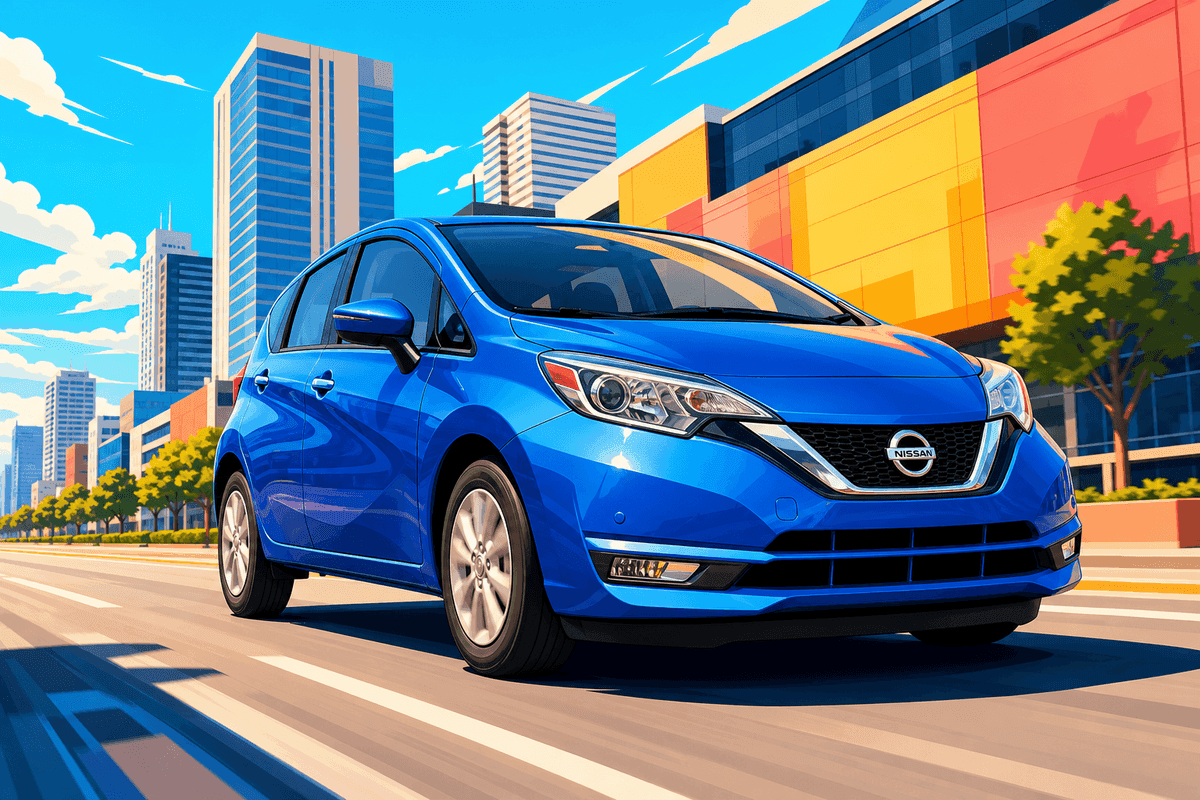
The Nissan Note never makes headlines, but it never stops selling either. Week after week we see the same pattern at the Japanese auctions: clean, low-mileage Notes heading to Sri Lanka, Kenya, Mauritius and the Caribbean, usually bought as a cheaper alternative to the Toyota Aqua and Honda Fit. This guide covers what we actually look for before bidding on one, generation by generation.
Why the Note works as an export car#
Japanese owners bought the Note as a city runabout. That means the auction halls are full of them — garage-kept, serviced on schedule, and often with genuinely low mileage. Parts are cheap and available in every right-hand-drive market we ship to. And from late 2016 the Note gained a card the Fit never matched: e-POWER, Nissan's series hybrid that delivers electric-car driving with no charging cable.
The three generations at a glance#
| Generation | Years | Powertrain | Our take |
|---|---|---|---|
| E11 | 2005–2012 | Petrol + CVT | Pure budget buy — condition matters more than spec |
| E12 | 2012–2020 | Petrol + CVT; e-POWER from late 2016 | The sweet spot for most importers |
| E13 | 2020–present | e-POWER only | Newest tech, highest landed cost |
E11 (2005–2012): the budget pick#
The first-generation Note is now a pure price play. Age-eligible markets with strict year rules have mostly moved past it, but where older imports are allowed it remains one of the cheapest ways into a Japanese hatchback. At this age, we grade the individual car, not the model: service history, underbody condition and how the CVT behaves on the test lane count for everything.
E12 (2012–2020): the sweet spot#
This is the generation most of our buyers end up with, and the one with the widest spread of price and condition at auction. The key date is late 2016, when the e-POWER variant arrived.
e-POWER is a series hybrid, and it is worth understanding because customers ask about it constantly: the petrol engine never drives the wheels. It only runs a generator that charges the battery, and an electric motor does all the driving. The result is smooth, quiet, electric-style response and strong city fuel economy — with nothing to plug in, ever.
Pre-2016 and non-hybrid E12s use a conventional petrol engine with a CVT. They are cheaper to buy and simpler mechanically, and for markets where hybrid servicing skills are thin, that simplicity is a genuine argument.
E13 (2020–present): e-POWER only#
From 2020 the Note went e-POWER only — no pure petrol option. The E13 is a visibly more upmarket car and auction prices reflect it. We recommend it to buyers who want a nearly-new hybrid with warranty-age condition, and to markets where late-model hybrids command a premium at resale.
What we check before bidding#
CVT on non-e-POWER cars#
Every petrol Note runs a CVT, and a tired CVT is the single most expensive fault a compact like this can have. We watch for shudder at takeoff, delayed engagement and whining under light load, and we treat unclear transmission notes on the auction sheet as a reason to walk away. e-POWER cars have no CVT at all — one less thing to fail.
12V battery quirks#
e-POWER Notes still depend on a small conventional 12V battery to boot the hybrid system. When that battery is weak, the car can throw warning lights or refuse to start the system entirely — which looks alarming but is usually a cheap fix. We flag weak 12V symptoms at inspection so a simple battery is not mistaken for a hybrid fault, in either direction.
City-car wear#
Notes live in cities, and city life leaves marks: kerbed alloys, bumper scuffs, worn driver's seat bolsters, and lots of short-trip engine cycles relative to mileage. We read the auction sheet interior grade carefully and prefer cars graded B or better inside — a low odometer with a tired cabin usually means hard urban use.
Where the Note sells best#
Demand is strongest in Sri Lanka via Colombo, Kenya via Mombasa, Mauritius via Port Louis and the Caribbean through ports like Kingston. In every one of these markets the Note is cross-shopped against the Aqua and the Fit — and it usually wins on purchase price while matching them on running costs, especially in e-POWER form.
Note vs Aqua vs Fit#
The honest framing we give buyers: the Aqua carries the Toyota badge premium, the Fit wins on interior packaging, and the Note is the value pick — similar economy, similar reliability record in our experience, and often a friendlier auction price for equivalent year and grade. If your customers ask for a hybrid but balk at Aqua money, the E12 e-POWER is the car to show them.
FAQ#
Is the Note e-POWER a plug-in hybrid?#
No. There is no charging port. The petrol engine charges the battery and the electric motor drives the wheels — you just refuel it like any petrol car.
Which generation is the best value for export?#
For most buyers, the E12. Choose a late-2016-or-newer e-POWER if fuel economy is the priority, or a petrol E12 if budget and mechanical simplicity matter more. The E13 makes sense where late-model hybrids resell at a premium.
Can AUTO-X ship a Note to my country?#
Almost certainly — we ship to 50+ destination ports and we check your country's age and inspection rules before you commit to a car, not after.
Ready to source your Note?#
Browse our current stock on the vehicles page or request a free quote with your destination port and we will come back with a full CIF estimate. One note on safety: we only ever accept payment to our verified corporate bank account — see our payment guide for how we keep transactions secure.