"Can you find me a Honda Fit that Zimbabwe will actually let in?" A buyer in Harare opened with exactly that question last month, and it is the right one to start with. Zimbabwe enforces a confirmed 10-year age limit on imported passenger vehicles, and a car that fails it can be refused at clearance after you have already paid for it in Japan. We are MOBIC Co., Ltd., a licensed Japanese used-vehicle exporter (licence No. 431310063715, Tokyo), and we have moved enough vehicles down the Dar es Salaam–Harare corridor to know where first-time importers lose money — and how to keep the process boring and predictable instead. Here is the whole journey, from the Japanese auction hall to Zimbabwean number plates.
The 10-year rule decides your shortlist before price does#
Zimbabwe restricts imported passenger vehicles to units no more than ten years old, counted from the year of manufacture. This is not a soft guideline: it is checked at clearance, and it is the single most common reason we have to talk a Zimbabwean buyer out of a car they have already fallen for. As of this writing, it generally means a passenger car built in 2016 or later.
Two practical habits follow from this. First, verify the actual manufacture date — not the "model year" in a listing. Japanese paperwork records first registration, and a car advertised as a 2017 model can turn out to be a late-2016 build, or older. We confirm the production date from the chassis number before quoting any Zimbabwean buyer. Second, avoid cars sitting right on the cut-off unless they can ship immediately; a unit that is compliant on auction day can age out while it waits for a sailing.
Why the sensible route is Dar es Salaam plus a bonded truck#
Zimbabwe is landlocked, so every Japanese car enters through a neighbouring country's port. For Harare, our default routing is Dar es Salaam in Tanzania, followed by bonded road transit south through Zambia to the Zimbabwean border post.
"Bonded" is the word that matters. The vehicle travels under customs seal from the port to Zimbabwe, so no Tanzanian or Zambian import duties are paid along the way — you pay import taxes once, to ZIMRA, at your own border. A licensed transit operator handles the corridor paperwork. The same corridor serves Lusaka, which is why the Zambia route guide reads like a sister document to this one. Buyers occasionally ask about Durban or Beira; both can work, but Dar es Salaam is the corridor we run most often and the one we can supervise end to end. Details of the leg from Japan are on our shipping to Harare page.
Six stages between the auction hall and your driveway#
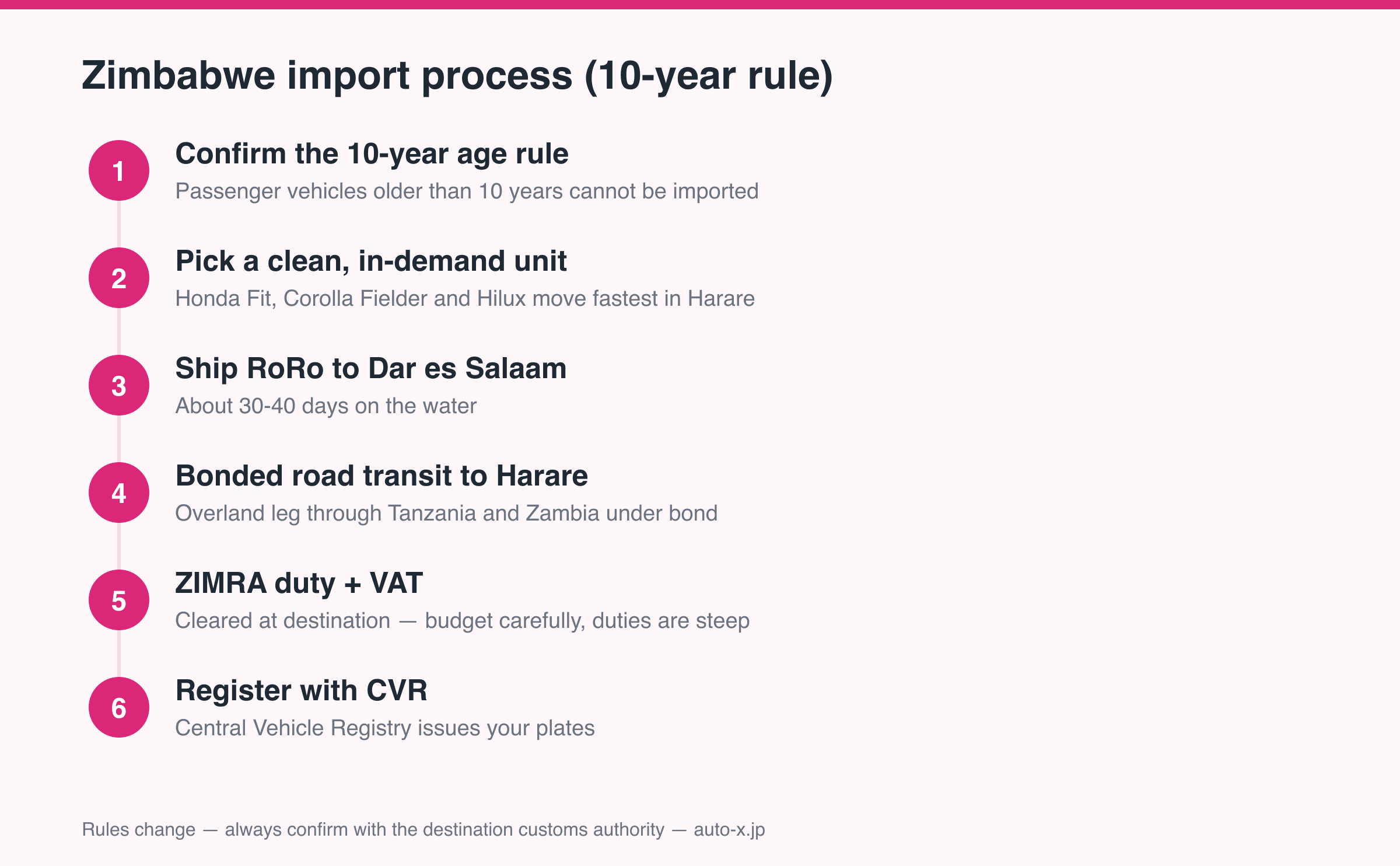
- Check the 10-year rule. Confirm the manufacture date before bidding, not after.
- Pick a clean unit. We recommend auction grade 4 or above with a translated auction sheet — more on why below.
- RoRo sailing to Dar es Salaam. The car is driven aboard a roll-on/roll-off vessel in Japan.
- Bonded road transit. Under customs seal through Tanzania and Zambia to the Zimbabwean border.
- ZIMRA clearance. Duty and VAT are assessed and paid; a good clearing agent earns their fee here.
- CVR registration. The Central Vehicle Registry issues your Zimbabwean plates.
On the Japan side, the export certificate, deregistration papers and English translation are the exporter's job — we covered exactly what you should receive in export documents explained. Keep every page; ZIMRA and the CVR will both want to see the trail.
What the money actually looks like#
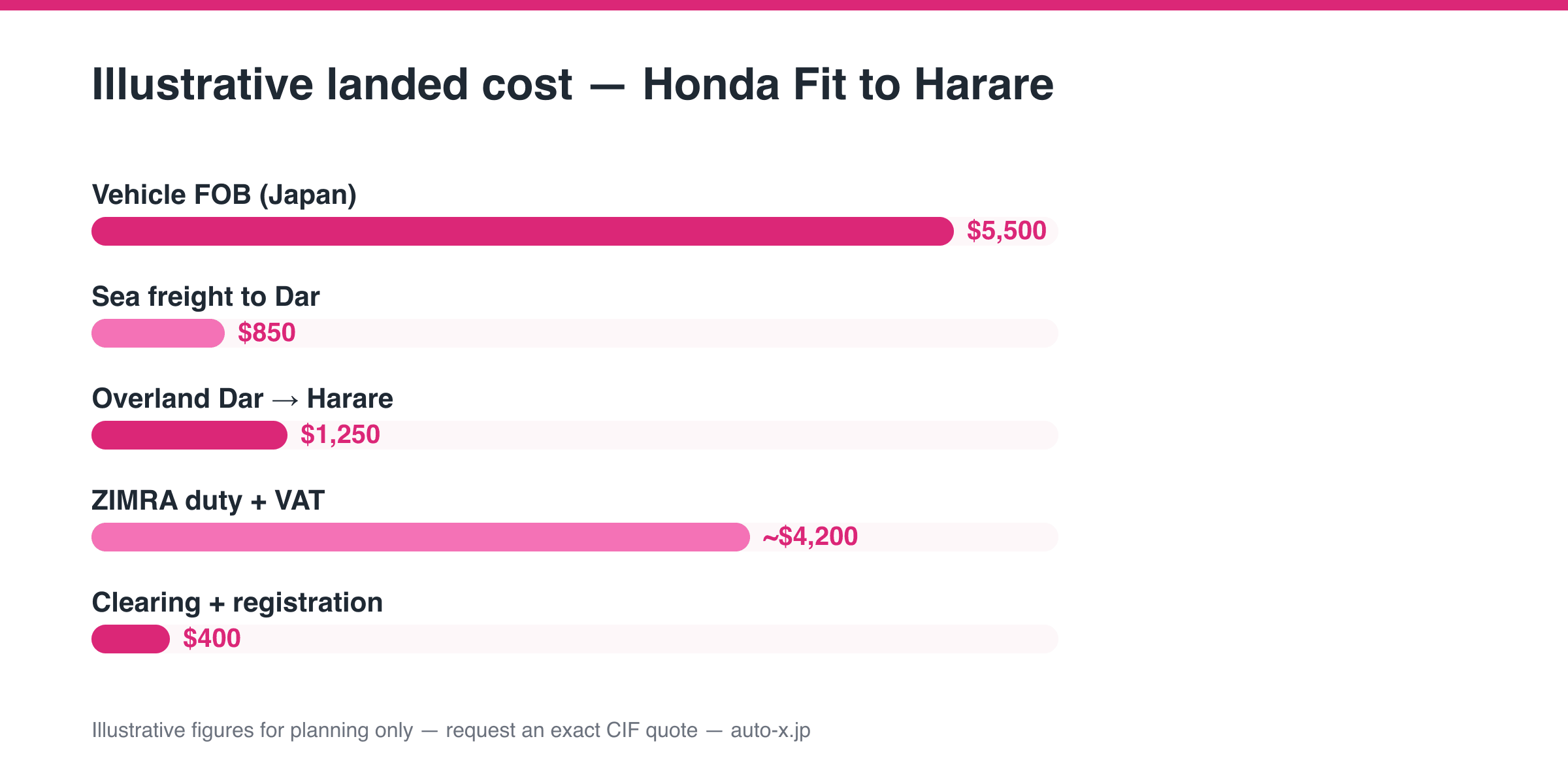
The chart above is an illustrative budget for a typical Honda Fit, not a quotation: roughly $5,500 FOB for the car in Japan, about $850 sea freight to Dar es Salaam, around $1,250 for the bonded overland leg to Harare, in the region of $4,200 for ZIMRA duty and VAT, and about $400 in clearing and agency fees. Real numbers move with the auction price, the exchange rate and the current tariff schedule.
Notice the shape of that budget: the tax line is the second-largest number after the car itself, and the overland leg costs more than the ocean leg. Both facts surprise first-time importers, and both are why we insist on quoting the full landed picture rather than a tempting FOB price alone.
ZIMRA duty and VAT: steep, so budget before you bid#
We will not print duty percentages here, because rates vary by vehicle category and engine size and Zimbabwe adjusts them — any fixed number in a blog post ages badly. What we can say plainly from experience: Zimbabwean import taxes are steep, and on smaller cars the combined duty and VAT can rival what you paid for the vehicle in Japan.
The practical defence is sequencing. Get a written estimate from a Zimbabwean clearing agent based on the exact car — make, model, year, engine — before you bid, not after the car is on the water. ZIMRA assesses taxes on a value built from the car's cost, insurance and freight, so a cheaper purchase price genuinely lowers the tax bill too. Ask your agent about pre-clearance so the paperwork is lodged before the truck reaches the border.
The three cars Zimbabwe keeps asking us for#
- Honda Fit — the runaway favourite. Frugal, easy to fix, and parts are everywhere because so many are already on Zimbabwean roads.
- Toyota Corolla Fielder — the wagon that carries a family, luggage and trade goods while returning sedan economy. Grade 4+ Fielders sell fast at auction; we bid early in the week for them.
- Toyota Hilux — the working vehicle of choice for farms and businesses. Note that pickups may be treated differently from passenger cars at the border; confirm the category with your clearing agent when budgeting.
All three are right-hand drive, which is exactly what Zimbabwe's keep-left roads require — no conversion, no compromise.
Grade 4+ with a translated auction sheet is your insurance policy#
Zimbabwe's local resale market has a condition problem, and buyers know it: odometers wound back, accident repairs hidden under fresh paint, "one owner" stories no one can verify. Importing directly from a Japanese auction cuts through all of it, because every auction car carries an inspection sheet written by an independent grader who has no stake in the sale.
Our standing advice for Zimbabwe is grade 4 or above. A grade 4 car has an honest, verifiable condition: straight panels, a tidy interior, no structural repair history. We translate the full auction sheet — grade, mileage notation, and the diagram marking every scratch and dent — so you see precisely what the Japanese inspector saw before you pay. When you eventually resell in Harare, that translated sheet becomes your proof of provenance in a market where proof is scarce; cars with documented history hold their value noticeably better.
FAQ#
Can I import a passenger car older than ten years?
In general, no — the age limit is enforced at clearance, and betting on an exception is how deposits get lost. If you believe your situation is special, get written confirmation from ZIMRA before any money leaves your account. Our own policy is simple: we do not ship non-compliant passenger cars to Zimbabwe.
How long does the whole process take?
Plan in months, not weeks. In our experience the sailing to Dar es Salaam, port handling, the bonded road leg and ZIMRA clearance together typically land somewhere around two to three months door to door, depending on vessel schedules and border queues.
Are Japanese cars suitable for Zimbabwean roads?
Very. Zimbabwe drives on the left, and Japanese vehicles are right-hand drive from the factory. Combined with Japan's strict inspection culture and low average mileage, that is why the Fit, Fielder and Hilux dominate the roads from Harare to Bulawayo.
Ready to put numbers on a specific car? Tell us the model and your budget, and we will confirm 10-year compliance, bid at auction on your behalf and price the full journey to Harare — request a free CIF quote.