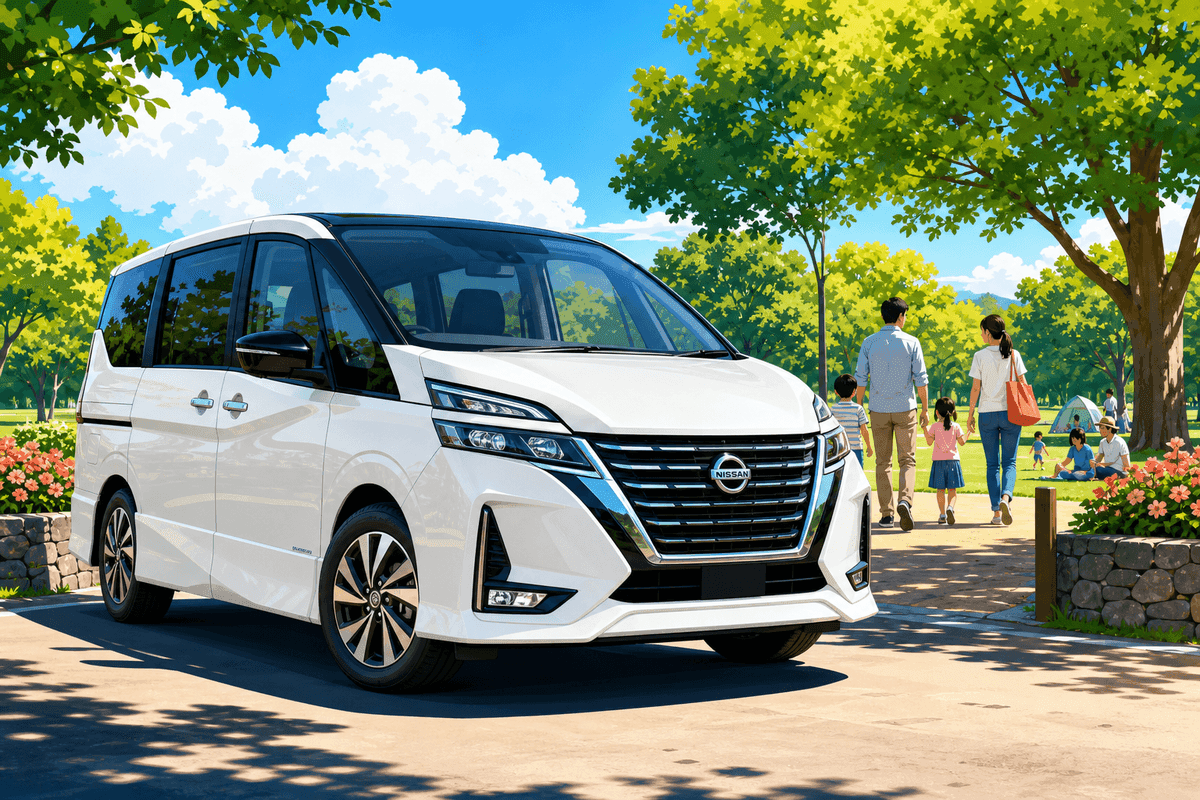
The Serena does not have the Alphard's presence or the Vellfire's swagger, and that is exactly why fleet buyers love it. This is Japan's best-selling minivan class doing what it does best: hauling eight people cheaply, reliably and with sliding doors on both sides. Shuttle operators in Nairobi ask for it by name, matatu-adjacent businesses run them until the seats wear through, and in Sri Lanka the Serena has been a family-and-hire staple for years. Auction supply is deep and prices are honest — which means the game is separating the well-kept family van from the one that has already done a decade of hard shuttle work in Japan.
Here is how we grade them.
Serena C26 (2010–2016)#
The C26 is the value buy. A 2.0-litre petrol four, CVT, and one of the most space-efficient cabins in the class — flat floor, walk-through front to rear, and seats that fold and slide into a genuinely useful cargo van layout. Many carry Nissan's S-HYBRID badge, which is a mild assist system rather than a full hybrid — do not price it like one, and do not let a seller convince your customer it is one. Equipment on mid and high grades is generous: both-side power sliding doors, around-view cameras on later cars, and cruise control.
At auction the C26 is plentiful and cheap, and that cheapness is a trap if you buy on price alone. These vans worked for a living in Japan too — kindergarten runs, care-home shuttles, big families. Odometer readings matter less than condition; a 130,000 km van with service records regularly beats a 70,000 km van without them.
Serena C27 (2016–2022)#
The C27 modernised the package: sharper styling, better safety kit including ProPILOT assistance on many cars, and — from 2018 — the e-POWER drivetrain. e-POWER matters, so understand it before you sell it: the petrol engine never drives the wheels directly, it only generates electricity for an electric motor that does all the driving. The result is EV-like response and excellent city fuel economy without plugging anything in. For stop-start shuttle duty it is genuinely superb. The battery is smaller than a full EV's and works hard, so its health check is central to grading any e-POWER car.
The C27 also fixed most of the C26's rough edges and holds stronger prices as a result. For markets where fuel cost is the customer's daily pain, a clean e-POWER is the strongest Serena story there is.
What Goes Wrong: Our Inspection Checklist#
CVT on the C26. Same discipline we apply to every Nissan CVT of this era: pull away smoothly, hold a steady throttle, listen for whine, feel for shudder. A hesitant or juddering CVT is the single most expensive common fault on a C26, and auction-sheet transmission notes are a walk-away unless the price is a parts-van price. Fluid service records add real value.
e-POWER battery and drivetrain (C27). On the test report we want no hybrid-system warnings, consistent power delivery, and the engine cutting in and out normally. A pack that is down on capacity shows up as the engine running near-constantly and economy well below expectations. e-POWER cars with clean sheets are excellent buys; cars with drivetrain notes are for specialists.
Sliding door rollers and tracks. The Serena lives and dies by its doors. Cycle both sides fully — power function from the dash, the fob and the handles. Worn rollers announce themselves with graunching, hesitation mid-travel, or a door that needs a shove to latch. It is a fixable fault, but it is also the most reliable tell that a van has done heavy people-moving duty.
Round out the check with the usual fleet-van tells: second-row seat wear, scuffed trim on every pillar kids can reach, and kerb damage on the sliding-door side.
Who Buys the Serena#
East Africa is the volume destination. Kenyan and Tanzanian operators buy Serenas for shuttle, school and staff-transport work — the matatu economy's more comfortable cousin — and the C26's price makes the maths work. Sri Lanka has bought Serenas for years as family-and-hire vans, with the e-POWER C27 now the aspirational pick where import rules allow. Caribbean buyers use them for hotel and airport transfer duty, where both-side power doors earn their keep daily. If your customer wants more presence at a higher budget, point them to our Toyota Vellfire buyer's guide — different class, same sliding-door logic.
Typical Recent Auction Levels#
Orientation, not quotation — levels move with season and exchange rate. Usable C26s have recently traded from roughly ¥300,000 for early, high-mileage vans to around ¥800,000 for late, well-kept examples. C27s run from about ¥800,000 for early petrol cars to ¥1,500,000-plus for tidy e-POWER cars in strong grades. The spread between a grade 3.5 van and a grade 4.5 van is modest money at this price point and almost always worth paying.
FAQ#
Is the S-HYBRID a real hybrid? No — it is a mild assist system on the C26 petrol. Fuel savings are marginal. e-POWER on the C27 is the drivetrain that genuinely changes fuel costs.
Can e-POWER be serviced outside Japan? The engine side is a conventional petrol unit, and general servicing is straightforward. The high-voltage side needs a competent hybrid-capable workshop — confirm one exists in your market before committing to e-POWER stock.
Which Serena for shuttle work on a tight budget? A late C26 with service records and healthy doors. Spend your budget on condition, not on year.
Ready to Source One?#
Check our current vehicle stock, read more model guides, or request a quote with your port and intended use — shuttle, hire or family — and we will match candidates from the coming week's auctions. As always: we invoice only from verified company bank accounts, never personal ones. Details on our payment page.