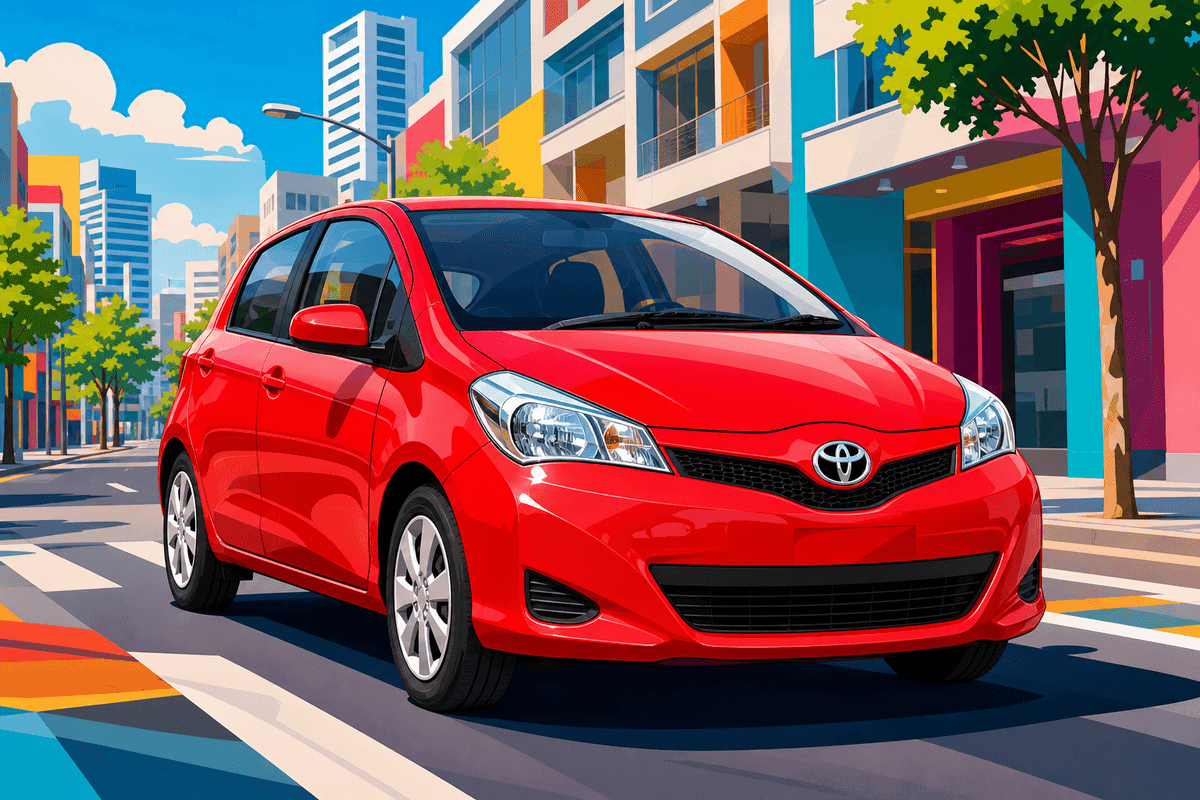
The Toyota Vitz is one of the most requested used Japanese cars we ship, and for good reason. This compact five-door hatchback — sold as the Yaris in export markets — pairs Toyota reliability, cheap running costs, and abundant parts availability into a package that thrives on rough roads and in busy cities alike. If you import cars for taxi fleets, driving schools, or first-time private buyers, the Vitz is close to a default choice. This guide walks through the generations, engines, fuel economy, a pre-purchase checklist, the markets where it sells best, and realistic price ranges.
Why the Vitz sells everywhere#
A few structural reasons keep demand high year after year:
- Low fuel consumption — critical where fuel is expensive and margins are thin.
- Cheap, everywhere parts — filters, brakes, suspension bushes and light panels are stocked in nearly every market.
- Simple mechanicals — most independent workshops can service it without special tools.
- Right size — small enough for congested streets, big enough for four adults plus luggage.
- Strong resale — buyers trust the badge, so units move quickly off the lot.
Generations at a glance#
The Vitz has run through three main generations. Knowing the chassis code tells you the engine family, the safety kit, and roughly the price band.
| Generation | Years (JP) | Chassis codes | Notable points |
|---|---|---|---|
| 1st (XP10) | 1999–2005 | SCP1x / NCP1x | Lightweight, 1.0/1.3, very cheap to run |
| 2nd (XP90) | 2005–2010 | SCP90 / NCP9x / KSP90 | Bigger cabin, 1.0/1.3/1.5, RS sport trim |
| 3rd (XP130) | 2010–2020 | KSP130 / NSP130 / NCP131 / NHP130 (hybrid) | Cleaner design, hybrid from 2017 |
The NHP130 hybrid (from the 2017 facelift) is the model to know if a buyer prioritises fuel economy above all — see our hybrid buyer's guide for how to inspect the battery.
Engines and drivetrain#
The Vitz keeps things simple with small, proven four-cylinder engines and a CVT (older cars used a 4-speed auto or 5-speed manual).
| Engine | Displacement | Code | Best for |
|---|---|---|---|
| 1.0 L | 996 cc | 1KR-FE | Cheapest to run, city use, light loads |
| 1.3 L | 1329 cc | 2NZ/2NR-FE | The all-rounder — the volume seller |
| 1.5 L | 1497 cc | 1NZ-FE / 2NR-FKE | More pull, RS trim, small hills and highway |
| 1.5 hybrid | 1497 cc | 1NZ-FXE + motor | Best economy, NHP130 only |
Notes for importers:
- The 1.3 L is the sweet spot for taxis and general resale — enough power, still frugal.
- Choose 1.0 L only for flat cities and cost-first buyers.
- Most 3rd-gen cars use a CVT; confirm smooth, judder-free acceleration on the test drive.
- The hybrid uses a nickel-metal-hydride pack that is cheaper to replace than many rivals — but battery health still drives its value.
Fuel economy you can quote buyers#
Real-world figures your customers will actually see (mixed city/highway):
- 1.0 L petrol — roughly 18–22 km/L
- 1.3 L petrol — roughly 16–20 km/L
- 1.5 L petrol — roughly 15–18 km/L
- 1.5 hybrid (NHP130) — roughly 25–30 km/L
These numbers are why the Vitz wins taxi tenders: over a year of daily driving, the fuel saving versus a larger sedan pays back the purchase difference several times over.
Pre-purchase checklist#
Before you commit to a unit at auction or from stock, verify:
- Auction sheet grade — aim for 3.5 or higher; read the map for panel repairs and rust marks.
- CVT behaviour — no shudder, no delay, no warning lamp when warm.
- Rust — check rear wheel arches, sills and the tailgate lip, especially on snow-region cars.
- Hybrid battery — for NHP130, confirm the health check and no hybrid warning light.
- Timing chain (not belt) — listen for rattle on cold start; these engines use a chain, so no belt-change budget needed.
- Service history & mileage — genuine, matching records; be wary of unusually low readings.
- Electrics — power windows, AC, and the multimedia unit all working.
Every car we export goes through a documented pre-export inspection, so you receive the condition report before the vehicle ships.
Best export markets for the Vitz#
The Vitz is a staple across our highest-volume destinations:
- East & Southern Africa (Kenya, Tanzania, Uganda, Zambia, Zimbabwe) — the default taxi and first car; RHD suits these markets directly.
- The Caribbean (Jamaica, Trinidad, Guyana) — compact size fits island roads; strong private demand.
- Pacific & Indian Ocean (Fiji, Mauritius) — economy and easy parts win here.
RHD Japanese-spec cars drop straight into right-hand-drive markets with no conversion — a major cost saving over LHD sources.
Price ranges (FOB, guidance)#
Indicative FOB Japan figures — actual pricing moves with grade, mileage and month:
- 1st gen (XP10) — $1,300–$2,500; cheapest entry, older safety kit.
- 2nd gen (XP90) — $2,200–$4,500; the value sweet spot.
- 3rd gen petrol (XP130) — $4,000–$8,000; modern, safest resale.
- 3rd gen hybrid (NHP130) — $6,000–$10,000; premium economy.
Add freight (RoRo or container) and insurance for a CIF landed cost. We quote CIF to your nearest port on request.
The bottom line#
For importers who need a car that sells itself — low fuel bills, cheap parts, and a badge buyers trust — the Toyota Vitz is hard to beat. Pick the 1.3 L second or third generation for the broadest resale, step up to the NHP130 hybrid for fuel-first buyers, and always work from a clean auction sheet.
Ready to source units? Browse used Toyota Vitz in our current stock or request a quote with your destination port and target grade.