
Malaysian buyers know Japanese imports by one word: recon. Walk through the showrooms of Klang Valley, Penang or Johor Bahru and you will see row after row of late-model Toyota Alphards, Vellfires and Harriers — almost all of which began their second life at a Japanese auction house like the ones we bid at every week. This guide explains, from the exporter's side of the water, how that stock gets there: who is legally allowed to import, why the showrooms look the way they do, what happens between the auction hall and Port Klang, and the two inspections every car must pass before it wears Malaysian plates.
We write this as MOBIC Co., Ltd. (AUTO-X), a licensed used-vehicle exporter in Tokyo (licence No. 431310063715); Malaysia-bound dealers are a regular part of our weekly loadings.
What "recon" actually means — and what it doesn't#
"Recon" is short for reconditioned, but the name oversells the work involved. A recon car is simply a used Japanese domestic vehicle that was sold at auction, exported, and lightly refreshed — detailing, minor cosmetic touch-ups — before going on display in Malaysia. So little reconditioning is needed because of the condition of the source stock: Japanese domestic cars typically arrive with modest mileage, documented service history and an auction sheet grading every panel. That quality gap is the entire foundation of the recon trade.
One rule shapes everything we select for Malaysia: imported used cars must fall within the age window permitted under the import rules, which in practice keeps recon stock to late-model vehicles only. When a Malaysian dealer sends us a want-list, model year is the first filter we apply at auction — before price, before colour.
The AP system: who is allowed to import#
Malaysia does not allow open importation of vehicles. Every car entering the country needs an Approved Permit (AP), and two kinds are worth knowing:
- Franchise APs are held by official distributors and cover brand-new vehicles. They have nothing to do with the recon trade.
- Open APs are what the recon business runs on. They are held by licensed Malaysian companies approved to import used vehicles. Most recon dealers either hold an allocation themselves or purchase AP cover from a holder for each unit.
For us as the exporter, the consequence is simple: we can win the car, prepare it and ship it, but the AP must exist on the Malaysian side before the vehicle can clear customs at Port Klang. Confirming a dealer's AP arrangement is the first conversation we have with any new Malaysian client — before we place a single bid. If you are an individual reading this to understand how your dealer sources stock, the AP is the reason you buy through a dealer at all: the permit system channels the recon trade through licensed companies.
Why the showrooms are full of Alphards, Vellfires and Harriers#
Visit any recon dealer in Malaysia and the concentration of Japanese luxury metal is striking. There are structural reasons for it.
The age window forces late-model stock. Because only recent vehicles qualify, the classic budget-import play — a cheap ten-year-old runabout — is off the table.
The duty stack rewards high-value cars. Import duty, excise and SST add substantial cost to every unit. On a cheap car those costs destroy the economics; on a premium MPV or SUV, the landed price can still undercut an equivalent new vehicle through official channels — where such a spec is even offered locally. Dealers chase the segments with the widest gap: luxury MPVs above all.
Malaysia loves the Alphard. The Alphard and Vellfire are status vehicles in Malaysia in a way few other imports are, and the Harrier occupies the same aspirational space among SUVs. Japanese auctions offer them in volume, in high grades, with the interiors and kits Malaysian buyers ask for by name. If you are weighing grades and model years, our Toyota Alphard guide and Toyota Harrier guide cover what we look for on the auction sheet.
From auction hall to Port Klang: the process#
Malaysia is one of the shortest routes we serve — roughly 10–14 days on the water, with frequent RoRo sailings from Japanese ports. Here is the sequence a recon car follows:
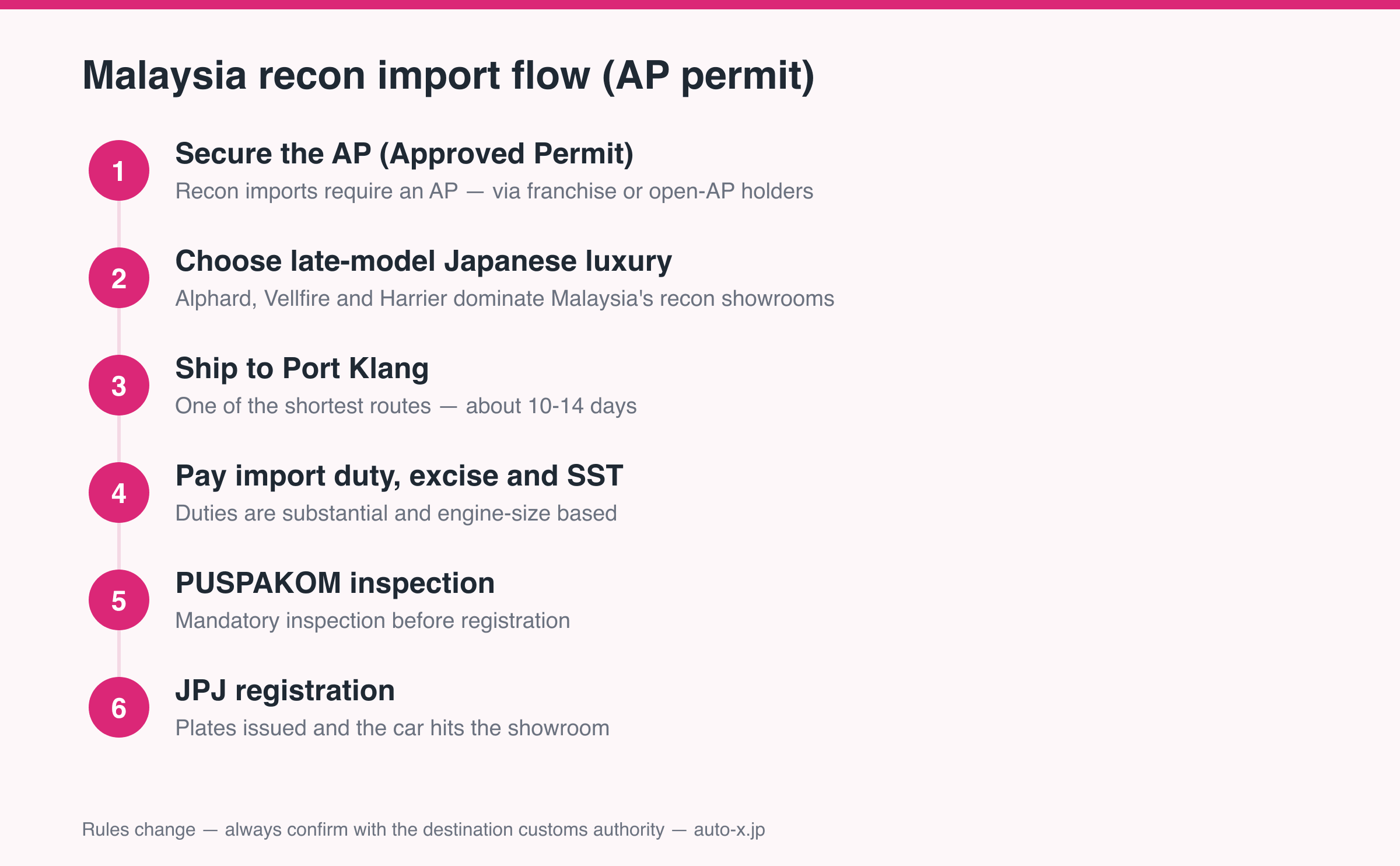
- Secure the AP. The Malaysian importer confirms permit cover for the unit.
- Select the car. We bid against the dealer's spec — typically a late-model Alphard, Vellfire or Harrier — through our auction agent service, sharing auction sheets and photos before any bid.
- Ship to Port Klang. Export deregistration, Japanese customs clearance, then a sailing of about 10–14 days. Route details are on our shipping to Port Klang page.
- Clear duties. Import duty, excise duty and SST are assessed and paid on the Malaysian side.
- PUSPAKOM inspection. The car is inspected before it can be registered.
- JPJ registration. The vehicle is registered and plated for Malaysian roads.
From winning bid to Malaysian plates, plan in weeks, not days — the sailing is quick, but permits, clearance and inspection each take their share of the calendar.
The duty stack: import duty, excise and SST#
We will not quote percentages here, because rates depend on engine capacity, vehicle type and the rules in force at the time of import — and quoting stale numbers helps nobody. What matters is the structure: import duty applies as the vehicle lands, excise duty is the largest component for most passenger cars and is heavily influenced by engine size, and SST applies on top. Together these can add up to a sum comparable to — or exceeding — the value of the car itself, particularly for larger engines. That is why a recon Alphard retails in Malaysia at a multiple of its Japanese auction price, and why nobody should judge a dealer's margin by comparing the two figures directly.
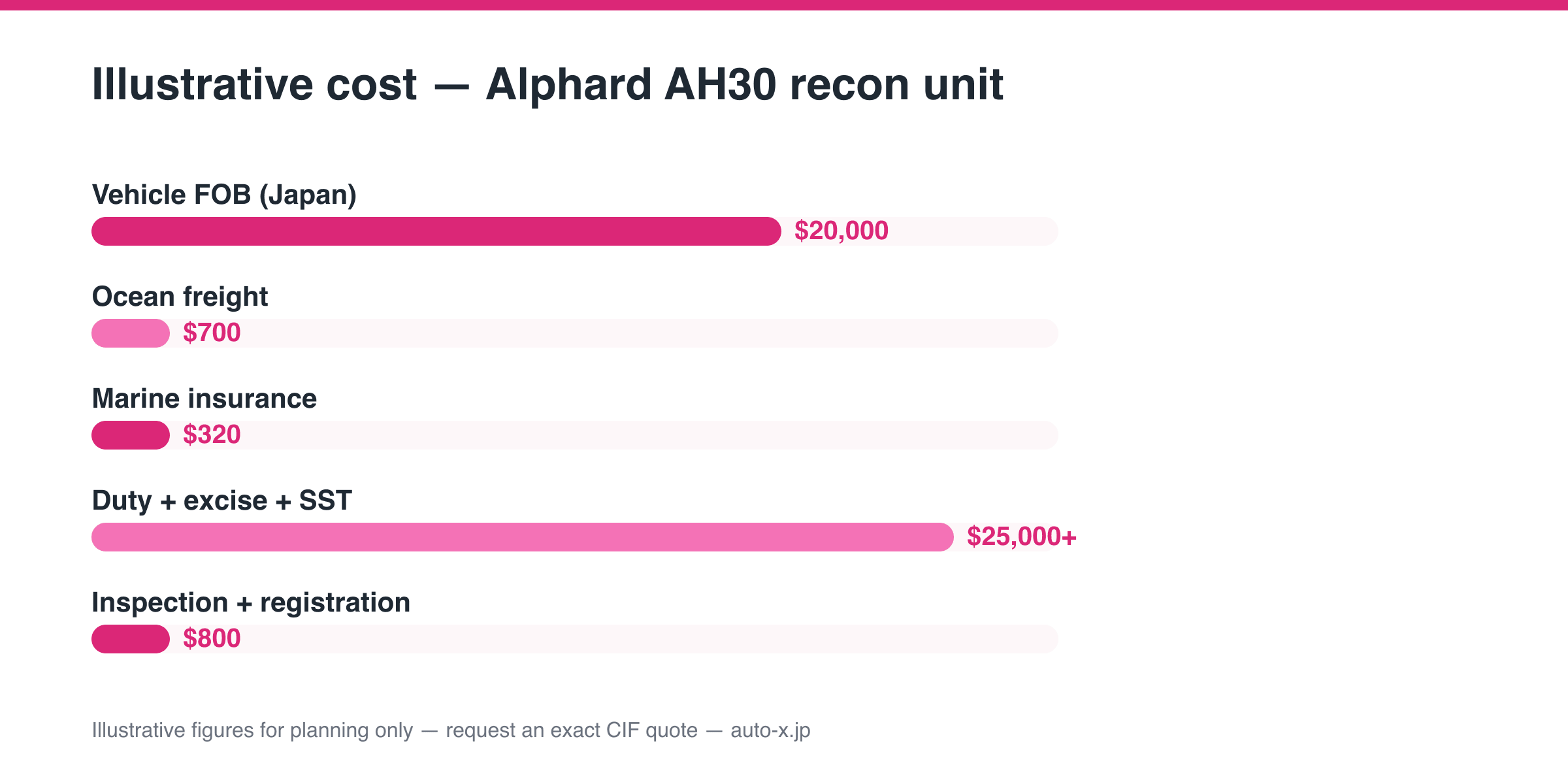
For an AH30-generation Alphard recon, an illustrative stack might look like: FOB around $20,000, freight roughly $700, marine insurance about $320, duties and taxes upwards of $25,000, and inspection plus registration in the region of $800. Treat these bars as proportions, not quotes — the exact duty figure varies with the unit and current rates. The takeaway is visual: on this route, the tax column towers over everything else, including the car. Always confirm current rates with a Malaysian customs agent or the official schedules before committing to a unit.
PUSPAKOM and JPJ: the final two gates#
Before an imported car can be registered, it must pass inspection at PUSPAKOM, Malaysia's vehicle inspection body. The inspection verifies the vehicle's identity — chassis and engine numbers against the import documents — and its roadworthiness. Only after passing does the car proceed to JPJ, the Road Transport Department, for registration and plates.
From the export side, this is where disciplined paperwork pays off. The chassis number on the export certificate, the auction sheet, the bill of lading and the invoice must all agree; a one-character discrepancy can stall a registration. We photograph the chassis plate of every unit before loading and reconcile documents before they leave our office, because a car stuck between PUSPAKOM and JPJ earns nobody anything.
How we work with Malaysian recon dealers#
Most of our Malaysia business is repeat dealers running a steady pipeline: a spec list, a monthly budget, and units flowing continuously. We bid daily across Japan's major auction houses, send auction sheets with our own translation and honest commentary — including reasons not to buy a particular car — and consolidate shipments where it saves freight. For dealers newer to importing, we walk through the documentation requirements before the first purchase so the Malaysian side clears without surprises.
FAQ#
Can I import a car into Malaysia without an AP?
For practical purposes, no. Each imported vehicle needs permit cover, and open APs are held by licensed companies. Individuals typically buy from a recon dealer rather than importing directly — which is exactly why it pays to understand how your dealer sources stock.
How long does the whole process take, auction to road?
The sailing itself is short — around 10–14 days to Port Klang. End to end, including auction purchase, export preparation, duties, PUSPAKOM and JPJ, dealers commonly plan for several weeks to a couple of months per unit.
Why is a recon car so much more expensive in Malaysia than in Japan?
Duties. Import duty, excise and SST — influenced heavily by engine capacity — can add a sum comparable to or larger than the car's own value. The Japanese auction price is only the starting point of the landed cost.
Whether you are a recon dealer building a pipeline of Alphards and Harriers or an individual doing homework before visiting a showroom, we are happy to show you real auction-level numbers for the exact spec you want. Tell us the model and destination and request a free CIF quote — we will reply with current, honest figures from the Japanese side.