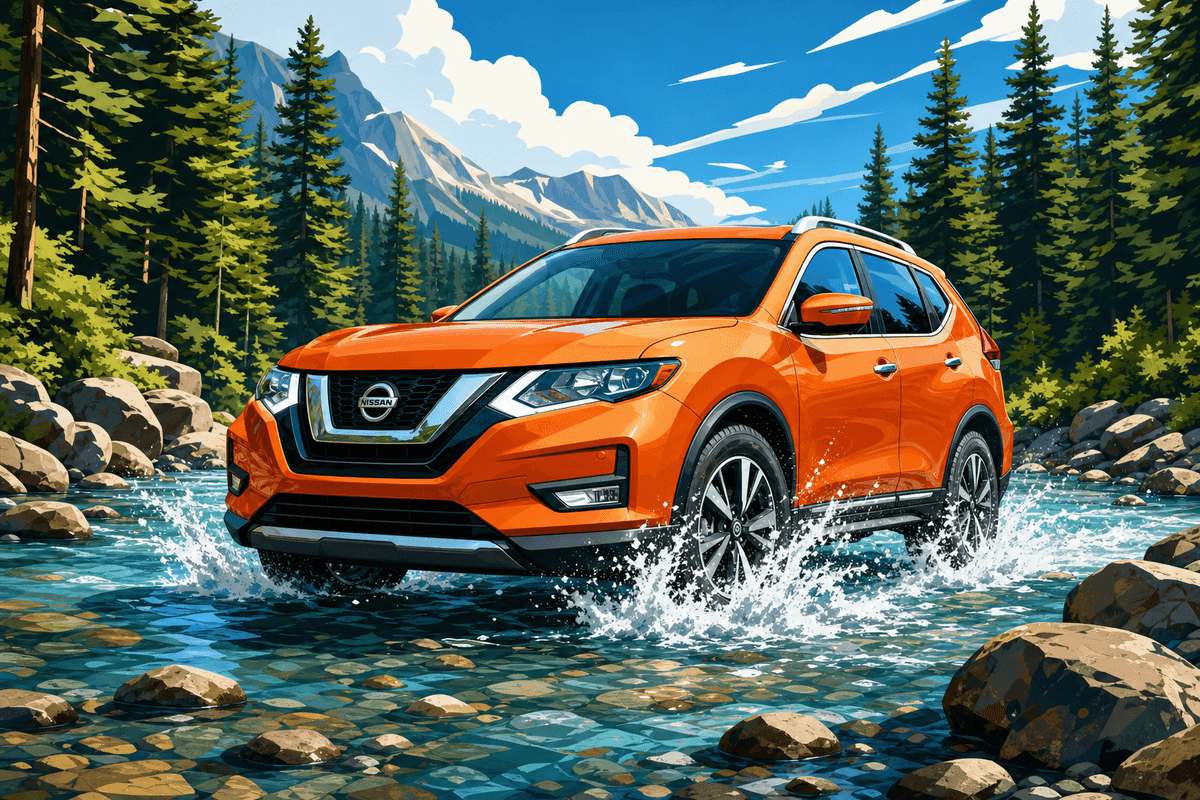
Ask a taxi driver in Ulaanbaatar or a safari operator outside Arusha what they want from Japan and the X-Trail comes up fast. It earned its rugged reputation honestly: proper all-wheel drive, real ground clearance, and a body that shrugs off roads that would rattle a city crossover to pieces. We ship them east to Vladivostok, south to Mombasa and west to the Caribbean, and after years of grading them at auction we can tell you the difference between a good X-Trail and an expensive mistake usually comes down to three checks — the CVT, the 4WD system, and where in Japan the car spent its winters.
X-Trail T31 (2007–2015)#
The T31 is the square, boxy one, and in many export markets that shape is the whole point — it reads as a working 4x4, not a school-run crossover. Most auction stock is the 2.0 or 2.5 petrol with Nissan's ALL MODE 4x4-i system, which gives you 2WD, Auto and Lock modes from a dial. The interior is plastic-heavy and honest, with a washable-luggage-area practicality that fleet buyers love. These were popular in snowy prefectures, which cuts both ways: the drivetrain got real use, and the underside got salted roads. The T31 stayed on sale in Japan well after the T32 launched abroad, so late, low-mileage examples exist.
What to know at auction: T31 supply is aging. Clean-underbody examples now carry a visible premium over cosmetically identical cars from the snow belt, and that premium is worth paying every single time.
X-Trail T32 (2013–2021)#
The T32 went rounder and more family-shaped, gained a 7-seat option, and later added a hybrid variant. The mechanical story that matters for exporters: CVT across the board, and a more electronically managed 4WD system. It is quieter, more efficient and more comfortable than the T31, and city buyers prefer it — but hardcore upcountry buyers in Mongolia and East Africa often still specify the T31 shape on sight. The hybrid is a genuine fuel saver for shuttle work; it needs the same battery-health scrutiny we apply to any used hybrid, and we would rather buy a strong petrol car than a cheap, questionable hybrid.
What Goes Wrong: Our Inspection Checklist#
The CVT. This is the number one X-Trail check, both generations. A healthy CVT pulls smoothly from a stop with no shudder, no flare, and no whine on a steady throttle. Judder at low speed or a note about transmission behavior on the auction sheet is a walk-away for us unless the price accounts for a rebuild. CVT fluid history matters — a car with recorded fluid services is worth a real premium in bid terms. If your destination is hot and hilly, be pickier still: heat is what kills CVTs.
The 4WD system. Cycle the mode selector and confirm the modes engage without warning lights. Failures here are less common than CVT trouble but expensive to chase — couplings, sensors and control modules. A car that has clearly lived in 2WD on pavement its whole life is often the mechanical sweet spot.
Rust from snow-country cars. Japan salts its winter roads heavily in Hokkaido, Tohoku and along the Sea of Japan coast. On early T31s especially, look at the auction sheet notes and underbody photos for corrosion on the rear subframe, suspension mounts and exhaust hangers. Surface rust is normal on a 15-year-old car; scaling or flaking on structural points is not. We physically inspect the underside on any T31 we bid seriously on.
Beyond the big three: check tailgate struts, worn driver's seat bolsters, and that the spare wheel and jack are actually present — upcountry buyers notice.
Who Buys the X-Trail#
Russia has been the X-Trail's biggest fan club for two decades, and demand through Vladivostok stays strong for both generations. Mongolia takes T31s in volume — the shape, the ride height and the simple 4WD dial fit the use case perfectly. East African buyers in Kenya and Tanzania run them as family cars, NGO fleet vehicles and safari-adjacent workhorses, typically 2.0 petrol T31s and early T32s. Caribbean buyers lean to the T32 for its comfort. If your customers are comparing Japanese SUVs at a higher price point, our Toyota Harrier buyer's guide covers the premium alternative.
Typical Recent Auction Levels#
Orientation only — levels move with season and exchange rate. Tidy T31s have recently traded from roughly ¥300,000 for early high-mileage cars up to around ¥900,000 for late, clean, low-kilometre examples. T32s run from about ¥700,000 for early cars to ¥1,500,000-plus for late facelifts and hybrids in strong grades. Underbody condition moves T31 prices more than odometer readings do — remember that when a cheap car looks tempting.
FAQ#
T31 or T32 for a rough-road market? T31 if your buyers prize simplicity and the boxy working-truck image; T32 if comfort, efficiency and seven seats sell. Both handle bad roads better than most rivals in the class.
How worried should I be about the CVT? Respect it, do not fear it. A smooth test drive, no auction-sheet notes and ideally a fluid-change record put the odds firmly on your side. Budget-priced cars with transmission notes are cheap for a reason.
Are hybrids worth it for Africa? Only with a verified-healthy battery and a destination with someone able to service hybrids. For most East African buyers we still recommend the plain petrol — simpler is safer upcountry.
Ready to Source One?#
See what is on the water now in our vehicle stock, browse more model guides, or request a quote with your port — we will send landed-cost numbers and current auction candidates with underbody photos. And a standing reminder: we only ever invoice from verified company bank accounts. Payment safety details are on our payment page.