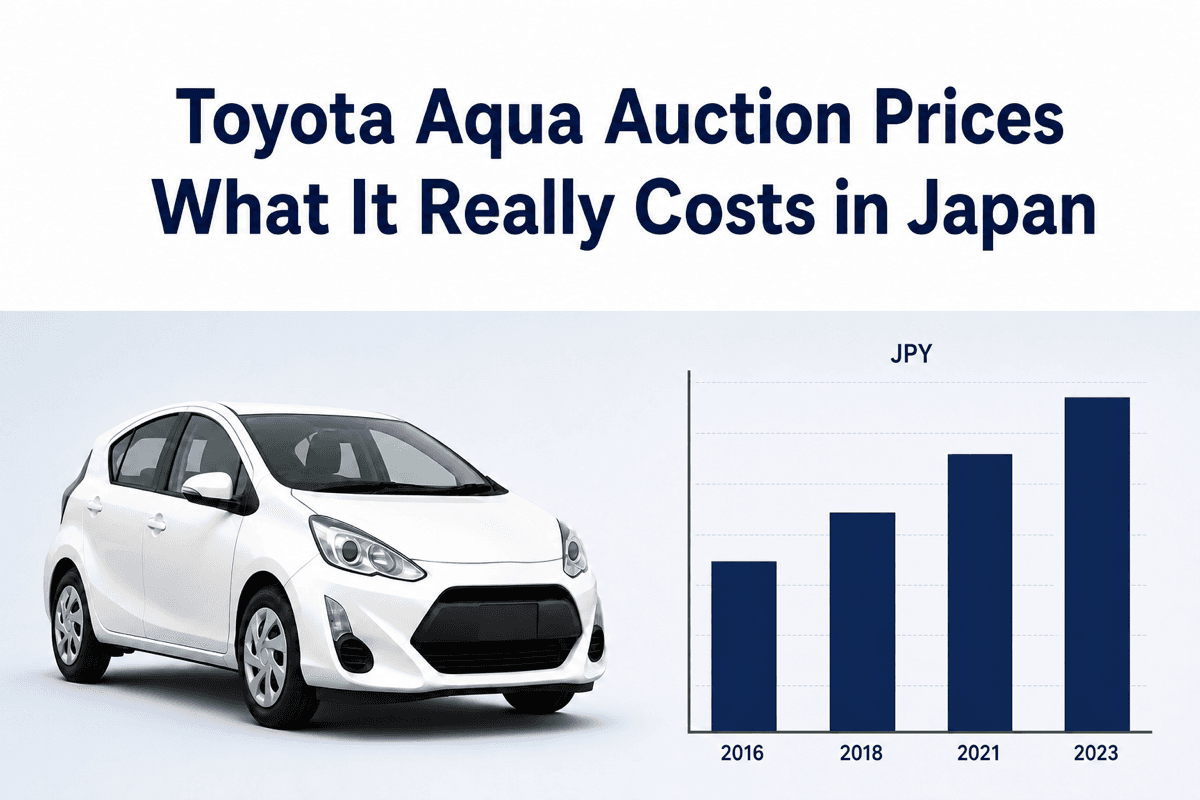
A clean 2017 Toyota Aqua typically hammers between ¥500,000 and ¥850,000 at a Japanese auction. A 2021 car runs ¥900,000 to ¥1,500,000. Almost all of that gap is model year — not mileage, not trim level.
We are asked for "the price of an Aqua" several times a week, and it cannot be answered with one number. So here are the ranges we actually bid into, drawn from roughly 2,300 Aqua results across the Japanese auctions in the three months to August 2026. These are rounded typical ranges covering the middle half of the market; individual cars land outside them in both directions.
Toyota Aqua hammer price by model year#
| Model year | Typical range | Typical mileage |
|---|---|---|
| 2016 | ¥450,000 – ¥750,000 | ~60,000 km |
| 2017 | ¥500,000 – ¥850,000 | ~60,000 km |
| 2018 | ¥700,000 – ¥1,050,000 | ~52,000 km |
| 2019 | ¥750,000 – ¥1,150,000 | ~47,000 km |
| 2020 | ¥800,000 – ¥1,150,000 | ~50,000 km |
| 2021 | ¥900,000 – ¥1,500,000 | ~45,000 km |
| 2022 | ¥1,150,000 – ¥1,550,000 | ~44,000 km |
| 2023 | ¥1,250,000 – ¥1,700,000 | ~39,000 km |
The Aqua is a hybrid-only model, so there is no petrol version to compare against. Every car in the table above is a hybrid.
The 2021 generation change is the biggest single step#
The Aqua moved to its second generation in 2021, and that break is the sharpest in the data. First-generation cars average around ¥800,000. Second-generation cars average around ¥1,500,000 — a step of roughly ¥700,000 for a car that, from the driver's seat, does exactly the same job.
If your market does not pay extra for the newer body, the last year of the first generation is the value pick: a 2019 or 2020 Aqua gives you the same platform, the same running costs and the same parts availability for well under half the money.
Auction grade: half a point costs about ¥200,000#
Every car at a Japanese auction carries a grade from the inspector. Across 2017–2020 Aquas the steps are remarkably even:
| Auction grade | Typical hammer price |
|---|---|
| 3.5 | around ¥600,000 |
| 4 | around ¥790,000 |
| 4.5 | around ¥1,000,000 |
Half a grade point is worth roughly ¥200,000 — a real decision, not a rounding error. A grade 3.5 car is not a bad car; it usually means visible scratches, small dents or one repainted panel. If your customers care about mechanical condition more than paint, grade 3.5 is where the value sits. If you retail to buyers who walk around the car first, pay for the 4.
If you are not yet comfortable reading grades and inspector marks, start with our guide to reading a Japanese auction sheet.
Mileage: the cliff is at 60,000 km#
For 2017–2020 cars:
| Odometer | Typical hammer price |
|---|---|
| Under 30,000 km | around ¥1,040,000 |
| 30,000 – 60,000 km | around ¥940,000 |
| 60,000 – 90,000 km | around ¥740,000 |
| 90,000 – 120,000 km | around ¥560,000 |
Moving from under-30,000 km into the 30,000–60,000 km band costs about ¥100,000. The next step down costs roughly double that. If odometer readings drive resale in your market, 60,000 km is where to draw your filter.
Where you bid matters by about 10%#
The same specification runs roughly 10% cheaper at regional auction venues than at the largest Tokyo halls. Bidding nationwide rather than at a single venue is one of the few reliable ways to take money off a landed cost without compromising the car itself. On a ten-car order that difference alone is worth more than most agency fees.
Aqua or Fit?#
The Honda Fit hybrid tracks the Aqua closely — usually within ¥50,000 at the same year and grade. Buyers often assume the Toyota badge commands a premium in this class; at auction it mostly does not. The deciding factors are parts availability in your market and what your customers already trust. We break the Honda side down in Honda Fit auction prices, and compare the whole hybrid segment in our hybrid buyer's guide.
The hammer price is not your FOB#
This is what surprises first-time importers most. On top of the hammer price you pay:
- The auction house fee for the vehicle
- Inland transport from the auction hall to the port or vanning yard
- Export deregistration and document preparation
- Pre-shipment inspection, where your destination requires one
- Your agent's fee
Together these add a mid-five-figure yen amount per car before anything is loaded. Any quote that gives you a single "price" without separating the hammer price from the fees is hiding something. We disclose the hammer price on every car we buy and do not mark it up — the full structure is on our pricing page.
Currency#
Auctions settle in yen. Your budget almost certainly is not in yen, and the rate moves enough month to month to swallow a whole grade point. Treat the figures above as yen figures and convert on the day you set your ceiling, not from a rate you saw last quarter.
Age limits decide your model year before your budget does#
Several import markets cap vehicle age, and a number of them measure that age at the moment customs clearance completes — not when the ship leaves Japan. With six to ten weeks of transit plus clearance time, a car that qualified on the day you bid can fail on arrival.
Work backwards from your own regulation, add a safety margin of a full model year, and only then look at the tables above.
How to set a bid ceiling#
Pick the model year from your age limit. Pick the grade from what your customers actually inspect. Pick the mileage band from what your market resells on. Then take the top of the relevant range, add the fees — that is your ceiling. Set it before the lane opens, not during it.
The cars that get bought badly are almost always bought without a ceiling.
Frequently asked questions#
Is the Toyota Aqua the same car as the Prius C? Yes. The Aqua is sold as the Prius C in some export markets. Japanese domestic auction stock is badged Aqua.
Do Aqua hybrid batteries fail? The first-generation battery has proven durable in hot climates, and replacement units are widely available. Battery condition is not usually the deciding factor at these price points — grade and mileage are.
What is the cheapest usable Aqua? A 2016 car at grade 3.5 with 80,000–100,000 km sits near the bottom of the market. Below that you are buying accident history or a car that will not pass inspection at destination.
Can I get a specific grade and mileage on request? Yes. Tell us the year, grade and mileage band and we search the week's auctions against it, then bid to a ceiling you set in advance.
Ready to set one? Request a quote or browse the Toyota Aqua model page.