

When two nearly identical Land Cruiser Prados cross the block twenty minutes apart and one hammers for $1,400 more, the reason is almost always printed in the corner of the auction sheet: the grade. We bid at Japanese auctions every week for importers in New Zealand, East Africa, the Caribbean and the Gulf, and the question new buyers ask us most is some version of "is a grade 4 really worth that much more than a 3.5?"
The honest answer is: sometimes yes, sometimes no — it depends on your market, your margin, and what the rest of the sheet says. This article explains what each overall grade actually means in practice, what the interior and exterior letters add, roughly what the market charges for each step up the ladder, and how we match grades to destinations. One thing we deliberately won't repeat here is the layout of the sheet itself — the damage-map symbols, equipment codes and inspector notes are covered in our separate guide on how to read a Japanese auction sheet. Read that one first if the sheet still looks like hieroglyphics; read this one to decide what to bid.
The grade ladder from S down to R#
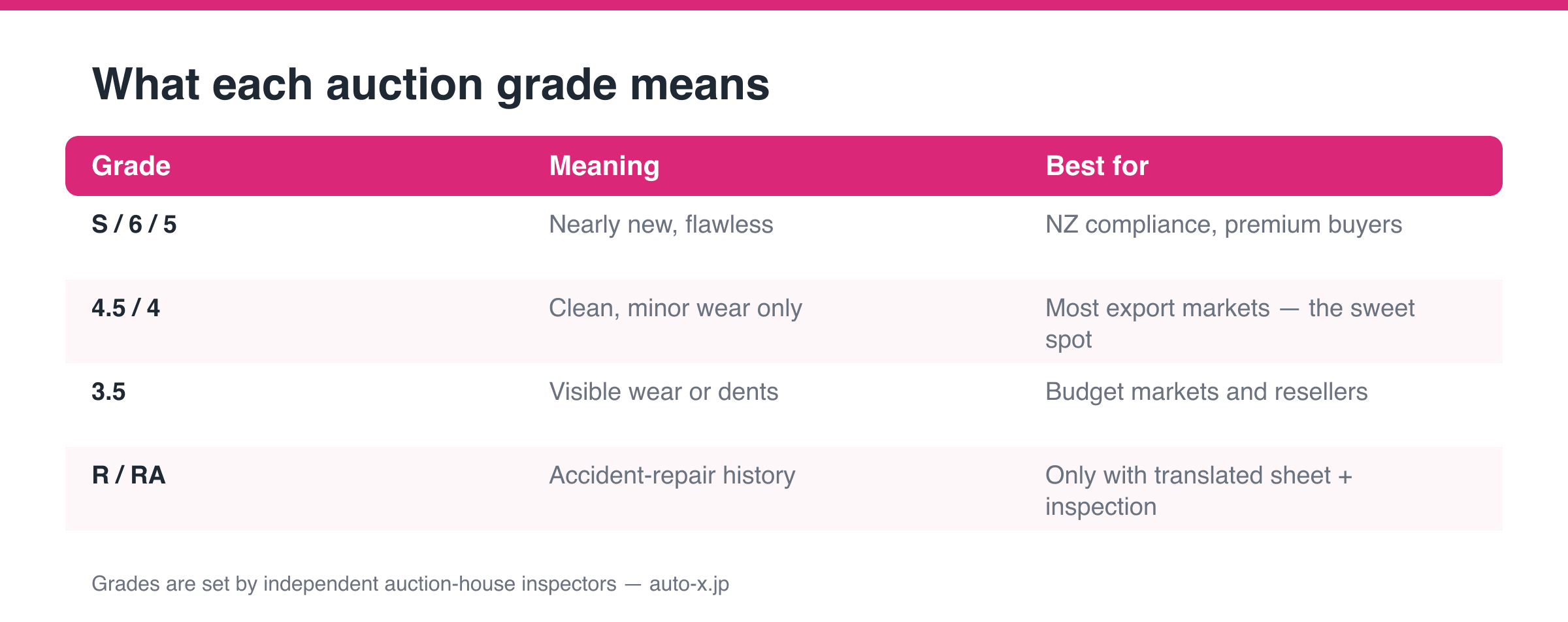
Every major auction group — USS, TAA, JU, HAA and the rest — employs its own inspectors, but the grading ladder they use is broadly consistent:
S (some houses use 6) — effectively a new car, usually under a year old with delivery mileage. These exist mostly for dealers filling domestic orders; for export they rarely make financial sense.
5 — near-new condition: very low mileage, no flaws worth noting. A small premium market.
4.5 — an exceptionally clean used car. Light use, no dents, at most a faint polish mark an inspector felt obliged to record.
4 — the workhorse grade of the export trade. A genuinely tidy car with normal wear: a small door ding, light stone chips, perhaps one panel professionally refinished. Mechanically expected to be sound.
3.5 — visible wear. Multiple small dents or scratches, scuffed bumpers, maybe faded paint on horizontal panels. Still a fully usable car; it simply looks its age.
3 — heavy cosmetic wear, or a specific problem the inspector wants flagged: corrosion spots, an interior that needs work, or paint that needs more than polish.
2 and 1 — rough cars: significant corrosion, mechanical issues, or heavy damage. We bid on these only when a parts buyer asks for them.
R and RA — the repair-history grades. The car has had accident damage repaired that involved structural or "counted" panels. R does not mean bad — it means disclosed. More on that below, because R-grade cars are one of the most misunderstood value plays in this business.
The letters matter as much as the number#
Next to the overall grade you'll find letter scores — typically one for the interior, and at many houses one for the exterior — running A (excellent) through D (poor).
These letters catch what the number hides. A grade 4 with a C interior is a car whose body is fine but whose cabin smells of cigarettes or has a cracked dash — a real problem if your customers are private buyers in New Zealand, a non-issue if the car is heading into taxi work. Conversely, a 3.5 with a C exterior and an A interior can detail up beautifully for markets where panel condition matters less than the cabin the driver sits in every day.
Our rule when we screen sheets: read the number for the body, the letters for the experience. A 4/B is our default recommendation for most buyers. A 4/D deserves the same suspicion as a 3.5.
What one half-grade costs in real money#
The market prices grades with surprising consistency. On the mid-range models we bid on most — Aqua, Fit, Vitz, Fielder, Note — the gap between a grade 4 and a grade 3.5 of the same model, year and mileage band typically runs $800–1,500 at hammer. Step from 4 to 4.5 and you pay another premium again, often for cosmetic differences your end customer will never notice after an inexpensive detail.
That gap is the single most useful number in auction buying, because it cuts both ways:
- If your market resells on condition (New Zealand, Cyprus, Caribbean private buyers), the 4 earns its premium back and more.
- If your market resells on price (much of East and Southern Africa), the 3.5 that runs identically is the better margin — the cosmetic wear is priced in at your end too.
R-grade cars stretch the discount much further: a properly repaired RA can hammer thousands of dollars under an equivalent grade 4. Whether that discount is a bargain or a trap depends entirely on what was repaired, which is why we never bid an R without reading the repair notes line by line.
Matching grades to export markets#
After years of shipping to very different destinations, our shorthand looks like this:
New Zealand — compliance inspection is strict and buyers expect clean cars. We steer NZ clients to grade 4 and above, interior B or better. A borderline structural repair that sails through in one market can fail NZ compliance; R grades only with full documentation and only for buyers who know the rules.
Kenya, Tanzania, Uganda, Zambia — these markets buy on landed price and mechanical condition. Grade 3.5 is the sweet spot: honest cosmetic wear, full mechanical function, and a hammer price that keeps the CIF competitive. Pair the grade check with a mileage check — see how to verify real mileage — because a low price with a wound-back odometer is no bargain.
Gulf and Caribbean — mixed. Presentation matters for resale, so 4 is the default, but a sharp 3.5 in the right colour often outperforms it.
R and RA for the informed buyer — when the sheet specifies exactly what was replaced (say, a rear panel after a low-speed hit, with no rail involvement), an RA car can be the best value on the row. When the notes are vague — "repair history" with no detail — we walk away, and we advise you to as well.
How we actually bid, step by step#
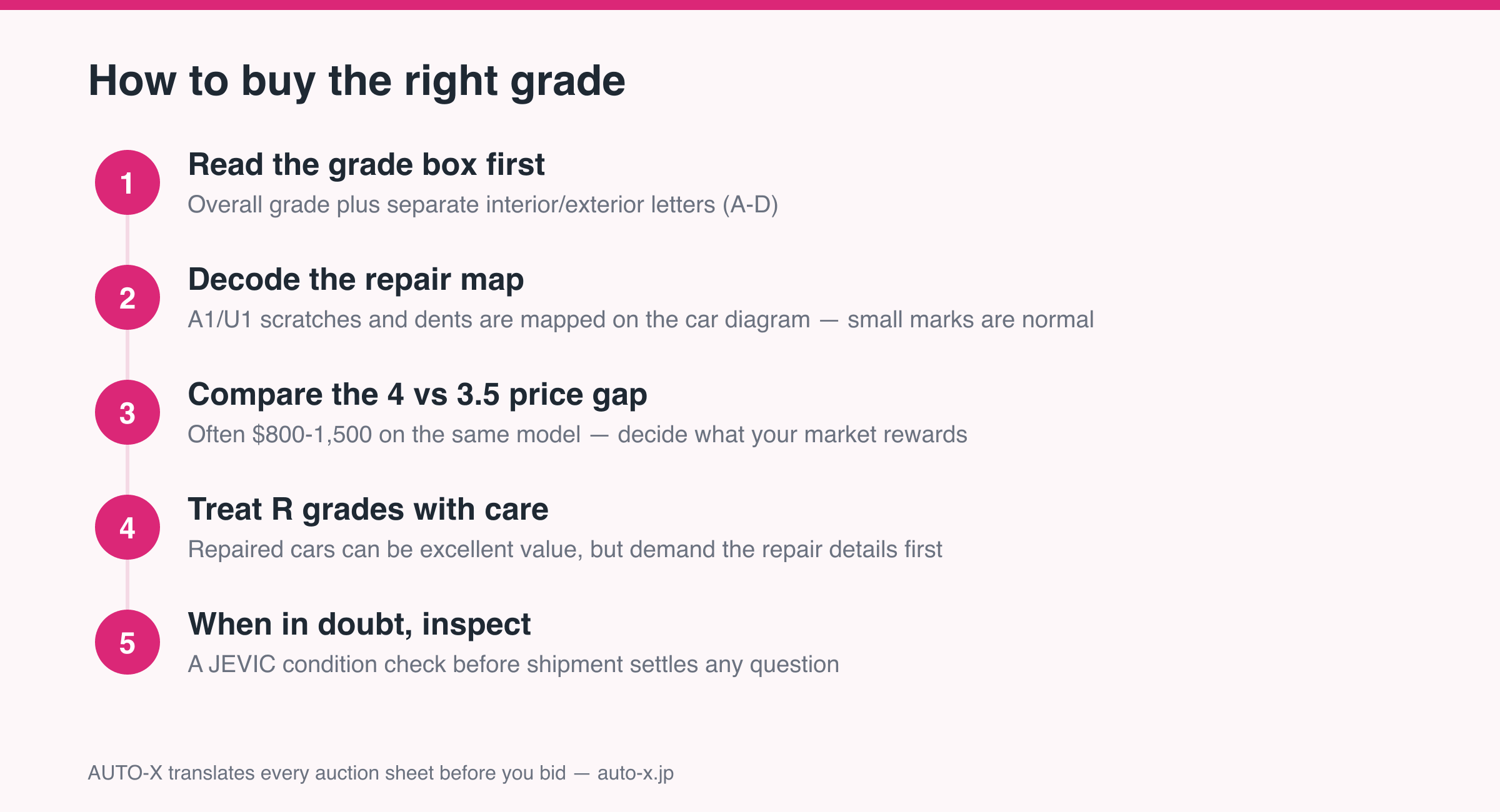
Our floor process condenses to five steps, and it's the same discipline we suggest any buyer follows:
- Read the grade box first — number plus letters, together.
- Decode the damage-and-repair map before falling in love with the photos.
- Compare the live 4-vs-3.5 gap on that exact model that week — when the gap compresses, buy the 4; when it stretches, the 3.5 is the play.
- Treat R/RA with respect, not fear — demand specifics, and price the discount against the repair.
- When in doubt, inspect — our staff physically check cars at major auction yards before we commit your money.
Every sheet translated before you bid#
Grades only protect you if you can read everything around them, and auction sheets are handwritten Japanese shorthand. Through our auction agent service, every sheet is translated in full — grade, letters, inspector comments, repair notes — and sent to you before you approve a bid, not after. As a licensed exporter (licence No. 431310063715) we are accountable for what we tell you a car is, which is exactly how we prefer it.
FAQ#
Is a grade 3.5 car a bad car? No. A 3.5 is a normal used car that looks used — dents, scratches, wear consistent with age. Mechanically it can be every bit as reliable as a 4. It's the right buy when your market prices on function rather than cosmetics.
Should I ever buy an R-grade car? Yes — selectively. When the repair is specified, minor, and reflected in a deep discount, R-grade cars are genuine value. When the repair details are missing or the damage touched structural rails, pass. We treat every R sheet as guilty until the notes prove otherwise.
Do all auction houses grade identically? The ladder is the same but the strictness isn't; a 4 at one house can feel like a 3.5 at another. This is why we rely on the full sheet and physical inspection rather than the number alone.
A grade is a starting point, not a verdict — the profit is in knowing when to pay for the 4 and when the 3.5 is the smarter container slot. Tell us your market and budget and we'll shortlist the right grades for you: request a free CIF quote.