

We see more enquiries for the Prius than for any other single model we handle — and also more nervous questions. Nearly all of that nervousness comes down to two things: which generation to buy, and whether the hybrid battery will fail a month after the car lands. Both have clear answers once you have put enough of these cars through the Japanese auction system. This guide walks through the four generations that matter for export, explains how we judge battery condition before we ever bid, and matches each generation to the markets where it actually makes money.
One note before we start: if you are still weighing the Prius against the Aqua or the Honda Fit Hybrid, read our hybrid comparison guide first — that article compares models, while this one assumes you have chosen the Prius and goes deep.
Four Generations, Four Very Different Cars#
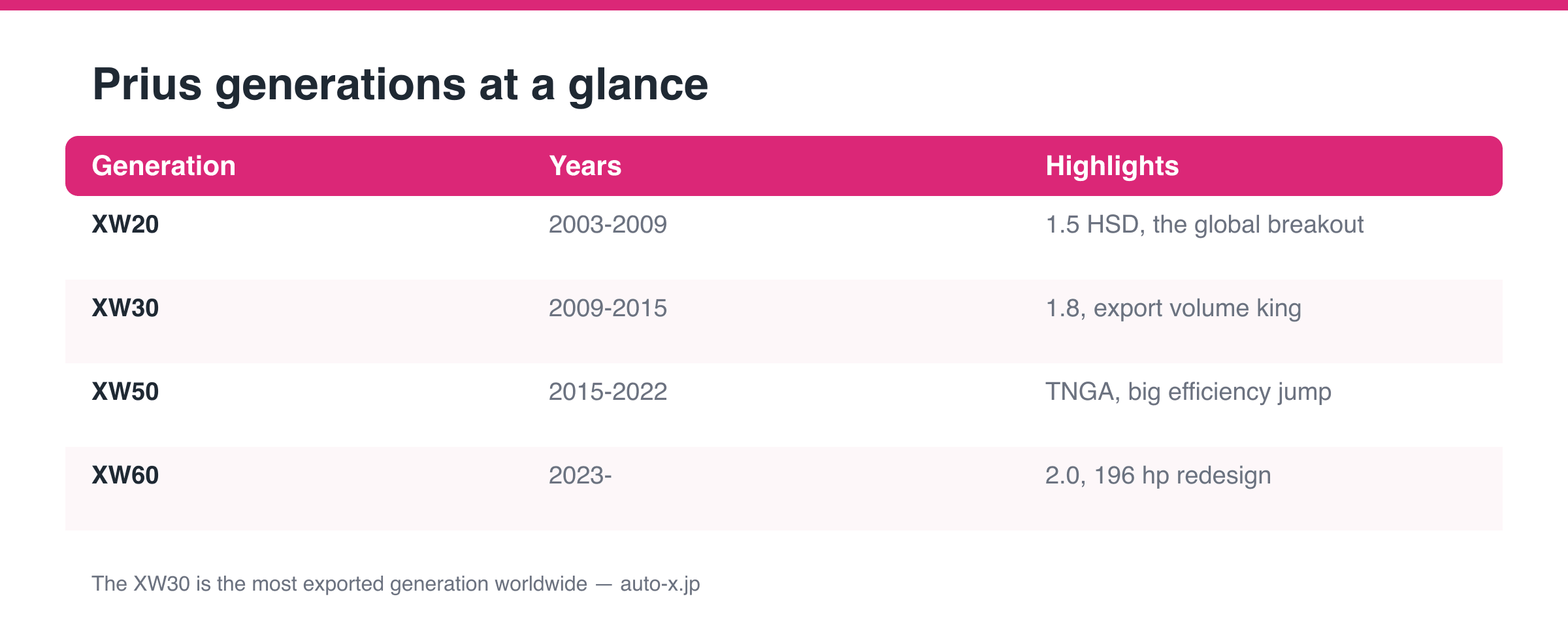
XW20 (2003–2009). The breakout generation — the wedge-shaped Prius that made the name famous. A 1.5-litre engine with Toyota's second-generation hybrid system, mechanically simple by modern standards and endlessly rebuildable. Auction supply is thinning and most surviving cars carry high mileage, but demand from cold-climate, price-sensitive markets keeps it alive.
XW30 (2009–2015). The export volume king. The move to the 1.8-litre 2ZR-FXE engine solved the XW20's habit of straining at highway speeds, and Toyota sold these in enormous numbers in Japan — which means deep auction supply, honest price discovery and cheap parts everywhere on earth. When a customer asks us for "a Prius" with no further detail, this is usually the car they mean.
XW50 (2015–2022). The first Prius on the TNGA platform. Ride, handling and body rigidity took a big step up, fuel economy improved again, and the interior finally feels like a car rather than an appliance. This is the sweet spot for markets with age-based import rules, since most of the run still clears an eight-year window.
XW60 (2023–). A genuinely quick car — the 2.0-litre hybrid produces 196 hp — with styling that ended the "boring Prius" jokes overnight. Auction prices remain high and supply is still mostly lease returns, so today it suits image-conscious buyers rather than fleet operators.
How We Judge Battery Health Before We Bid#
Auction sheets do not include a battery health percentage, so this is where an experienced bidder earns their fee. What we actually look at:
- Warning lamps in the dashboard photo. Auction inspectors photograph the cluster with the ignition on. A hybrid system warning here is disclosed information, and it collapses the price — an opportunity or a trap depending on your plan.
- Inspector notes. Japanese inspectors write down what they find. Notes like "hybrid warning lamp on" appear on the sheet, and reading them before you commit is part of our job as bidders.
- Mileage–age balance. A ten-year-old Prius with 60,000 km sometimes worries us more than one with 150,000 km. Batteries degrade with heat cycles and with sitting, not just with distance, and steady use tends to keep packs healthy.
- Former use. Ex-taxi and ex-fleet cars are flagged at auction: high mileage but usually consistent servicing. A reasonable buy for a taxi operator, a poor one for private resale.
- Service history. Maintenance records photographed in the cabin, and dealer service stickers, tell us whether the car lived on a schedule or on luck.
None of this replaces a plug-in diagnostic, but it is remarkably predictive. It is also exactly the work our auction agent service does on every Prius we bid on.
The Battery Fear Is Overpriced — Literally#
Here is the part most first-time importers get wrong: they treat a possible battery failure as a catastrophe, when the market has already priced it in. That fear is a large part of why used Priuses are such good value in the first place.
Three things soften the real-world cost. First, the NiMH packs in the XW20, XW30 and most XW50s are modular: packs usually fail a few cells at a time, and rebuilders replace individual modules rather than the whole unit. Second, because the XW30 sold in such volume, used and refurbished packs for it are the cheapest and easiest to source of any hybrid model. Third, independent battery rebuilding has become a normal trade in the biggest Prius markets — Ulaanbaatar, Colombo and Nairobi all have workshops that do nothing else. A battery job on a landed car is an inconvenience, not a write-off.
Matching the Generation to the Market#
Mongolia. The Prius is close to a national car in Mongolia, and the XW20 and XW30 dominate because landed cost rules everything. Buyers there know the model deeply — expect sharp questions about battery condition. Winters at −30°C are harder on the 12V auxiliary battery (which stops the car from booting at all) than on the traction pack itself. We covered the full route and duty picture in our guide to importing to Mongolia.
Sri Lanka. With private vehicle imports reopening from 2025 after the long ban, pent-up demand has been strongly hybrid-shaped — fuel prices made sure of that. Age limits on imports push buyers to recent stock, which puts the XW50, and increasingly the XW60, in the frame rather than the older bargains.
Fiji. Fiji's duty structure has long favoured hybrids over conventional petrol cars, which makes the arithmetic friendly for mid-priced stock. Clean XW30s and early XW50s hit the balance of concession benefit and purchase price that Fijian dealers ask us for.
East Africa. Kenya's rule allowing imports only up to eight years old means the XW50 is effectively the entry Prius for Nairobi. Tanzania and Uganda permit older cars, and there the XW30 is the classic taxi-fleet workhorse: cheap to buy, cheap to run, and every mechanic already knows it.
What They Cost at Auction Right Now#
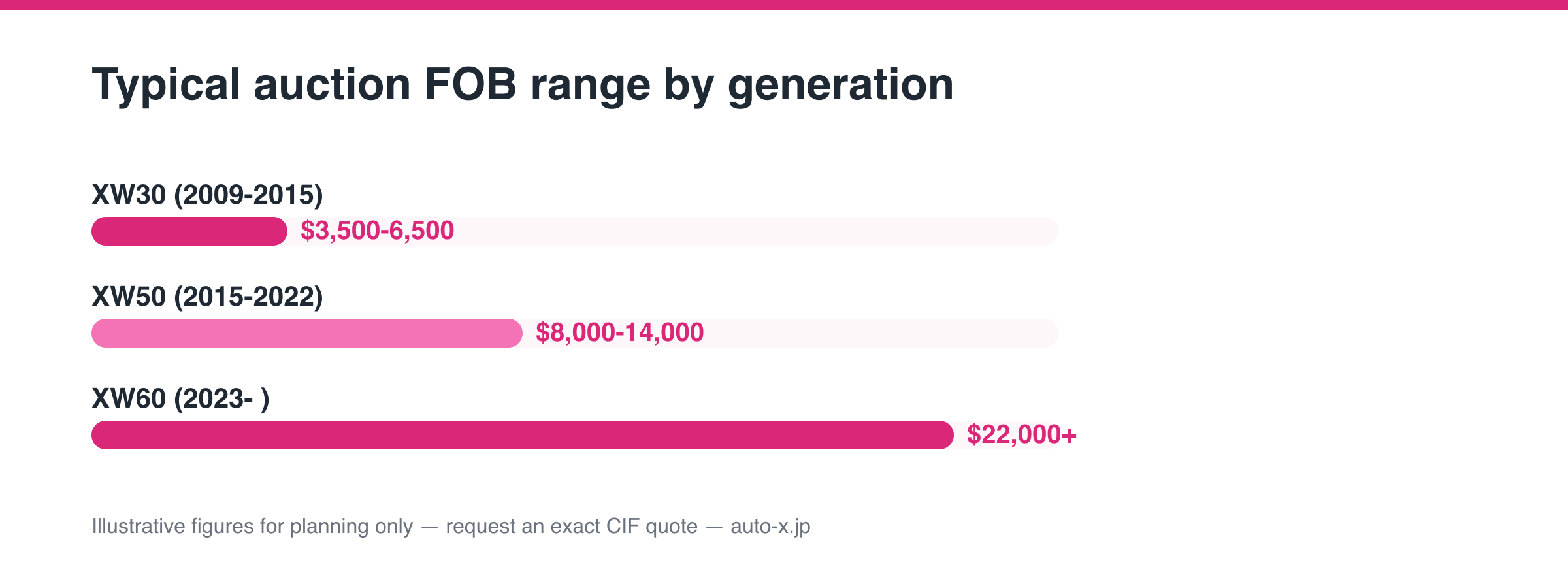
As illustrative FOB ranges from recent activity: solid XW30 cars run roughly $3,500–6,500 depending on year, grade and mileage; XW50s span about $8,000–14,000 with late facelift cars at the top; and the XW60 still starts above $22,000. Late XW20s in export-worthy condition trade below the XW30 band. Treat these as orientation, not quotes — auction prices move weekly, and grade moves them more than year does.
Our Pre-Bid Prius Checklist#
- Confirm your market's age and emissions rules before you shortlist a generation.
- Read the auction sheet's inspector notes in full — especially any mention of warning lamps.
- Check the dashboard photo yourself, ignition on.
- Weigh mileage against age; be suspicious of very low mileage on old cars.
- Ask about former taxi or fleet use.
- Budget a battery contingency into your landed cost — then be pleased when you don't need it.
FAQ#
Which Prius generation is the best value for export today? For most markets, the XW30. Supply is deep, prices are modest, parts are universal, and the 1.8 drivetrain is thoroughly proven. Only age-restricted markets like Kenya or Sri Lanka change the answer to the XW50.
Can you really assess a hybrid battery without inspecting the car in person? Not with certainty — but auction-sheet evidence (warning lamps, inspector notes, usage history, mileage–age balance) filters out most bad candidates before bidding. That screening is the core of what we do as your bidder.
Is the XW60 worth exporting yet? For most B2B buyers, not on price. It is a superb car, but auction values are still close to Japanese retail. We expect the equation to improve as early lease returns build supply.
Ready to run the numbers on a specific Prius? Tell us your destination port and target generation and request a free CIF quote — we will come back with real auction candidates and a full landed-cost estimate.