
The Land Cruiser most of the world actually drives is not the big one. It is the Prado — the mid-size ladder-frame SUV that fills NGO fleets in East Africa, family driveways in the Gulf, and mine-site car parks everywhere in between. At AUTO-X we ship more Prados than full-size Land Cruisers in a typical month, and buyers ask us the same three questions every week: which generation, which engine, and what should it cost FOB Japan?
One thing before we start: this guide covers the Prado line only — J90, J120, J150 and the new J250. The full-size family (70, 80, 100, 200 and 300 series) is a different truck with different engines, weights and price bands, and we cover it separately in our full-size Land Cruiser guide.
Prado vs Full-Size: Make Sure You Are Buying the Right Land Cruiser#
First-time importers mix these up more often than you would think, because in Japan both wear the same Land Cruiser badge. The Prado is the mid-size model: shorter, several hundred kilograms lighter, and powered by four-cylinder and V6 engines rather than the large-displacement petrol and diesel units of its bigger brothers. That translates into a lower purchase price, cheaper freight, lower fuel bills and cheaper consumables. If your customers are private families, ride operators or aid organisations, the Prado is usually the right call. If they need flagship presence or heavy towing capacity, read the full-size guide instead.
The Four Generations, and Who Each One Suits#
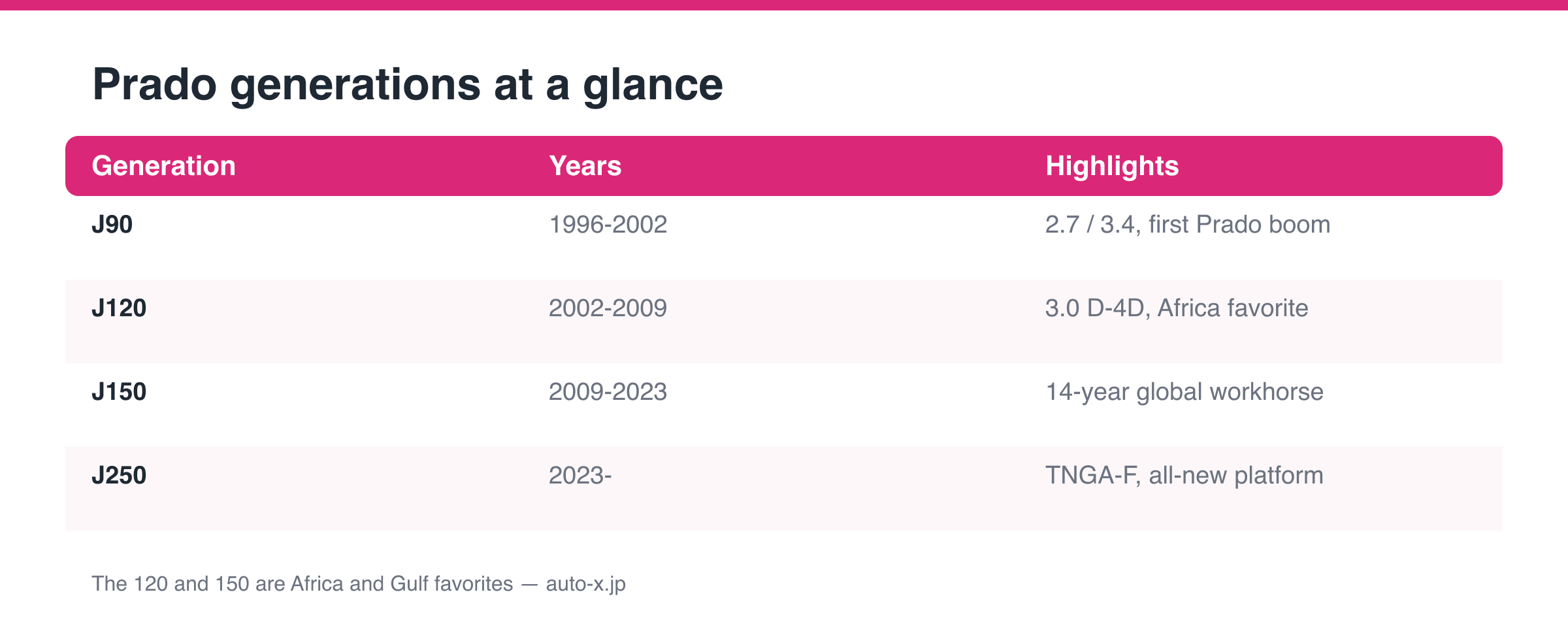
J90 (1996–2002). The first Prado with genuinely modern road manners. The 3.4 V6 petrol is smooth and long-lived, and the 1KZ-TE 3.0 turbodiesel has a loyal following of its own. Today the J90 is a budget play: clean examples are getting scarce at auction, and most trade cheaply. Best for markets with no age restrictions and tight budgets.
J120 (2002–2009). The generation that made the Prado a continental standard. It is mechanically simple, mechanics from Kampala to Muscat know it by heart, and parts are everywhere. Export demand centres on the 3.0 D-4D diesel — but note that Japanese domestic supply skews heavily petrol, so genuine diesel 120s at auction are scarcer than most buyers expect and priced accordingly.
J150 (2009–2023). A fourteen-year production run means this is where the supply is. Facelifts in 2013 and 2017 kept it current, and from 2015 the Japanese lineup added the 2.8 turbodiesel alongside the ever-present 2.7 petrol TX. Whatever your year, spec and budget, there is a J150 to match. This is our default recommendation for most markets.
J250 (2023–). The new Prado, built on the TNGA-F platform it shares with the 300-series. Noticeably bigger, far more refined, and priced like it. Auction cars are still near-new with low kilometres, so expect to pay strong money. Early demand is coming from the Gulf and CIS-adjacent markets rather than Africa.
Diesel or Petrol? Let the Destination Decide#
We rarely let a buyer choose an engine on personal preference alone.
- East and Southern Africa: diesel, almost without exception. Fuel availability, low-end torque on rough roads and — critically — resale value. A petrol Prado is hard to move on in Nairobi or Dar es Salaam.
- Gulf states: petrol works well. Fuel is cheap, the 2.7 and the V6 are unstressed in the heat, and local workshops prefer them. Diesel sells too, but it does not carry the premium it does in Africa.
- Russia and the Caucasus: both sell. The 2.7 petrol TX is the volume seller; the 2.8 diesel commands a clear premium.
- Caribbean and Pacific: usually petrol, following local fuel infrastructure.
Why the J120 and J150 Own Africa and the Gulf#
It comes down to standardisation. Two decades of continuous Prado imports mean every sizeable town in East Africa and every Gulf city has mechanics who know these chassis, shelves of used parts, and buyers who trust the badge. Fleets buy what they already run, so NGOs and companies keep specifying 120s and 150s, which keeps resale liquid — a tidy 150 in Mombasa or Dubai finds a new owner in days, not weeks. That resale certainty is worth as much as any specification on paper.
The Prado-Specific Checklist We Run Before Bidding#
- Diesel injectors. On D-4D diesels, injector condition is the most expensive unknown on the car. We look for cold-start smoke, injector rattle and service records showing replacement.
- Chassis rust. Prados from snow-country prefectures can hide serious frame corrosion under clean bodywork. We read the auction-sheet notes carefully and inspect the underbody whenever access allows.
- Genuine mileage on fleet units. Many Prados lived as company cars. That is not a bad thing — fleet maintenance is often excellent — but we verify the odometer through the auction mileage-check system and service stamps before bidding on any suspiciously low reading.
- Timing belt on the older V6. The 3.4 petrol uses a belt, not a chain; no replacement record means budgeting for one on arrival.
- 4WD engagement, transfer operation and diff locks where fitted, checked in the yard when possible.
What the Auction Supply Actually Looks Like#
In a normal week across the major Japanese auctions, J150s appear in real volume — mostly TX-grade 2.7 petrol, with a steady minority of 2.8 diesels that attract fierce bidding. J120s still show up daily, but clean low-mileage examples are thinning out year by year. J90s are cheap when they appear, though high-grade cars are now rare. J250s arrive as near-new trade-ins at strong prices. If you want a diesel 150 or an honest 120, the difference between winning well and overpaying is disciplined bidding — which is exactly what our auction agent service exists for.
Price Expectations, FOB Japan#
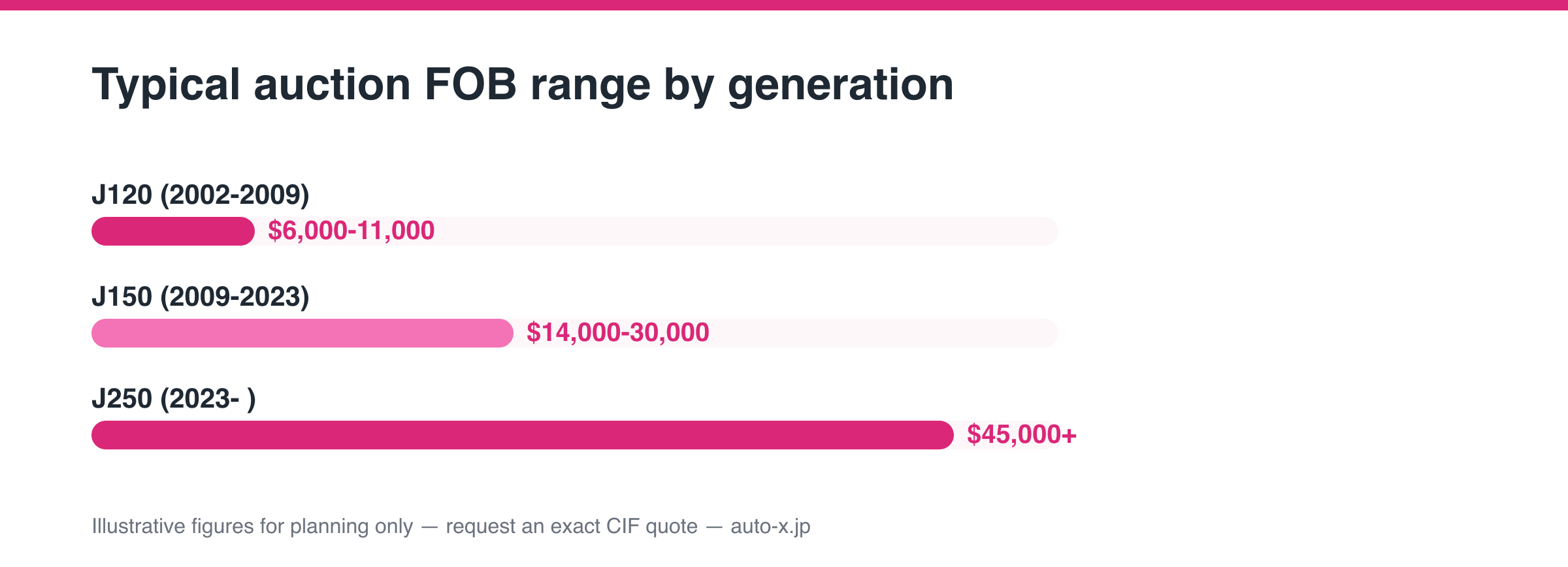
As illustrative FOB ranges based on what we currently see at auction: a usable J120 typically lands between $6,000 and $11,000; J150s run roughly $14,000 to $30,000 depending on year, engine and grade; and J250s start around $45,000 and climb from there. Diesel power, verified low mileage and later facelifts all push a car toward the top of its band. These figures move with the market and the exchange rate — treat them as orientation, not a quotation.
FAQ#
Is the 2.7 petrol Prado underpowered? Fully loaded or at altitude, you will feel it. For city and mixed use it is entirely adequate, and its simplicity is exactly why fleet buyers keep choosing it. If your routes mean heavy loads on rough roads, pay the diesel premium.
Which Prado fits age-restricted markets like Kenya? Kenya's eight-year rule effectively points you at later J150s right now. That is no hardship — post-2017-facelift cars are excellent — but budget accordingly.
Prado or a full-size 100-series at the same money? Different tools. The same budget buys a newer Prado or an older 100. For fuel cost and parts prices the newer Prado usually wins; for towing and V8 durability, the 100. Our full-size Land Cruiser guide covers that side of the family in detail.
Ready to source one? Browse current stock on our Land Cruiser model hub, or request a free CIF quote and we will come back with landed pricing for your port within one business day.