Every week our export desk answers some version of the same message: "I want to start importing cars from Japan — where do I begin?" It comes from mechanics who already flip local cars, from taxi-fleet owners, from office workers with savings and a business plan. This article is the advice we actually give them, as a licensed Japanese exporter (MOBIC Co., Ltd., export licence No. 431310063715) that works with first-time dealers every week. It is not a get-rich-quick pitch. Margins vary widely by market, and the dealers who are still ordering from us two years later are the ones who treated their first six months as paid education.
Start with your streets, not with Japanese auctions#
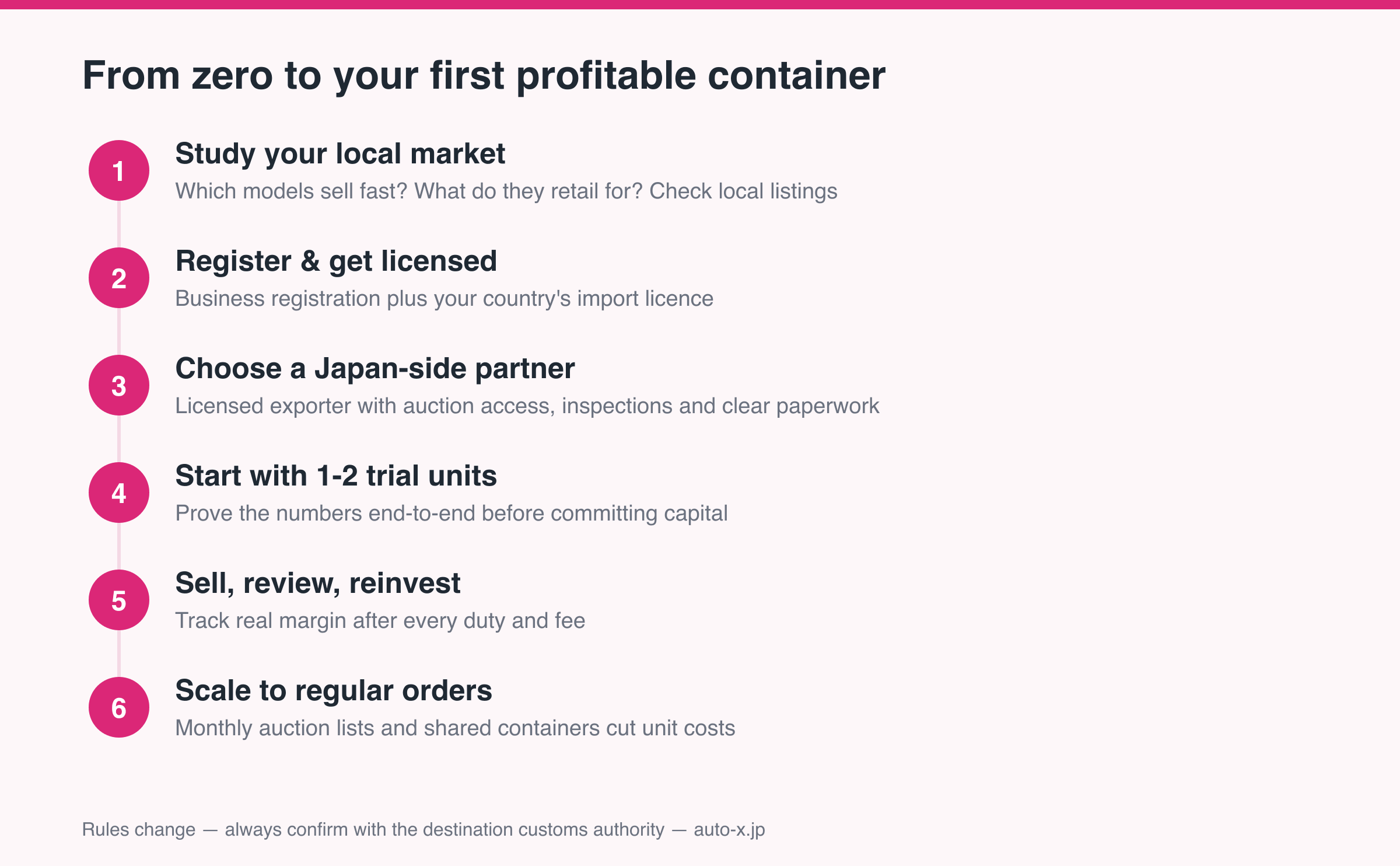
The most common early mistake is choosing cars you like instead of cars your market buys. Before you spend anything, spend two weeks on research: walk local dealer lots, browse the classified sites people in your city actually use, and write down what sells within 30 days versus what sits. Note the three to five models that dominate, their typical year and mileage, and — critically — their local retail prices. Your maximum buy price works backwards from local retail, not forwards from the auction sheet.
Note engine sizes too. Many countries band import duty by displacement, and the gap between a 1,490 cc and a 1,500 cc engine can be the entire profit on a unit.
Make yourself legal before you make yourself busy#
Requirements differ by country, but the pattern is consistent: register a business entity, obtain whatever import licence or importer code your customs authority issues, and open a business bank account that can send international transfers. Do this before you buy anything. Cars have arrived at port while their owner was still queueing for an importer code — and port storage charges accrue daily.
At the same stage, line up a licensed clearing agent at your port of discharge. A good agent will quote the full landed-cost picture in advance and will tell you about age limits, inspection requirements and duty brackets you did not know existed. Our first-time importer's checklist covers the full document-and-deadline sequence.
Vet your Japan-side partner like your money depends on it#
Because it does. Once you wire a deposit to Japan, your protection is the professionalism of the company on the other end. Here is what we tell buyers to verify — including about us:
- An export licence you can check. Every legitimate Japanese exporter holds a used-goods dealer licence. Ask for the number and the company registration; ours is No. 431310063715, registered to MOBIC Co., Ltd. in Tokyo.
- Real auction access. Ask which auction houses they buy from, and ask to see auction sheets before bidding, not after.
- A described inspection process. Who checks the car after the auction win, and what do you receive — photos, video, undercarriage shots?
- Sane payment terms. The industry standard is a deposit to confirm the order, with the balance paid against shipping documents (the bill of lading). Any "exporter" asking for full prepayment to a personal account, or payment in cryptocurrency, is a walk-away signal. Our safe payment guide explains the red flags in detail.
The paperwork on the Japan side — deregistration, export certificate, B/L — follows a fixed sequence, documented in our export documentation guide.
Prove the pipeline with one or two units#
However confident your research feels, your first order should be one or two cars — never a container. A trial unit tests the whole pipeline at small scale: the exporter's communication, real shipping time to your port, what your clearing agent actually charges versus what they quoted, how long the car takes to sell, and what buyers say when they kick the tyres. Every one of those data points will adjust your model. Committing a container's worth of capital before you have them is gambling, not business.
Put a real number on your starting budget#
Here is an illustrative budget for a single mid-range unit shipped RoRo to East Africa. Your numbers will differ by country and vehicle, so treat this as a template, not a promise:
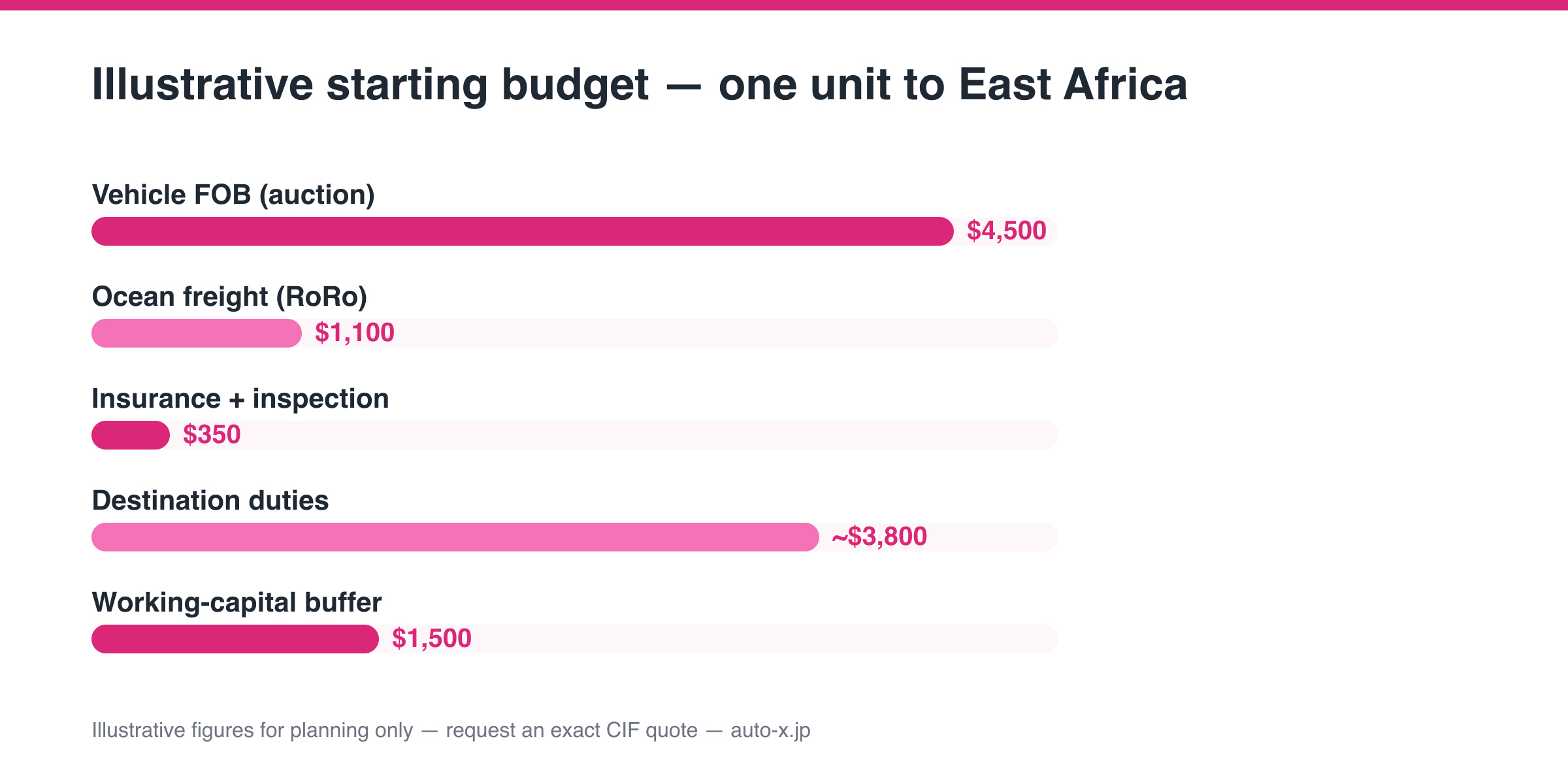
- Vehicle (FOB Japan): $4,500
- RoRo freight: $1,100
- Marine insurance + pre-export inspection: $350
- Duties, taxes and clearing: ~$3,800
- Working capital reserve: $1,500
That is roughly $11,250 to land one car with a cushion for surprises. Duties are frequently the largest line after the vehicle itself — which is exactly why our CIF cost breakdown by country exists. Run it for your destination before you commit a budget.
Know your true margin, not your hoped-for margin#
After your first sale, calculate margin the honest way: final selling price minus everything — FOB, freight, insurance, inspection, duty, VAT, clearing, port storage, transport from port, repairs, advertising, and the transfer fees on every payment. First-timers routinely "make $1,200" on a car until the spreadsheet shows $260. That is not failure; that is calibration. Adjust the model, the buy-price ceiling or the target segment, and run units two and three. Only scale what the spreadsheet — not the feeling — says is working.
Scale on rhythm: monthly orders and shared containers#
Once two or three cycles have run profitably, scaling is mostly about cadence and freight economics. A regular monthly order gives you predictable stock and a stronger relationship with your exporter's buying team. At three to four units, container shipping starts beating RoRo per unit, and many of our dealers share a 40 ft container with another importer at their port to reach container economics earlier. Reinvest the margin, keep the model list tight, and resist widening into unfamiliar segments faster than your sales data justifies.
The mistakes we see most often#
- Buying on price alone. The cheapest unit at auction is cheap for a reason; repair costs at destination erase the saving.
- Ignoring duty brackets. A slightly larger engine or one extra year of age can shift a car into a punishing duty band. Check before bidding, not at the port.
- No clearing agent lined up. Storage charges accrue daily while you search for one.
- Scaling on one lucky flip. One good unit is a data point, not a trend.
FAQ#
How much capital do I need to start? As a rule of thumb: the landed cost of one to two vehicles for your market plus a 15–20% reserve. For many African and Caribbean markets that means roughly $8,000–$15,000 per unit landed. Run a CIF estimate for your actual destination rather than borrowing someone else's number.
Do I need to travel to Japan? No. Practically all first-time dealers we work with buy remotely using auction sheets, inspection photos and video. Visiting later as you scale is useful, not required.
How long until my first car is sold? Typically 6–12 weeks from order to arrival depending on the route, plus clearance and your local selling time. Plan your cash flow for at least three months without revenue from that unit.
Ready to price your first unit properly? Tell us your target model and destination port and request a free CIF quote — we will break down FOB, freight and insurance line by line, the same way we do for every first-time dealer we work with.