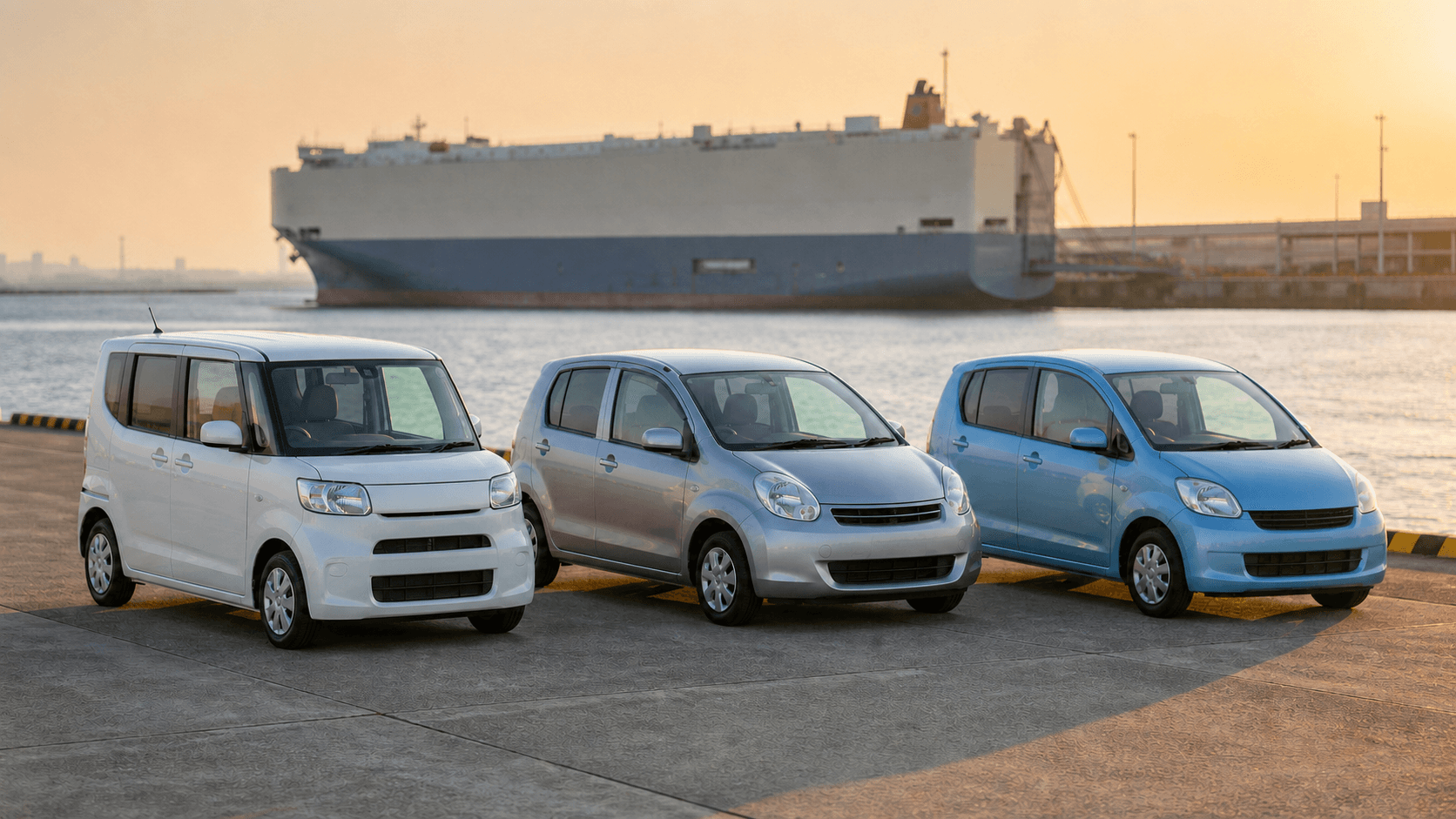
With a total budget of about US$2,500–3,000 CIF, the best value at the Japanese auctions today is not an old premium car — it is a clean 2010–2013 kei car (Suzuki Alto, Daihatsu Mira e:S) or a 2010–2012 Toyota Passo. These cars routinely sell at auction for the price of a set of tyres in Europe, yet they start every morning, sip fuel, and have parts available in every market Japan exports to.
This guide is for buyers with a small budget who want a good car, not a cheap problem. Everything below is based on what we actually see week to week as auction members.
Why a small budget goes further in Japan#
Japan's used-car market has a structural quirk: the domestic inspection system (shaken) makes older cars expensive to keep, so owners trade them in long before they are worn out. The result is an enormous supply of mechanically healthy 10–15 year old cars with modest mileage — and auction prices that fall far below what the cars are actually worth as transport.
That is why more than 100,000 vehicles cross the auction blocks every week, and why a genuinely usable car can hammer for under ¥100,000.
The four best cars under $2,500#
1. Toyota Passo (2010–2012) — the all-round pick#
A 1.0-litre Toyota city car sharing its platform with the Daihatsu Boon. Toyota badge, Toyota parts network, 18–22 km/L in real use. Typical auction price for a grade 3.5–4 car around 100,000 km: roughly ¥80,000–120,000. If you want one car to recommend to a first-time importer on a budget, this is it.
2. Daihatsu Mira e:S (2012–2014) — the fuel-economy champion#
A 660 cc kei car engineered specifically for economy — 25–30 km/L is normal. Light, simple, cheap to fix. A bonus for many African and Caribbean markets: the small engine lands in the lowest excise/duty band, so the total landed cost drops twice — once at purchase, once at clearance.
3. Suzuki Alto (2010–2013) — the price floor#
The cheapest way into a healthy Japanese car. Clean Altos regularly hammer around ¥60,000–90,000. Mechanically the platform is as simple as modern cars get, which is exactly what you want far from a dealer network.
4. Nissan Note (2010–2012) — the family option#
A 1.2–1.5L hatchback that is a class roomier than the kei cars. It costs a little more and usually lands right at the top of a $2,500 budget, but it is the pick if you carry passengers daily.
What about the Toyota Vitz? Within this budget a Vitz means a 2008–2009 car with high mileage — the model holds its value too well. The Passo gives you the same Toyota reliability, newer, for less. If you specifically want a Vitz, budget $3,500+ and read our Toyota Vitz buyer's guide.
What to avoid at this price#
The auction system makes cheap cars honest — if you read the signals:
- Stick to auction grade 3.5 and up. Grade R (repaired) and grade * (accident/meter issues) cars are why some listings look impossibly cheap. See our guide to Japanese auction grades.
- Verify mileage on the auction sheet, not the listing headline. Auction inspectors flag odometer inconsistencies — a protection no roadside seller will give you.
- Do not chase the absolute cheapest hammer price. A ¥40,000 car is that price for a reason. The sweet spot is the boring, straight, one-owner car at ¥70,000–110,000.
The budget math, honestly#
A realistic landed-cost picture for an East African port (rounded, per car):
| Item | Typical range |
|---|---|
| Auction price (grade 3.5–4) | $450–800 |
| Auction and export fees, inland transport, inspection | $500–700 |
| RoRo freight + marine insurance | $800–1,000 |
| Total CIF | $1,800–2,500 |
Import duty and VAT in your country are extra and vary widely — but note that 660 cc–1.0L engines sit in the lowest tax bands in many markets. Our CIF cost breakdown by country covers this in detail.
How we handle small-budget orders#
We treat a $2,500 order with the same process as a $25,000 one: you tell us the model and budget, we send you actual auction cars with photos and the inspection sheet, you approve, we bid. If we cannot win a car within your budget, you lose nothing — we simply try again the following week.
Tell us your budget and destination through our quote form, and we will show you what it really buys this week.